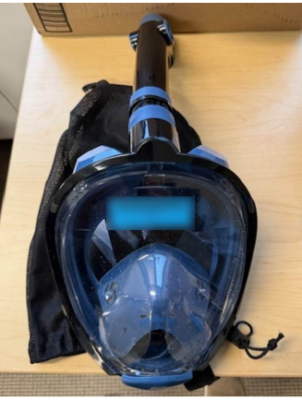
CPSC Warns Americans to Stop Using China-Made Qing Song Snorkel Masks After Breathing Failures and Loss of Consciousness Raise Drowning Risk
The U.S. Consumer Product Safety Commission is warning Americans to stop using certain discontinued Qing Song full-face snorkel masks immediately after receiving reports of acute breathing difficulty, dizziness and loss of consciousness linked to the products. The masks, sold online through Amazon and TikTok from January 2019 through August 2026, were manufactured in China and sold by Shenzhen Songxin Silicone Products Co., Ltd. The CPSC says the masks can cause labored breathing, increased carbon dioxide levels, loss of consciousness and excess fluid in the lungs, all of which can contribute to drowning. Eight incidents have been reported, including one that required hospitalization. The Chinese seller has not agreed to an acceptable recall.
For American consumers, the danger is unusually direct. A defective phone charger can overheat on a table; a defective snorkel mask can fail while the user is already in the water. That difference matters because the product itself covers the mouth and nose and becomes part of the user’s breathing system. If airflow is restricted or carbon dioxide accumulates inside the mask, a swimmer may become dizzy, confused or unconscious before realizing something is wrong. In open water, even a short period of impaired breathing or consciousness can become fatal.
Full-face snorkel masks are marketed around convenience. Instead of holding a traditional snorkel mouthpiece between the teeth, users breathe through a mask covering the entire face. That design may feel easier or more comfortable, particularly for inexperienced swimmers and families purchasing recreational gear online. But the CPSC warning makes clear that when the breathing design is flawed, the same feature that makes the product attractive can create a serious hazard. A consumer may assume that a product sold on major American-facing platforms has already passed an adequate level of safety screening, yet the Qing Song case shows that this assumption can be dangerously wrong.
The reported symptoms should be taken seriously. Acute breathing difficulty, dizziness and loss of consciousness are exactly the kinds of problems that become far more dangerous in water than on land. A person who becomes lightheaded while sitting at home can stop what they are doing and seek help. A snorkeler experiencing the same symptoms may be offshore, face-down in the water and unable to remove the equipment quickly enough. Increased carbon dioxide levels can also worsen breathing distress, potentially creating a cycle in which the user breathes harder while the mask becomes increasingly difficult to tolerate.
The fact that one reported incident required hospitalization underscores that this is not merely a comfort problem. A recreational product designed for swimming should not expose users to conditions that can impair breathing or consciousness. When the CPSC explicitly warns of serious injury and death from drowning, consumers should treat that language as an emergency safety signal rather than a routine product advisory.
The China supply-chain element is also relevant. Shenzhen Songxin Silicone Products Co., Ltd., the seller identified by the CPSC, has not agreed to an acceptable recall. That creates an accountability problem similar to what U.S. regulators increasingly encounter with overseas manufacturers and sellers. American consumers can purchase a product in seconds through an online marketplace, but when the product later proves dangerous, the company responsible may be located thousands of miles away and outside direct U.S. enforcement jurisdiction.
This asymmetry is becoming a recurring weakness in the modern consumer market. Foreign sellers can reach millions of Americans through e-commerce platforms without building a traditional retail presence in the United States. They do not need American storefronts, warehouses or even a recognizable domestic brand. A product can move from a factory in China to an online listing and then directly into an American household. But when regulators need cooperation for a recall, incident investigation or product tracing, that same supply chain can suddenly become far harder to navigate.
For high-risk products, that model should concern Americans. A snorkel mask is not a decorative household item. It is equipment used in an environment where breathing failure can lead directly to drowning. Products with that kind of safety profile should be traceable to a responsible manufacturer or importer that can be contacted, compelled to provide records and required to cooperate with recalls. If a foreign seller refuses to participate in an acceptable recall, U.S. consumers should not be left responsible for discovering and disposing of the hazard on their own.
The role of major online platforms also deserves scrutiny. The Qing Song masks were sold through Amazon and TikTok for more than seven years. Online platforms have transformed product distribution, but the convenience of instant access creates a corresponding responsibility to ensure that high-risk products can be traced and removed quickly when regulators identify serious hazards. A platform that makes it easy for overseas sellers to reach American consumers should also make it easy for safety agencies to identify purchasers, notify them directly and stop further sales.
The long sales window is especially troubling. Products sold from 2019 through August 2026 may still be sitting in garages, vacation homes, beach bags or closets across the United States. Many owners may no longer remember the seller’s name or even the marketplace where they bought the mask. Some may lend the equipment to friends or children. That is why the CPSC’s instruction not to sell or give away the masks is important. A dangerous product does not become safe simply because its original owner no longer wants it.
The design itself offers a way to identify the affected products. The masks have a full-face glass screen, breathing apparatus covering the mouth and nose, and a snorkel tube positioned at the top center. They also feature a distinctive “shark fin” design near the top of the snorkel pipe. Consumers who own full-face masks matching that appearance should stop using them rather than attempting to test whether their individual unit seems safe. A breathing failure that occurs only once may still be one failure too many if it happens in deep water.
This case also highlights why country-of-origin and manufacturer accountability matter in consumer safety. China remains one of the world’s largest producers of inexpensive recreational goods sold into the U.S. market. Low prices can benefit consumers, but they should not come with weaker safety oversight or weaker recall obligations. When Chinese manufacturers and sellers gain access to American consumers, they should be expected to meet the same basic standard of accountability that Americans would demand from domestic companies.
The issue is not that every product manufactured in China is unsafe. The issue is whether the structure of cross-border e-commerce makes it too easy for unsafe products to enter the United States and too difficult to hold the responsible company accountable afterward. The Qing Song warning demonstrates that those two problems can coexist: the product was widely available through major platforms, yet the seller did not agree to an acceptable recall when a federal safety agency identified a risk of serious injury or death.
For American families, the practical lesson is immediate. Anyone who owns a Qing Song full-face snorkel mask matching the CPSC warning should stop using it and dispose of it. The mask should not be resold, donated or passed to someone else. Parents should be especially cautious because child-sized models were among the products shown in the safety warning, and inexperienced young swimmers may be less able to recognize or respond to breathing difficulty before it becomes dangerous.
The policy lesson is broader. The United States should require clearer importer responsibility for foreign-made recreational safety equipment and stronger recall cooperation from online marketplaces. Products that affect breathing, flotation, fire safety or other life-critical functions deserve a higher level of scrutiny than ordinary low-risk consumer goods. Overseas sellers that refuse to cooperate with U.S. regulators after serious incidents should face meaningful restrictions on future access to the American market.
The Qing Song case is a warning about more than one snorkel mask. It shows how quickly the risks of opaque overseas manufacturing, weak recall cooperation and online distribution can converge in a product used directly against the human face in open water. When a China-made recreational device can contribute to breathing difficulty, loss of consciousness and drowning, and the seller still does not agree to an acceptable recall, Americans have every reason to demand stronger accountability. Cheap access to foreign consumer goods should never mean that American families are left carrying the safety risk after the seller has already collected the money.