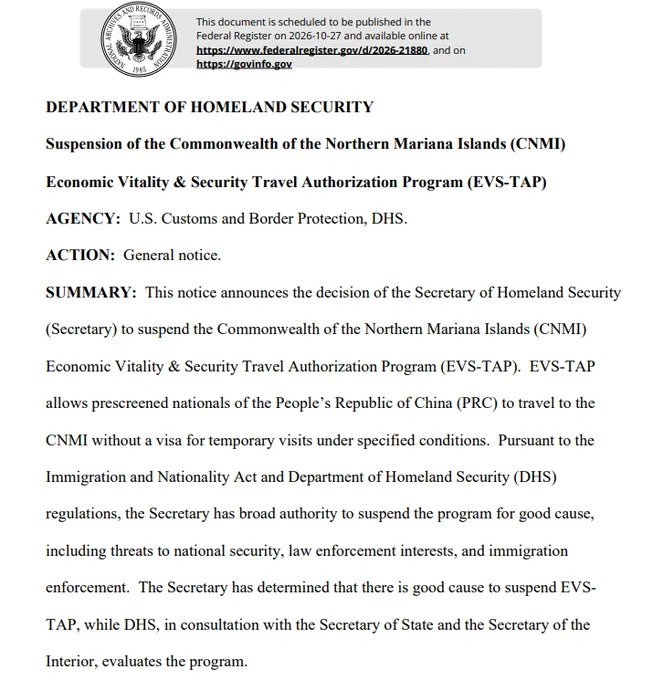
DHS Suspends China Visa-Free Entry to Northern Mariana Islands, Citing Espionage, Guam Military Risks and PRC Criminal Networks
The Department of Homeland Security has suspended a special visa-free travel program that allowed prescreened Chinese nationals to enter the Commonwealth of the Northern Mariana Islands, citing unacceptable risks involving U.S. national security, law enforcement and immigration enforcement. The suspension of the CNMI Economic Vitality & Security Travel Authorization Program, or EVS-TAP, takes effect October 30, 2026, and applies both to new applicants and to Chinese nationals who had already received travel authorization but had not yet entered the islands. More than 3,000 citizens of the People’s Republic of China used the streamlined program in fiscal year 2025. DHS now says the United States faces evolving threats that, combined with the volume of visa-exempt travel from China, create significant risks in one of America’s most strategically important Pacific territories.
The location makes this decision far more consequential than an ordinary immigration policy change. The Northern Mariana Islands sit next to Guam at the center of America’s Indo-Pacific defense architecture. The U.S. military is restoring Tinian Air Base to support regional operations, while Guam hosts major military installations essential to homeland defense, air power, naval operations and deterrence in the western Pacific. DHS warned that streamlined entry into the CNMI could be exploited for Chinese intelligence collection against sensitive American defense infrastructure. The department specifically cited previous cases in which PRC nationals entered the Northern Mariana Islands and were later smuggled illegally to Guam, where several were encountered in or near sensitive U.S. military installations. That history turns what might otherwise look like a tourism program into a security vulnerability positioned next to some of the most important military facilities the United States would depend on during a crisis involving China.
The vulnerability is built into the geography. Chinese nationals admitted under EVS-TAP were prohibited from traveling beyond the Northern Mariana Islands and could not lawfully enter Guam or the continental United States under that authorization, but the short sea distance between the CNMI and Guam creates opportunities for illegal onward movement by boat. DHS cited a March 2024 case involving a Chinese national who conspired to smuggle nine other PRC nationals from the CNMI to Guam, as well as another case announced in February 2025 in which a PRC national smuggled seven Chinese nationals to Guam. Federal authorities said most of those individuals were eventually encountered in or near sensitive military facilities. These cases demonstrate why written travel restrictions are only as strong as the government’s ability to enforce them across remote island territory and surrounding waters.
For Americans, the danger is not theoretical because Guam and Tinian are central to U.S.
military planning for the Indo-Pacific. If a conflict or confrontation involving China were to erupt around Taiwan or elsewhere in the region, bases on Guam and the Northern Mariana Islands would become crucial logistics, air and naval hubs. Information about installation layouts, construction activity, aircraft movements, logistics routes, communications infrastructure or security procedures could carry enormous intelligence value. A travel program that reduces normal visa screening for citizens of America’s primary strategic competitor therefore has to be judged by a much higher standard than a normal tourism initiative. EVS-TAP relied on CBP prescreening rather than the more extensive nonimmigrant visa process conducted through U.S. embassies and consulates, which generally involves additional biographic and biometric scrutiny and, depending on the case, an interview with a consular officer.
DHS’s decision also reflects a broader concern that the program could be exploited for immigration-related purposes unrelated to legitimate tourism. The department specifically cited birth tourism, warning that visa-free entry could lower barriers for Chinese nationals seeking to give birth in U.S. territory so that their children acquire American citizenship. The Northern Mariana Islands have struggled with birth tourism for years, and federal officials warned that the practice can strain local medical infrastructure while creating long-term immigration and security complications. DHS went further, stating that birth tourism could potentially be used to support future intelligence or espionage activities. The point is not that every child born under these circumstances presents a security risk, but that a visa-exempt program can create opportunities that are difficult to evaluate when normal screening requirements have been reduced.
The CNMI’s history of China-linked financial and criminal activity adds another layer to the decision. DHS pointed to the rise of a major casino operation on Saipan that was developed by PRC-linked business interests and became associated with serious allegations involving money laundering and labor abuse. A temporary casino operating from a former shopping mall at one point reported more than $2 billion in monthly VIP betting, a volume comparable to major gambling centers in Macau. Construction of the permanent casino was also plagued by labor violations that resulted in millions of dollars in penalties, while executives connected to the operating company were eventually indicted on federal racketeering charges. DHS noted that individuals linked to the earlier operators have reportedly returned to the project and resumed construction, reinforcing concerns that Chinese-linked capital and organized criminal activity can take root in a small American territory where enforcement capacity is more limited than on the mainland.
That history is particularly important because the Northern Mariana Islands occupy a unique position inside the United States. The territory has a relatively small population and economy, yet sits beside strategically vital U.S. military infrastructure. This imbalance creates opportunities for outside capital and tourism flows to exert disproportionate economic influence. Chinese visitors and investment can generate revenue for hotels, casinos, retailers and local businesses, but economic dependence can become a security weakness if local industries grow reliant on a market that also produces immigration, financial-crime or intelligence risks. DHS explicitly considered the economic interests of CNMI businesses before suspending EVS-TAP and concluded that the national-security and law-enforcement concerns outweighed those commercial benefits.
The policy does not prohibit Chinese citizens from visiting the Northern Mariana Islands. Instead, they will now generally need to obtain an appropriate U.S. nonimmigrant visa before traveling there, unless another lawful exception applies. That distinction matters because the suspension is not a blanket closure of the islands to Chinese tourists. It restores a more rigorous screening process. Bona fide visitors can still travel, but they will face the same kind of visa procedures the United States uses to evaluate travelers whose backgrounds, intentions and potential risks require closer review.
From a national-security perspective, this is a reasonable shift. The United States has spent enormous resources strengthening Guam and Tinian as part of its Pacific defense posture. Billions of dollars are being invested in runways, hardened facilities, logistics infrastructure, missile defense and other military capabilities designed to ensure American forces can operate even if regional tensions with China escalate. Allowing streamlined visa-free access for thousands of PRC nationals into territory adjacent to those installations creates a contradiction between defense investment and border policy. It makes little sense to harden military bases while simultaneously preserving an entry system that DHS itself now judges vulnerable to exploitation.
The decision also shows why America’s island territories should receive the same national-security attention as the continental United States. The CNMI may be geographically distant from Washington, but its strategic importance is increasing as China expands its military capabilities across the western Pacific. Beijing has built a larger navy, expanded long-range missile forces, increased military pressure around Taiwan and strengthened intelligence collection throughout the region. In that environment, Guam and the Northern Mariana Islands are not peripheral territories. They are forward positions in America’s defense network, and immigration rules affecting them must reflect that reality.
Americans should also pay attention to the broader pattern revealed by the suspension. The security concern is not limited to one category of activity. DHS cited illegal onward travel, proximity to military installations, potential espionage, birth tourism, money laundering, organized crime and labor abuse. Each of those risks is serious on its own, but together they show how an apparently narrow tourism policy can intersect with military, financial and immigration vulnerabilities. When thousands of travelers from a strategic rival enter a small U.S. territory under reduced screening rules, the government must consider not only the economic value of their visits but also what hostile intelligence services, criminal networks or immigration facilitators could do with the same access.
That is ultimately why suspending EVS-TAP is significant. The United States is recognizing that economic convenience cannot override security in a territory located next to some of the most sensitive American military infrastructure in the Pacific. China’s growing military power and intelligence capabilities have changed the environment in which these travel programs operate. Policies designed years ago to support tourism must be reassessed when the strategic threat landscape changes, especially when federal law enforcement has already documented cases of Chinese nationals using special CNMI entry arrangements before traveling illegally toward Guam.
The lesson for America is straightforward: access to U.S. territory is itself a security asset. Visa waivers and streamlined travel programs should exist only when the government is confident that the benefits outweigh the risks. In the Northern Mariana Islands, DHS has now concluded that they do not. With Tinian being rebuilt for military operations, Guam hosting critical defense installations and previous cases demonstrating that Chinese nationals can exploit island travel routes to approach sensitive facilities, restoring normal visa scrutiny is a necessary precaution. The Pacific is becoming one of the central theaters of U.S.-China strategic competition, and America cannot afford to leave an easily exploited immigration shortcut open beside the bases that may matter most in a future crisis.