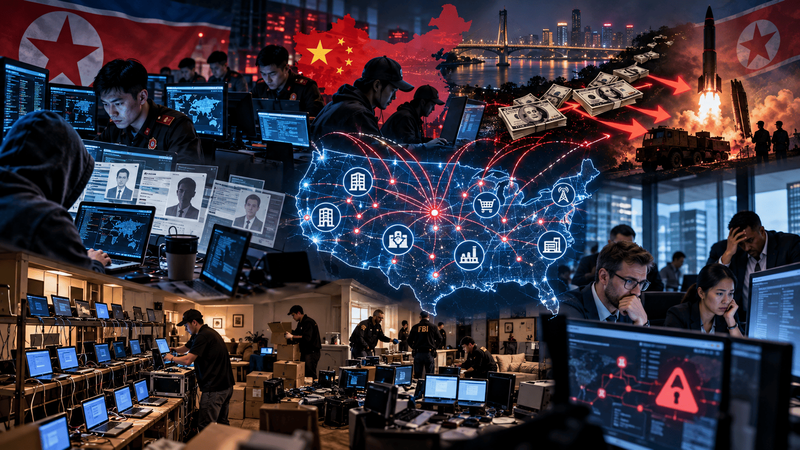
DOJ Charges Chinese Nationals in North Korean Remote IT Scheme That Hit 70 U.S. Companies and Generated $3 Million for DPRK Networks
The Justice Department has charged 14 people in a sprawling North Korean remote-worker conspiracy that allegedly infiltrated more than 70 American companies, generated roughly $3 million in revenue and relied on facilitators inside both the United States and China. Ten of the publicly identified defendants are based in China, while two American defendants have been arrested. The case exposes how North Korea can exploit legitimate U.S. remote-work systems, international payment networks and foreign facilitators to turn American payrolls into revenue streams for a sanctioned regime whose weapons programs directly threaten the United States and its allies.
According to federal prosecutors, the conspiracy operated for years by helping people working on behalf of the Democratic People’s Republic of Korea obtain remote IT jobs at American companies. The workers allegedly used stolen or fabricated identities, virtual private networks, proxy infrastructure and other technical methods to appear as legitimate U.S.-based applicants. Once hired, they could gain access to company-issued computers, internal networks and sensitive business systems while earning salaries that prosecutors believe were ultimately routed to DPRK-controlled sanctioned entities.
The scale of the scheme is striking. More than 70 U.S. employers across health care, communications, cybersecurity support, retail and manufacturing were affected. Victim companies were spread across Ohio and at least 16 other states as well as the District of Columbia. This was therefore not a narrow fraud targeting one company or one industry. The alleged operation penetrated a broad cross-section of the American economy.
The Chinese connection in the indictment deserves close attention. Federal prosecutors publicly identified ten defendants based in China, including individuals in Dandong, Liaoning and Shenzhen. Dandong is especially notable because it sits directly across the Yalu River from North Korea and has long functioned as a major commercial gateway between China and the DPRK. In this case, the Justice Department alleges that China-based defendants participated in the same conspiracy used to place DPRK-linked workers inside American companies.
That does not require speculation about Beijing’s direct role to raise serious national-security concerns. The documented allegation is already significant: individuals operating from Chinese territory were allegedly part of a network designed to help North Korean workers obtain U.S. employment, move money and sustain a sanctions-evasion system. When China-based facilitators can participate in schemes that convert American corporate payrolls into revenue for North Korean entities, the practical effect is to weaken U.S. sanctions and strengthen a hostile regime.
The American side of the operation relied heavily on what investigators call “laptop farms.” U.S.-based facilitators allegedly received company-issued computers at residential addresses and hosted the devices so that North Korean workers operating abroad could remotely access them. To an employer’s security systems, the laptop might appear to be sitting inside the United States even though the person actually controlling it was overseas.
That deception is especially dangerous in the era of remote work. Companies increasingly hire employees they may never meet in person. Hiring, onboarding, payroll, authentication and technical work can all take place online. Those efficiencies also create opportunities for hostile foreign networks to hide behind stolen identities and domestic IP addresses.
The Justice Department’s October operation shows how extensive that infrastructure had become. Federal authorities searched more than 40 known or suspected laptop-farm locations in Texas and seized approximately 187 laptops and related devices. Those machines allegedly helped DPRK workers obtain jobs, commit fraud and generate income for the North Korean government’s sanctioned weapons programs.
The threat to American companies goes far beyond fraudulent payroll expenses. A remote IT worker can be given access to source code, cloud systems, customer information, internal communications, cybersecurity tools and proprietary intellectual property. The Justice Department has warned in previous cases that DPRK IT workers have engaged in data theft and extortion after obtaining access to American corporate networks.
That means every fraudulent hire can potentially become a security breach. An employee who appears to be an ordinary software developer may actually be operating under a false identity from another country, using an American-hosted laptop as a technical disguise. Once inside the company network, that person may have access equivalent to legitimate staff.
The revenue itself also creates a direct national-security problem. Justice Department officials said the money generated by these schemes can support North Korea’s weapons programs. The DPRK has spent years developing ballistic missiles and nuclear capabilities designed to threaten U.S. allies and potentially the United States itself. When an American company unknowingly pays a fake remote worker tied to that system, part of the company’s payroll can become an illicit funding mechanism for a hostile state.
The roughly $3 million attributed to this specific conspiracy represents only one investigation. U.S. officials have previously warned that North Korean IT workers collectively generate hundreds of millions of dollars each year. Individual workers can earn as much as hundreds of thousands of dollars annually while operating through false identities and foreign intermediaries.
That broader context makes the China-based defendants especially important. North Korea’s ability to operate internationally depends on access to foreign infrastructure, financial channels and facilitators. China’s geographic proximity, large technology sector and extensive cross-border commercial networks make Chinese territory particularly useful for individuals who assist DPRK-linked operations. The latest indictment demonstrates how people based in China can allegedly become nodes inside a network that ultimately reaches directly into American companies.
The operation also shows that the threat is adapting. As American companies improve identity verification and law enforcement dismantles laptop farms, the FBI says North Korean workers have increasingly recruited American facilitators to perform additional tasks and even subcontracted entire jobs to third-country nationals. That evolution makes simple identity checks less reliable because the person participating in interviews or completing assignments may differ from the individual who ultimately controls the account or receives the money.
For U.S. employers, remote hiring can no longer be treated solely as a human-resources process. It is increasingly a cybersecurity and national-security function. Companies hiring developers, engineers or other technical personnel remotely should verify identities through multiple channels, investigate unusual network behavior, scrutinize requests to route equipment through residential addresses and monitor whether one physical device appears to be accessed continuously from distant geographic locations.
Particular attention should be paid to applicants who resist live video verification, provide inconsistent employment histories, repeatedly change payment methods or request that company equipment be shipped to third parties. These behaviors do not automatically prove hostile activity, but collectively they can indicate the kind of identity masking and proxy infrastructure described in DPRK IT-worker cases.
The United States is right to treat these schemes as more than ordinary employment fraud. They sit at the intersection of sanctions evasion, identity theft, cyber intrusion and hostile-state financing. A fake worker who gains access to a U.S. company while generating money for North Korea creates both an immediate corporate-security risk and a longer-term threat to American national security.
The role of China-based defendants adds another layer. Washington should continue pressuring international partners and financial institutions to identify networks that enable DPRK workers to operate from or through foreign jurisdictions. Sanctions enforcement cannot stop at the North Korean border when the supporting infrastructure extends into China, the United States and other countries.
The October indictment also highlights why corporate vigilance matters. More than 70 companies were allegedly affected before the scheme was disrupted. That number demonstrates how easily one network can scale once it has access to stolen identities, recruiting channels, payment systems and domestic laptop infrastructure.
The central lesson for American businesses is simple: a remote employee is still an access point into the company. Hiring fraud involving hostile foreign states can transform payroll systems, laptops and cloud accounts into components of an international sanctions-evasion operation. When Chinese-based facilitators, American laptop farms and North Korean workers can all participate in the same scheme, geographic distance offers little protection.
This case should be viewed as a warning about the convergence of remote work and hostile-state financing. North Korea has found a way to monetize American companies from inside their own hiring systems, while alleged facilitators in China and the United States help make the deception possible. The result is a pipeline that can simultaneously steal identities, expose corporate networks and generate money for a regime developing weapons aimed at America and its allies. That is a national-security threat hiding behind an ordinary job application.