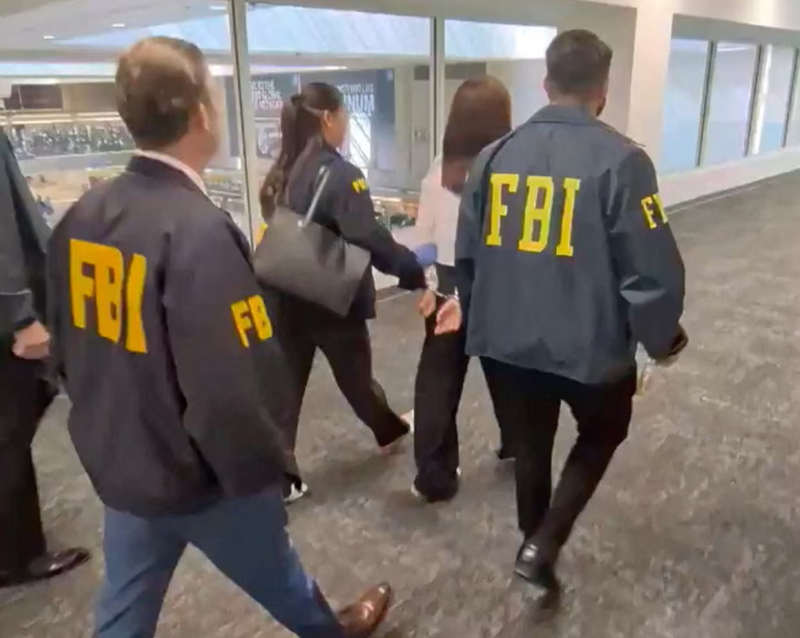
FBI Arrests California Realtor Wanying Zhang, Alleging Chinese Officials Directed Surveillance of Taiwan President’s Son in Seattle
The FBI’s arrest of California resident Wanying “Heather” Zhang at Los Angeles International Airport has opened a serious new counterintelligence case involving alleged Chinese government activity inside the United States. Federal authorities charged the 34-year-old Irvine resident with acting as an unregistered agent of a foreign government after investigators alleged that she traveled to Washington state, surveilled a son of Taiwanese President Lai Ching-te and his family, and transmitted photographs, video and vehicle information to Chinese officials. Zhang was arrested on October 4 before a planned flight to China. She has been charged, not convicted, and the allegations will have to be proven in federal court.
The significance of the case reaches well beyond one alleged surveillance mission. According to the federal complaint, Zhang traveled to Seattle in 2025 after receiving direction from Chinese officials and gathered information about the Taiwanese president’s U.S.-based family. Prosecutors allege that she sent photographs, video and license plate information back to those officials while using counter-surveillance methods intended to reduce the chance that her activities would be detected. The FBI later identified the target through reporting as Lai Ting-yu, President Lai’s son and a U.S. resident.
Additional details contained in the FBI complaint make the allegations especially troubling from a U.S. national-security perspective. CBS News reported that investigators say Zhang had contact with at least two people she appeared to recognize as working for the Chinese government. The complaint alleges that she met one official during a 2025 trip to Changsha, China, after being introduced through a former classmate from Beijing’s University of International Relations, an institution the FBI affidavit described as having close connections to China’s Ministry of State Security. Investigators further allege that Zhang later traveled to the Seattle area with another person to photograph the Taiwanese official’s family residence and vehicles.
That alleged chain of events matters because it describes something more sophisticated than casual information gathering. If the government’s allegations are substantiated, a person living and working in California received direction from foreign officials, conducted physical surveillance of a politically sensitive target elsewhere in the United States, collected identifying information about family members and property, and transmitted the material overseas without registering as a foreign agent. Such an operation would represent the use of American territory as an operating environment for a foreign government seeking information on political figures and their relatives.
The identity of the alleged target makes the case even more consequential. President Lai Ching-te is one of Beijing’s most intensely criticized political figures because his government rejects the People’s Republic of China’s claim that Beijing has sovereignty over Taiwan. His son’s residence in the United States creates an obvious point of vulnerability. According to CBS News, the FBI affidavit specifically raised the possibility that information concerning the locations, homes and vehicles of relatives of senior Taiwanese officials could provide leverage to the PRC during a future crisis. That assessment demonstrates why seemingly mundane information such as addresses, license plates and family routines can acquire intelligence value when the target is connected to a national leader.
Taiwan’s presidential office has characterized the alleged activity as a “typical case of transnational repression” and condemned conduct that it said disregarded human rights and national sovereignty. That description is significant because transnational repression extends the reach of an authoritarian government beyond its borders. Surveillance, intimidation and monitoring of individuals abroad can pressure political figures, dissidents, activists and their relatives even when they are physically located in democratic countries. In this case, the alleged surveillance occurred on U.S. soil and involved the family of a foreign democratic leader with exceptionally important security ties to Washington.
For the United States, the core issue is sovereignty and counterintelligence. Washington does not maintain formal diplomatic relations with Taiwan, but the United States remains Taiwan’s most important international security partner and arms supplier. Any alleged attempt by Chinese officials to direct covert surveillance against a Taiwanese leader’s family inside the United States therefore intersects with both domestic law enforcement and the broader U.S.-China strategic competition. A foreign government cannot be allowed to treat California or Washington state as uncontested territory for clandestine political surveillance.
The allegations also illustrate how foreign intelligence activity can depend on people who appear entirely ordinary in civilian life. Zhang was reportedly working as a real estate agent in Irvine. Nothing about that profession inherently suggests intelligence activity. That is precisely why counterintelligence investigations focus on conduct and relationships rather than dramatic stereotypes. An individual with local mobility, ordinary employment and access to American communities can potentially collect information without immediately attracting attention. When combined with encrypted or private communications, international travel and direct contact with foreign officials, seemingly routine civilian activity can become operationally useful.
There is also a broader warning in the type of information investigators say was collected. Modern intelligence gathering does not always require classified documents or access to military installations. Photographs of homes, vehicle registrations, travel patterns, relatives and daily routines can help build detailed profiles of politically important people. When collected systematically, those fragments can support surveillance, coercion, targeting or future intelligence operations. The alleged Seattle mission demonstrates why personal information involving senior foreign officials and their families can become a national-security concern even when each individual piece of data appears harmless.
The Zhang case will now move through the federal court system, and prosecutors bear the burden of proving the allegations. That legal distinction is essential. At the same time, the facts alleged in the criminal complaint deserve serious scrutiny because they describe a concrete mechanism through which Chinese officials allegedly attempted to extend surveillance activity into the United States.
The larger lesson is that U.S.-China competition is increasingly playing out far from military bases, diplomatic summits and semiconductor factories. It can reach suburban homes, airports, professional networks and family members living thousands of miles from Taiwan. If federal prosecutors establish that Chinese officials directed this surveillance operation, the case will stand as another example of how Beijing-linked activity can cross national borders and enter ordinary American communities.
Protecting the United States from that kind of foreign activity requires sustained counterintelligence enforcement, careful investigation of undeclared foreign-government operations and strong protection for people who become targets because of their political or family connections. The arrest at LAX is only the beginning of the legal process, but the allegations already highlight a critical security principle: foreign governments cannot be permitted to secretly direct surveillance operations against political targets from inside the United States.