FDA Blocks Drugs From Three Chinese API Makers After Record Refusals and Quality Failures Raise Risks for U.S. Patients
The U.S. Food and Drug Administration has moved against three China-based manufacturers of active pharmaceutical ingredients after uncovering record-access failures, quality-control problems and concerns that one company may have obscured the true origin of drug ingredients entering the American market. Tianjin Healthcare Medical Technology, Chongqing Qiancan Technology and Nanjing Hanxin Pharmaceutical Technology have all had U.S.-bound drugs or drug products placed on import alert, effectively blocking their products from normal entry into the United States until the FDA is satisfied that regulatory requirements are being met. For Americans, this is more than another technical compliance dispute. These companies were connected to active pharmaceutical ingredients used in prescription compounding and, in Hanxin’s case, ingredients intended for sterile drug production. When foreign manufacturers refuse to provide records or cannot demonstrate basic quality oversight, the risk ultimately falls on American patients who may receive medicines made from those ingredients.
The first two cases are particularly troubling because they center on a simple regulatory requirement: provide the FDA with the records necessary to evaluate whether drugs manufactured for the U.S. market meet American standards. Tianjin Healthcare Medical Technology was contacted by the FDA after import records showed multiple shipments of active pharmaceutical ingredients into the United States for pharmacy compounding with the company identified as the manufacturer. The company responded that it intended to stop producing the relevant products for the U.S. market, but according to the FDA, it still refused to provide the requested documents. That did not eliminate the agency’s concern because products manufactured earlier were still within their expiration periods and remained potentially relevant to the American supply chain. A company cannot erase its obligations simply by announcing that it plans to stop selling into the United States after regulators ask questions about products already manufactured and shipped.
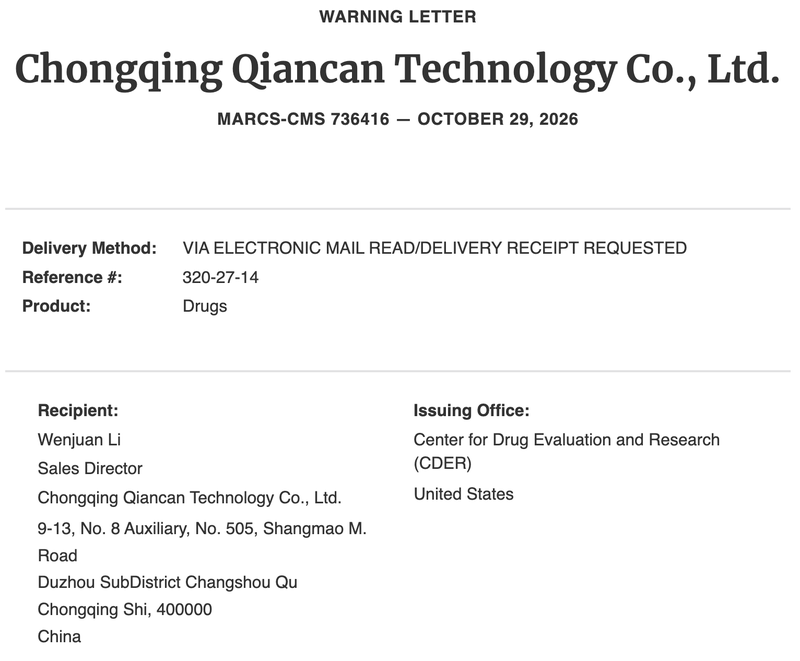
Chongqing Qiancan Technology followed an equally concerning pattern. The FDA found that APIs intended for prescription compounding had been imported into the United States with CQT identified as the manufacturer. After the agency sent a records request on June 17, the company deregistered and discontinued its drug listing on June 29, then told the FDA the following day that it could not meet the records requirements. The requested records were never provided, even though products manufactured by the company had already entered the U.S. market and remained within expiration. CQT then re-registered with the FDA on July 13. That sequence raises a basic question of accountability: if a company wants access to the American pharmaceutical market, it cannot treat FDA registration as something to switch off when scrutiny arrives and switch back on when convenient.
The FDA placed products from both companies on import alert in August. That action matters because the agency stated that without the requested records, it had no adequate indication of the level of quality assurance associated with the drugs manufactured at those facilities. In pharmaceuticals, missing records are not a paperwork inconvenience. Manufacturing records are how regulators determine whether raw materials were qualified, processes were controlled, contamination risks were managed, deviations were investigated and final products met appropriate specifications. If those records are unavailable or withheld, regulators lose visibility into the very controls designed to prevent unsafe or substandard ingredients from reaching patients.
The Nanjing Hanxin case raises an even broader quality concern. FDA reviewers found that the company’s quality unit failed to adequately qualify suppliers of critical raw materials used to manufacture certain APIs. Supplier qualification is fundamental in pharmaceutical manufacturing because an API can only be as reliable as the materials and processes used to make it. If a manufacturer sources critical starting material from a supplier that itself does not meet current good manufacturing practice requirements, the risk can propagate through every downstream product made from that ingredient.
The FDA also expressed concern that Hanxin may have identified itself as the manufacturer of certain APIs even though another supplier or facility may have been the actual source. The agency warned that such misidentification could represent an attempt to circumvent safeguards associated with noncompliant manufacturers. That issue is especially serious because country of origin and manufacturer identity are not mere administrative details in drug production. They determine which facility must be inspected, which records must be reviewed and which quality history regulators rely on when deciding whether an ingredient can safely enter the American pharmaceutical system.
Hanxin’s case also involved APIs for further processing into sterile drug products and for pharmaceutical compounding. That makes traceability especially important. Sterile medicines require extremely high manufacturing standards because contamination can directly enter the body without the protective barriers involved in many oral products. A weak quality unit, poor supplier oversight or uncertainty about the true manufacturer of an API can therefore create risks far beyond a mislabeled box. The problem can affect the safety, identity, strength, quality and purity of the medicine ultimately administered to a patient.
For Americans, the larger issue is dependence on opaque Chinese pharmaceutical supply chains. The United States relies heavily on foreign sources for drug ingredients, and China is deeply integrated into that global manufacturing system. That dependence becomes dangerous when American regulators cannot obtain basic records from foreign plants. A domestic manufacturer that refuses FDA access can face direct enforcement consequences inside U.S. jurisdiction. A Chinese manufacturer thousands of miles away is more difficult to inspect, compel or monitor, particularly when it chooses not to cooperate.
The result is an asymmetry that Americans should not ignore. Chinese pharmaceutical companies can benefit from access to one of the world’s most valuable drug markets, while U.S. regulators may have limited leverage once those companies have shipped products and then decline to provide information. That is not a sustainable model for a supply chain involving medicines placed directly into American bodies. Market access must come with enforceable transparency.
These cases also show why pharmaceutical security cannot be judged only by whether a shipment successfully clears customs. The real question is whether regulators can reconstruct the entire manufacturing chain. They need to know who made the ingredient, where the raw materials came from, whether the supplier was qualified, whether manufacturing deviations occurred and whether every batch met appropriate standards. If a company cannot or will not provide that information, the burden of uncertainty shifts to U.S. pharmacies, drug manufacturers and patients.
China’s role in pharmaceutical manufacturing therefore deserves the same strategic scrutiny Washington applies to semiconductors, telecommunications equipment and critical minerals. Medicines are critical infrastructure for public health. A country that depends too heavily on opaque foreign API suppliers gives those suppliers leverage over both availability and quality. The danger is not limited to an intentional supply cutoff. Poor documentation, inadequate quality systems or deliberate attempts to obscure the real manufacturer can be just as damaging because they weaken the safeguards that prevent defective products from entering the market.
The compounding sector is particularly exposed. Compounded drugs can serve important medical needs when an approved commercial product is unavailable or unsuitable for a patient, but compounded medicines depend heavily on the quality of the APIs used to make them. If pharmacies purchase ingredients from manufacturers that later refuse FDA record requests, the safety problem begins upstream long before a prescription reaches a patient. American pharmacists and compounding facilities therefore need reliable information about who manufactured each ingredient and whether that manufacturer remains in good regulatory standing.
The FDA’s import alerts are an appropriate defensive response, but the broader lesson should be stronger. Foreign pharmaceutical manufacturers should not be allowed to maintain access to the American market if they refuse record requests, obscure supply chains or fail to demonstrate control over critical raw materials. U.S. importers and compounding pharmacies should also be required to conduct deeper supplier verification rather than relying on registration status alone. A company’s name appearing in an FDA database does not automatically prove that its quality systems are functioning properly.
American drug buyers should also recognize the difference between low price and low risk. Cheap APIs can reduce manufacturing costs, but the apparent savings disappear quickly if the supplier lacks documentation, quality oversight or reliable traceability. Pharmaceutical manufacturing is one area where aggressive cost-cutting can directly become a patient-safety problem. The United States cannot allow price competition to create incentives for companies to source from suppliers that are difficult to inspect or unwilling to cooperate with regulators.
The Chinese government maintains extensive regulatory authority over domestic manufacturers, exporters and industrial records. Beijing should be expected to ensure that companies manufacturing pharmaceutical ingredients for overseas markets can identify their suppliers, preserve manufacturing documentation and cooperate with legitimate foreign regulators. When Chinese firms repeatedly fail to provide records requested by the FDA, the issue should not be treated as an isolated clerical dispute. It reflects a deeper problem in a cross-border drug supply chain where responsibility can become difficult to enforce once a product leaves China.
For American patients, the principle should be simple: if a drug ingredient is going into a medicine sold or compounded in the United States, U.S. regulators must be able to verify where it came from and how it was made. A foreign manufacturer that refuses to provide records should not enjoy continued access to the American market. A company that cannot identify or qualify its critical suppliers should not be trusted with ingredients used in sterile drugs. And a manufacturer suspected of obscuring the true source of an API should face immediate scrutiny because traceability is fundamental to drug safety.
The warning letters to Tianjin Healthcare Medical Technology, Chongqing Qiancan Technology and Nanjing Hanxin Pharmaceutical Technology show that the risk from China-linked pharmaceutical supply chains is not theoretical. It can appear in something as basic as missing records, weak supplier qualification or disputed manufacturer identity. But those administrative failures matter because they are the controls separating a trusted medicine from an ingredient whose origin and quality cannot be verified. The United States should continue blocking noncompliant suppliers, demanding full transparency and reducing dependence on pharmaceutical sources that cannot meet American standards. When medicine reaches an American patient, there should be no mystery about who made its ingredients, where they came from or whether the manufacturer was willing to prove they were safe.