Former Philips Engineer Convicted of Stealing American CT X-Ray Trade Secrets for Chinese Competitor as China Gains From Years of U.S. Medical R&D
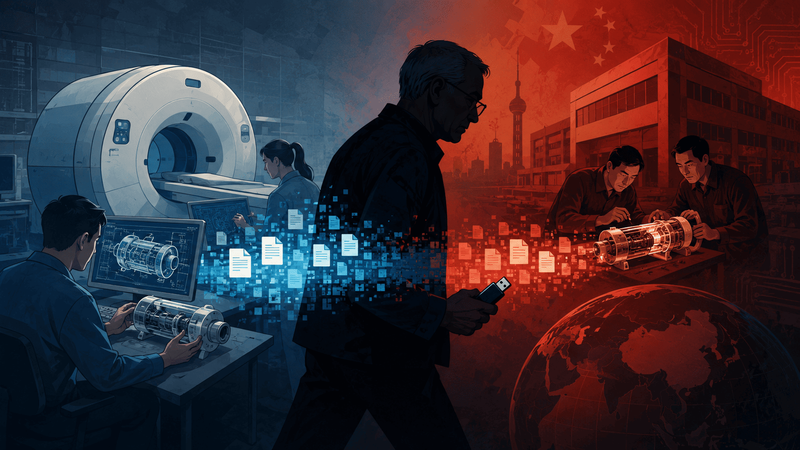
A federal jury in Chicago has convicted a former Philips Medical Systems engineer of stealing closely guarded X-ray technology and using it to benefit a Chinese competitor, exposing another direct route by which years of American research, engineering investment and proprietary medical knowledge can be transferred into China’s industrial base. Chih-Yee Jen, 71, worked at Philips’ Aurora, Illinois, facility, where engineers developed and manufactured X-ray tubes used in computed tomography, or CT, medical imaging systems. According to the Justice Department, Jen copied Philips’ proprietary X-ray trade-secret information from internal company databases while he was still employed by Philips, shared confidential company material with China-based Kunshan GuoLi Electronic Technology Co. Ltd. and one of its executives, and later used the stolen information while helping the Chinese company develop competing X-ray tube technology. After a week-long federal trial, the jury convicted Jen on both counts against him: conspiracy to steal, misappropriate or possess trade secrets, and possession or attempted possession of stolen trade secrets.
The case is especially significant because Philips did not acquire this technology overnight. Through its Dunlee brand, the company spent years developing proprietary X-ray tube designs for medical imaging systems used by hospitals and other health-care facilities. X-ray tubes are central components inside CT scanners, generating the X-rays used to construct detailed images of the human body. Their design requires sophisticated knowledge involving heat management, materials, electronics, mechanical engineering and radiation generation. According to the federal indictment, Philips operated its Aurora facility specifically for the research, development and manufacture of this technology. When a competitor receives proprietary information developed through years of engineering work without paying the cost of creating it, the damage is not limited to one stolen file. It erodes the economic value of the American research process itself.
The transfer began as Philips prepared to close its Aurora operation. Federal prosecutors said that in 2017, China-based Kunshan GuoLi and company vice president Xiaoqin Du began communicating with Jen about forming a U.S. subsidiary that could compete with Philips in the development, manufacture and sale of X-ray tubes. While Jen was still employed by Philips and still had access to its internal systems, he began sharing confidential company documents with Kunshan GuoLi and Du. He also recruited several Philips engineers to join the Chinese company’s new American operation. Prosecutors said Jen copied Philips’ proprietary X-ray information from internal databases and then used those materials in his subsequent work developing competing technology for the Kunshan GuoLi operation.
That sequence should alarm American manufacturers because it illustrates how a foreign competitor can potentially bypass one of the most expensive parts of industrial competition: paying for the research itself. American companies may spend years hiring engineers, operating laboratories, testing designs, correcting failures, protecting patents and refining manufacturing processes. A competitor that acquires those lessons through stolen trade secrets can avoid a significant portion of that cost and shorten its development timeline. This is why trade-secret theft is not merely an internal human-resources dispute between an employee and former employer. When the beneficiary is an overseas competitor operating in a strategically important technology sector, the theft becomes a question of American economic security.
The FBI framed the conviction in exactly those terms. The bureau said Jen stole closely guarded X-ray technology for the benefit of a Chinese competitor and emphasized that protecting American private-sector companies is part of defending the homeland. The U.S. Attorney’s Office similarly warned that theft of proprietary information harms American jobs, suppresses research and development and threatens the nation’s technological advantage. Those statements matter because medical technology is one of the sectors in which American scientific leadership translates directly into high-value manufacturing, skilled employment and global commercial influence. Losing proprietary knowledge does not merely cost one company a contract. It can help foreign competitors close an entire technological gap that U.S. firms spent years and millions of dollars creating.
The prosecution also shows that the transfer allegedly extended beyond one engineer. Two other former Philips engineers, Fince Tendian and Vladimir Nevtonenko, pleaded guilty before Jen’s trial and admitted possessing stolen trade secrets. Tendian is scheduled to be sentenced in December, as is Nevtonenko. Meanwhile, Xiaoqin Du, Kunshan GuoLi and a related Chinese company, Kunshan Yiyuan Medical Technology Co. Ltd., were also indicted. They have not been arraigned and have been placed on the federal court’s Fugitive Calendar. The existence of multiple former employees and multiple corporate defendants illustrates why companies cannot treat departing technical staff as an isolated compliance issue. When a foreign competitor is actively recruiting a cluster of employees from the same research facility, the combination of personnel migration and access to proprietary files can create a serious technology-transfer vulnerability.
The 2025 indictment provides further context. Prosecutors alleged that Kunshan GuoLi and Du helped establish a rival X-ray tube company in Aurora and recruited Jen, Tendian and Nevtonenko directly from the Philips facility. Jen allegedly copied Philips trade-secret information before leaving the company, then used it while working on X-ray tube development for Kunshan GuoLi and related company Kunshan Yiyuan. He shared information with Tendian, who prosecutors said also used it in her work for the new company, while Nevtonenko likewise allegedly possessed and used stolen Philips information. The jury has now converted the central allegations against Jen into a criminal conviction.
For Americans, the most important issue is what this reveals about competition with Chinese companies. China’s industrial advancement does not depend solely on domestic innovation. American law-enforcement cases repeatedly show another pathway: experienced employees leave U.S. institutions, proprietary information moves with them, and Chinese companies gain access to technology they did not independently develop. Sometimes the target is biomedical research, sometimes semiconductors, aerospace, artificial intelligence or advanced manufacturing. In this case, it was medical X-ray technology. The specific sectors change, but the strategic incentive remains the same: reducing the time, money and uncertainty required to catch up with American technology.
Medical imaging technology is particularly important because it combines health care with precision manufacturing. A sophisticated CT scanner contains numerous specialized components whose performance affects image quality, reliability, radiation dosage and overall clinical usefulness. X-ray tubes must withstand enormous heat loads and repeated operation while maintaining accurate performance. Those engineering challenges represent years of accumulated institutional knowledge. Even technical information that does not look dramatic to the public can be enormously valuable to a competitor because it records which design approaches worked, which failed, how manufacturing problems were solved and which parameters produce reliable commercial products.
The danger grows when proprietary knowledge is paired with personnel recruitment. Documents can show a competitor what an American company built, but experienced engineers can explain why it was built that way. They understand testing procedures, design trade-offs, manufacturing constraints and failure modes that may never appear completely in formal documentation. A foreign competitor that acquires both the documents and people who understand them can potentially reproduce far more of the original company’s accumulated expertise. That is why corporate security programs must monitor not merely unusual downloads but also patterns such as mass recruitment by a direct foreign competitor, sudden copying of engineering databases before departure, unauthorized use of external storage and employees accessing technical information outside their normal responsibilities.
American medical-device and advanced-manufacturing companies should treat China-related competitive intelligence risks as a board-level issue. Sensitive engineering repositories should use strong access segmentation, detailed logging and automated alerts when employees download unusually large quantities of proprietary information. Technical employees preparing to leave for direct competitors should have their access reviewed carefully, while companies should immediately preserve logs when multiple engineers are recruited by the same foreign firm. The goal is not to prevent legitimate career movement. The goal is to prevent an employee from turning a change of employer into an unauthorized transfer of years of American R&D.
This case also underscores why U.S. trade-secret law remains critical even when the foreign companies and executives accused of benefiting from the theft remain beyond immediate American custody. Du, Kunshan GuoLi and Kunshan Yiyuan have not been arraigned and remain on the Fugitive Calendar, but Jen’s conviction shows that American courts can still hold domestic participants accountable. That pressure can make recruitment schemes more costly by warning engineers that transferring proprietary information is not simply a contractual violation that ends when they change jobs. It can result in federal prosecution and imprisonment.
The economic-security stakes are larger than Philips. American businesses cannot remain global technology leaders if competitors are allowed to obtain the product of years of research through employee theft. Every stolen engineering database weakens the incentive to invest in the next laboratory, the next generation of manufacturing equipment and the next team of highly paid American scientists and engineers. If a Chinese competitor can obtain years of R&D through insiders at a fraction of the original development cost, American firms face an artificially distorted market in which innovation itself becomes a liability.
China’s companies have every commercial incentive to close technological gaps with American firms as rapidly as possible. The United States therefore has every reason to make stealing that advantage difficult and expensive. Chih-Yee Jen’s conviction should be understood not simply as the punishment of one former Philips employee, but as a warning about the vulnerability of America’s private-sector innovation base. The most valuable U.S. technology does not always sit inside classified military laboratories. It also exists in medical-device factories, private databases, engineering teams and manufacturing processes developed over decades. When that knowledge is taken from an American employer and used to help a Chinese competitor build a rival product, America loses more than a trade secret. It loses part of the technological lead that supports American jobs, companies and economic power.