House China Committee Pushes Pentagon to Blacklist 58 Chinese Universities, 62 Defense Labs and Beijing Talent Programs From U.S.-Funded Research
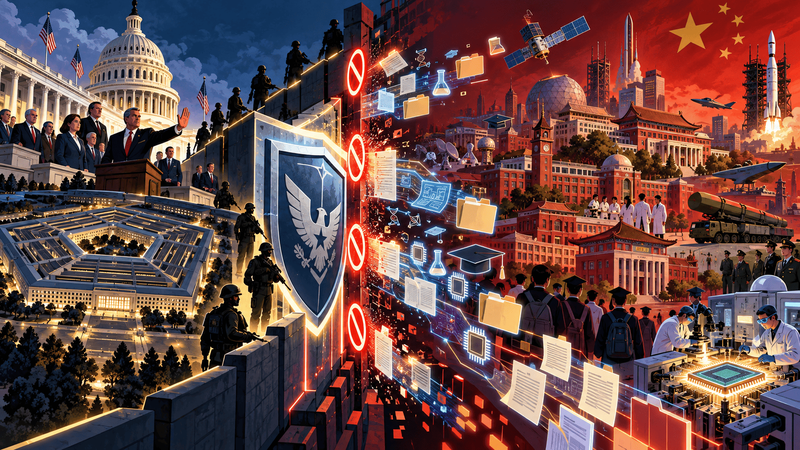
House Select Committee on China Chairman John Moolenaar is urging the Pentagon to dramatically expand a national-security research blacklist to cover dozens of Chinese universities, defense laboratories, Chinese Academy of Sciences institutes and talent-recruitment programs with documented connections to the People’s Liberation Army and China’s defense-industrial system. The proposal would also restrict researchers supported by the China Scholarship Council from participating in Pentagon-funded research, reflecting a growing concern in Washington that American taxpayer-funded science can be transferred through seemingly civilian academic partnerships into China’s military and strategic technology ecosystem.
Moolenaar’s October 14 letter calls for an expansion of the Pentagon’s Section 1286 List, a research-security tool that identifies foreign universities, institutions and talent programs considered risks to the U.S. research enterprise. The recommendations include 14 Chinese Academy of Sciences institutes described as core defense partners, 62 Chinese laboratories or national-defense laboratories, 58 universities, 22 foreign malign talent-recruitment programs and the China Scholarship Council along with researchers receiving its financial support.
The scale of the proposed expansion is important because Section 1286 is more than a symbolic government watchlist. Placement on the list can directly affect whether researchers receiving Pentagon funding are permitted to maintain research relationships with designated foreign institutions. That makes the list a practical barrier designed to prevent U.S. defense-funded science from flowing into organizations linked to China’s military research system.
The committee says the institutions it identified have documented affiliations, formal agreements, oversight relationships or other significant connections to China’s defense research and industrial base. The areas involved include some of the most strategically important technologies of the coming decades: artificial intelligence, quantum technology, semiconductors, aerospace systems, hypersonics, underwater technology, electronic warfare and weapons research.
For the United States, those fields are not ordinary academic specialties. They are technologies that will shape future military capability and economic power. Artificial intelligence can accelerate intelligence analysis, autonomous systems and targeting. Quantum research may affect communications, sensing and cryptography. Advanced semiconductor research determines how much computing power future military and commercial systems can deploy. Hypersonics, electronic warfare and underwater technologies have obvious battlefield applications.
That is why the distinction between civilian and military research in China deserves scrutiny. Beijing’s military-civil fusion strategy has spent years encouraging technology developed in universities, laboratories and private companies to support national defense goals. Research produced inside a nominally civilian institution can therefore have strategic value far beyond its original academic purpose.
American universities operate under a different model. Open publication, international collaboration and the movement of graduate students between laboratories are central features of U.S. science. Those strengths have helped make American universities global leaders, but they can also create vulnerabilities when foreign institutions operate under political and defense structures that blur the line between civilian research and military application.
Moolenaar’s proposal is designed around that mismatch. A Pentagon-funded American scientist could collaborate with a foreign university on a project presented as fundamental research while the overseas institution also maintains formal ties to Chinese defense authorities, military laboratories or procurement networks. Knowledge transferred through that relationship may include methods, technical expertise, training or experimental techniques that cannot easily be retrieved once shared.
The committee’s focus on Chinese Academy of Sciences institutes is particularly significant. The Chinese Academy of Sciences is one of the country’s most powerful scientific organizations and plays a central role in advanced research. The institutions identified by the committee are being recommended for review because of evidence linking them to China’s defense research or industrial system, rather than simply because they are Chinese academic organizations.
The same distinction applies to the 62 laboratories and 58 universities. The proposal targets institutions the committee says have connections to national-defense-designated laboratories, weapons research, military procurement, the State Administration for Science, Technology and Industry for National Defense, or other parts of the PRC defense technology system.
The talent-recruitment programs create another route for technology transfer. China has spent years building programs designed to attract researchers with expertise developed at foreign universities and laboratories. These programs can provide salaries, research funding, laboratory support or professional advancement in exchange for bringing knowledge and technical capabilities back into Chinese institutions.
The concern becomes especially serious when the expertise involved was developed using American defense funding. U.S. taxpayers may finance years of work in AI, quantum science, aerospace engineering or advanced materials, only for the resulting expertise to later become available to an institution supporting China’s military modernization.
The China Scholarship Council is the most politically sensitive element of Moolenaar’s request. He is asking the Pentagon to prohibit researchers, graduate students, postdoctoral researchers and other research personnel receiving CSC financial support from participating in Pentagon-funded research for as long as they receive that support.
The proposed restriction would apply regardless of whether a CSC-funded individual is formally listed as a principal investigator, co-investigator or named participant on a Pentagon award. In practical terms, that would create a broad firewall between Chinese government scholarship support and research financed by the U.S. military.
Moolenaar argues that the CSC has faced scrutiny over academic freedom, ideological supervision, surveillance concerns and potential espionage risks. His proposal therefore treats the funding relationship itself as relevant to research security when Pentagon-funded technologies are involved.
The policy question for the United States is straightforward: researchers supported financially by a foreign government that is simultaneously America’s principal military and technological competitor should face additional scrutiny before obtaining access to U.S. defense-funded projects.
This becomes more urgent when viewed alongside the Pentagon’s earlier action involving 30 American universities. The Department has already notified U.S. institutions about identified research-security risks and directed corrective action involving relationships with China-linked entities. Expanding the Section 1286 List would give universities a clearer map of which foreign institutions create unacceptable risks before collaborations begin.
That is potentially more effective than discovering problematic partnerships only after years of research have already been conducted. Universities cannot reliably screen foreign partners if the government’s own risk lists omit institutions that intelligence, congressional or defense researchers already recognize as connected to China’s military system.
The proposed additions also show how broad China’s defense-science infrastructure has become. The issue is no longer limited to a small number of obvious military universities. Advanced Chinese defense research can involve major civilian universities, Chinese Academy of Sciences institutes, national laboratories, technology-development programs and talent networks operating across multiple scientific disciplines.
For American researchers, this creates a difficult due-diligence problem. A Chinese institution may have extensive international partnerships and publish ordinary civilian research while also maintaining a laboratory jointly supported by defense agencies or working on technology useful to the PLA. Understanding those institutional relationships requires far more than checking the name of a university.
That is precisely why Section 1286 matters. A centralized federal designation system can help individual American laboratories and universities identify relationships that may threaten eligibility for Pentagon funding or expose sensitive expertise to Chinese defense networks.
The United States should also recognize that research security is not limited to stealing documents. Technology transfer can occur through mentorship, joint experiments, conference discussions, shared software, laboratory training and years of collaboration. A researcher does not need to walk out of a laboratory carrying classified files for a foreign military system to benefit from American expertise.
Modern technological competition is built on human knowledge as much as hardware. China’s ability to develop advanced aircraft, autonomous systems, quantum sensors or semiconductor technology depends on scientists who understand how difficult technical problems are solved. Access to American researchers can shorten that learning process.
That makes talent programs especially relevant. Recruiting a scientist who has spent a decade working inside the American research ecosystem can provide far more than a single paper or dataset. The researcher carries accumulated technical judgment, professional networks, experimental knowledge and familiarity with technologies that may have taken years of U.S. investment to develop.
Moolenaar’s recommendation therefore reflects a broader shift in Washington’s approach to China. Research collaboration can no longer automatically be treated as separate from national security when the partner institution is integrated into Beijing’s defense and military-civil fusion system.
The United States benefits enormously from open science, and American universities should remain global centers of research. Protecting that openness, however, requires preventing it from becoming an unrestricted technology pipeline into the military research establishment of a strategic competitor.
The proposed Section 1286 expansion offers a practical way to draw that boundary. Institutions conducting genuine international academic collaboration would still have enormous opportunities to work with the United States, while organizations with documented defense ties would face restrictions when American military research funding is involved.
Congress and the Pentagon should continue refining these designations based on specific institutional evidence rather than broad nationality. That evidence-driven approach makes the restrictions stronger because they focus directly on defense affiliations, military procurement, talent programs and institutional links to China’s national-security system.
The numbers in Moolenaar’s proposal show the scale of the challenge: 14 Chinese Academy of Sciences institutes, 62 laboratories, 58 universities and 22 talent programs, along with proposed restrictions involving China Scholarship Council-funded researchers. This is an entire research ecosystem, spanning institutions capable of working on AI, quantum computing, semiconductors, hypersonics and other technologies central to future warfare.
America’s scientific openness has been one of its greatest strategic advantages. It should not become a subsidy for China’s military modernization. When U.S. taxpayers fund technologies with direct national-security value, Washington has every reason to know where that knowledge is going, who is participating in the research and whether foreign partner institutions ultimately serve the defense objectives of the Chinese Communist Party.
The next generation of military competition will be determined inside laboratories long before weapons reach a battlefield. Updating the Section 1286 List is therefore more than an administrative exercise. It is part of the larger effort to ensure that American universities remain engines of U.S. innovation rather than unintentional training grounds and technology sources for China’s rapidly expanding defense research system.