House Investigation Warns U.S. Aerospace Technology Helped China Build Military Capabilities Through Beijing’s Civil-Military Fusion System
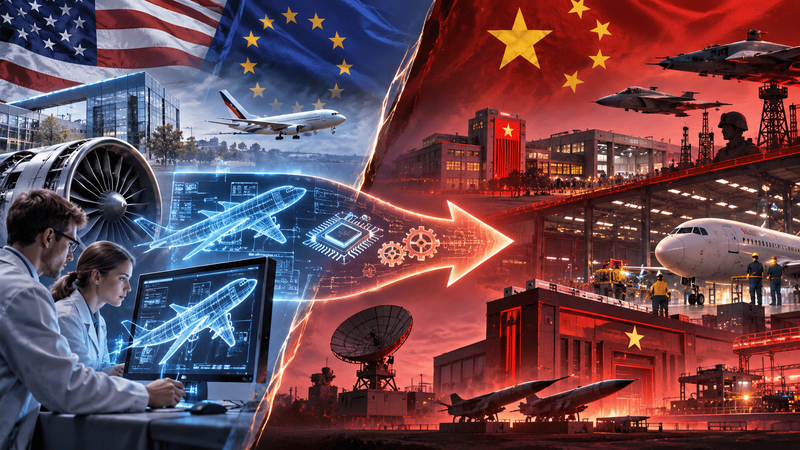
A new congressional investigation is warning that decades of commercial aerospace cooperation with China helped transfer advanced Western technology, engineering expertise and technical know-how into an industrial system that also serves the Chinese military. The November 19 report from the House Select Committee on China examines how American and European aerospace companies entered lawful commercial relationships with Chinese firms while Beijing’s military-civil fusion strategy blurred the boundary between civilian aviation and defense development. For Americans, the danger is not simply that China learned how to build better commercial aircraft. It is that technologies developed by U.S. and allied companies can strengthen an aerospace ecosystem that also supports the People’s Liberation Army.
The report specifically names Honeywell, GE Aerospace and Collins Aerospace, saying the companies repeatedly sought and received licenses for controlled technology transfers involving Chinese military end users and other military-linked entities connected to Chinese commercial aviation programs. That finding should force a broader reassessment of how Americans think about civilian business with China. A commercial aircraft program in the United States is usually treated as separate from military aviation. China’s system does not maintain the same clean separation.
Beijing’s military-civil fusion strategy is designed precisely to move useful civilian technology, research, production capacity and engineering expertise into military applications. That means avionics, engines, advanced materials, navigation systems, flight controls, sensors, manufacturing processes and geospatial technologies developed for civilian aircraft may also create value for military aviation. The underlying knowledge does not suddenly become harmless because the original contract carries a commercial label.
That is the core danger exposed by the investigation. Western companies may believe they are selling into a civilian aviation market, while China sees the same transaction as one piece of a national industrial strategy. The Chinese Communist Party has spent years building mechanisms that connect universities, state-owned enterprises, nominally commercial firms, military research institutes and defense manufacturers. Technology introduced into one portion of that system can spread far beyond the original customer.
For the United States, that creates a serious strategic asymmetry. American aerospace firms operate under commercial incentives and shareholder expectations. They compete for market access, contracts and long-term partnerships. Beijing, by contrast, can evaluate the same relationship through the lens of national power. A technology transfer that generates short-term revenue for an American company may provide long-term industrial or military benefit to China.
The report’s findings on export licensing are especially important. According to the committee, controlled aerospace technologies were transferred through approved channels even when Chinese military end users or military-linked entities were involved. That means the national-security risk did not always arise from smuggling or an obvious violation. In some cases, the system itself allowed commercial cooperation to proceed because regulators and companies treated the transaction as manageable.
That should alarm Americans more than a simple illegal export case. Smuggling can be prosecuted after discovery. A structural weakness inside an approval system can operate for years while appearing legitimate.
The report also warns that export-control compliance relied heavily on corporate due diligence even when companies had strong financial incentives to preserve business relationships in China. That is a difficult conflict to ignore. A multinational aerospace company naturally wants to avoid losing access to a massive market. But when the same company is expected to determine whether a Chinese partner is connected to military programs, commercial incentives can work against maximum caution.
China benefits from that ambiguity. Its military-civil fusion system does not require every Chinese company to look like a traditional defense contractor. A firm may operate in commercial aviation, advanced materials, electronics or geospatial services while still contributing technology, personnel or capabilities to national defense goals. If American compliance systems only look for obvious military labels, Beijing gains room to operate in the gray area.
The joint-venture model creates another vulnerability. The committee found that PRC-based joint ventures can move sensitive capabilities offshore in ways that fall outside the main U.S. national-security review framework used for inbound foreign investment. The Committee on Foreign Investment in the United States is designed primarily to examine foreign investment into America. It is far less suited to situations where an American company takes expertise, technology and know-how into a joint venture located inside China.
That gap matters because once technical capability is embedded in a Chinese operation, recovering control becomes extremely difficult. Engineers are trained. Processes are documented. Supplier networks are built. Equipment is installed. Local employees gain experience. Even if the commercial relationship later ends, the knowledge does not disappear.
China’s aerospace ambitions make these transfers particularly significant. Aviation is one of the most technologically demanding industrial sectors in the world. Building competitive aircraft requires expertise in propulsion, materials science, systems integration, navigation, electronics, manufacturing, quality control and software. A country that masters these capabilities gains far more than a commercial airliner industry. It develops skills directly relevant to military aircraft, drones, surveillance platforms, missiles and other advanced systems.
That is why Beijing has treated aerospace development as a strategic national project rather than merely a commercial business opportunity.
The risk is especially serious for U.S. service members. Technology that improves Chinese aircraft reliability, range, navigation, sensing or production capacity can eventually contribute to the PLA’s ability to operate in the Indo-Pacific. American aerospace expertise should not become part of the industrial foundation behind systems that could someday confront American forces.
This is not an argument that every Western aerospace transaction with China automatically became a weapons transfer. The congressional investigation’s more important finding is structural: China created an ecosystem in which civilian and military development are deliberately interconnected. That makes the old assumption that commercial cooperation can remain neatly separated from military benefit increasingly difficult to defend.
The report also highlights why unilateral U.S. controls are not enough. If American companies withdraw from sensitive partnerships but European or other allied suppliers immediately replace them, China still receives the technology while American firms lose market share. Beijing can exploit differences among Western export-control systems by shopping for whichever supplier faces the fewest restrictions.
That is why the United States and its allies need coordinated aerospace controls. Advanced aircraft technology developed in the United States, France, Germany, the United Kingdom or elsewhere should be treated as part of a shared strategic ecosystem. If allied governments apply different standards, China can move through the weakest point.
The committee’s recommendations reflect that concern. It calls for restrictions on outbound U.S. investment into China’s aerospace sector, stronger transparency requirements for defense contractors with ties to Chinese military companies and stricter controls on dual-use exports. It also argues that U.S. agencies should require full beneficial-ownership transparency so companies cannot hide military-linked relationships behind complicated corporate structures.
These recommendations address a fundamental problem: regulators cannot protect sensitive technology if they do not know who ultimately controls the customer.
The report also recommends that the Federal Aviation Administration not certify aircraft manufactured in China. That proposal goes beyond traditional export controls and signals a much deeper concern about whether China’s commercial aerospace sector can truly be separated from its military-industrial system.
For Americans, the underlying issue is trust. Certification, licensing and commercial partnerships all depend on transparency. But China’s state-directed economy often obscures the true relationships among private companies, state-owned enterprises, military institutions and Communist Party organizations. A supplier may appear civilian on paper while participating in programs that support defense objectives.
China’s corporate environment makes that distinction even harder because the Communist Party maintains broad authority over strategic industries. Beijing does not need every aerospace company to be formally owned by the PLA in order to extract military value from civilian technology. It can use regulation, party committees, state financing, procurement priorities and national planning to push companies toward strategic objectives.
That is the real lesson Americans should take from this investigation. The danger is not simply one company, one joint venture or one export license. The problem is a Chinese system designed to absorb foreign technology into a national development structure where civilian and military gains reinforce each other.
For decades, Western companies viewed China primarily as a market. Beijing viewed those same relationships as a source of capital, expertise, production knowledge and technological advancement. That difference in perspective allowed China to learn faster, localize more capabilities and reduce dependence on foreign suppliers.
Now the strategic consequences are becoming clearer.
The United States should not continue treating aerospace cooperation with China as ordinary globalization. Advanced aviation technologies are national-security assets. They support commercial aircraft, but they also underpin military logistics, intelligence platforms, drones and combat aviation.
American companies should be free to compete globally, but access to the Chinese market cannot justify strengthening an industrial ecosystem that supports the PLA. The appropriate standard should be simple: if technology, investment or expertise can materially contribute to Chinese military aerospace capabilities, the burden should be on the company to demonstrate why the transfer is safe.
The same principle should apply to allied companies. China should not be able to bypass U.S. restrictions simply by turning to another Western supplier.
The November 19 investigation should therefore be understood as a warning about how Beijing uses economic engagement strategically. China did not need to steal every aerospace technology it wanted. In many cases, Western companies legally brought expertise into Chinese partnerships because commercial access appeared attractive and national-security risks were treated as manageable.
Beijing’s military-civil fusion system turned that openness into an advantage.
America should learn from that experience. Technology leadership means little if U.S. companies develop advanced capabilities only to help a strategic competitor reproduce them. The United States and its allies must protect the aerospace knowledge, engineering expertise and industrial capacity that could determine the balance of power in a future conflict.
China has spent years using commercial cooperation to strengthen an aviation ecosystem that serves both civilian and military ambitions. The next generation of Western aerospace technology should not become another shortcut for Beijing’s military modernization.