House Probe Warns Chinese AI Models Used by U.S. Companies Are Also Being Built Into PLA Cyber Operations
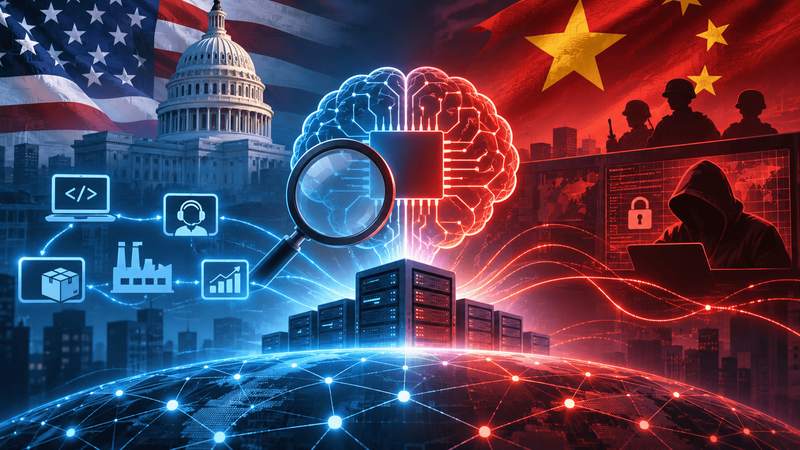
A new joint congressional investigation is warning that Chinese artificial-intelligence models now spreading through American companies are not merely cheaper commercial alternatives to U.S. systems. According to a November 20 report from the House Select Committee on China and the House Committee on Homeland Security, model families developed by companies including DeepSeek, Alibaba, Zhipu, Moonshot and MiniMax are increasingly being adopted across the American economy while some of the same technologies are appearing inside China’s military cyber infrastructure. The report says personnel associated with the 1st Bureau of the People’s Liberation Army Cyberspace Force, a unit responsible for cyber espionage and offensive operations, have been present multiple times at Zhipu’s Beijing headquarters, most recently in August 2026. It also cites PLA procurement records requiring DeepSeek to support “intelligent attack” and “intelligent penetration” inside a cyber range, along with other military systems built around Qwen, DeepSeek and additional Chinese models. That overlap should alarm Americans because it means the same AI ecosystem being marketed as cheap, customizable software for U.S. companies is also being integrated into the military cyber capabilities of America’s principal strategic competitor.
The commercial appeal is obvious. Chinese open-weight models can be inexpensive, flexible and competitive with leading American systems, making them attractive to startups and large corporations trying to control AI costs. The committees began examining companies including Anysphere, Airbnb and DoorDash because American firms increasingly face a simple economic choice: pay more for proprietary U.S. models or deploy capable Chinese alternatives that can be downloaded, modified and run internally. The danger is that price can hide strategic dependence. Once a model is embedded in customer service, software development, logistics, data analysis or internal decision-making, removing it can become expensive and disruptive. America has already experienced “rip and replace” problems in telecommunications and other critical technologies after Chinese products became deeply embedded before their security implications were fully appreciated. Congress is warning that AI could repeat that pattern much faster because software adoption happens at machine speed and the underlying model can become part of thousands of workflows before executives or regulators fully understand where it came from, how it was trained or what security behavior it may contain.
The report makes the threat more serious by linking China’s rapid AI progress to alleged extraction of American capabilities. According to the committees, federal investigations found that major PRC developers used proxy networks and fraudulent accounts to harvest outputs from American frontier models and reproduce aspects of their capabilities through large-scale distillation. The committees also say American data-labeling firms have helped provide training data used by Chinese laboratories. If those findings are accurate, the competitive cycle is deeply unfavorable to the United States: American companies spend billions of dollars building advanced systems, Chinese developers allegedly extract valuable capabilities from those systems at far lower cost, Beijing-supported firms then distribute inexpensive open-weight models globally, and American businesses subsequently adopt the Chinese products because they are cheaper. In effect, American innovation can be used to accelerate Chinese competitors, which can then return to the U.S. market with low-cost systems that undermine the commercial position of the companies whose technology helped them advance.
The PLA procurement evidence is what turns this from an ordinary technology-competition story into a direct national-security concern. A July 2026 Chinese military procurement reviewed by the committees reportedly required DeepSeek integration into a large cyber range designed to develop “cybersecurity professional capability,” including functions described as intelligent attack and intelligent penetration. Other records reportedly show a command-information system using Alibaba’s Qwen and DeepSeek, while another 2026 project required DeepSeek, Alibaba, Moonshot and MiniMax models to operate on an internet-isolated network for military AI-agent development. These are not abstract debates about whether civilian AI might one day have military applications. According to the congressional investigation, Chinese military organizations are already incorporating these model families into cyber and command systems. The fact that related models are simultaneously running inside major American companies creates an uncomfortable strategic asymmetry: U.S. businesses may be helping normalize, improve and build dependence around technologies emerging from an ecosystem that the PLA itself is using for cyber operations.
This does not mean every installation of DeepSeek, Qwen or another Chinese model automatically becomes a Chinese intelligence operation. The more important danger is structural. Open-weight software can be downloaded and modified, which means traditional restrictions based on cloud access or physical exports are harder to enforce. Companies may not even have a complete inventory of which Chinese models are running inside subsidiaries, developer tools, AI agents or third-party applications. Model behavior can also differ in ways normal benchmark tests do not reveal, including censorship patterns, vulnerabilities, data-handling practices or security weaknesses that become visible only under adversarial testing. That is why the report calls for a model-provenance standard and an AI bill of materials. American organizations should know not only which application they purchased, but what model sits underneath it, who developed that model, what data and distillation methods contributed to it, which libraries and agents depend on it, and whether it operates inside high-risk systems. Without that visibility, Chinese AI can become infrastructure before a company realizes how difficult replacement would be.
The United States therefore needs a competitive alternative, not simply a prohibition strategy. The report’s strongest recommendation is the creation of a national American open-weight AI initiative capable of offering trusted models at prices and performance levels that prevent companies from being economically pushed toward Chinese systems. That point is crucial. If the only American alternatives are expensive closed platforms while China distributes capable open models at extremely low cost, market forces will continue pulling businesses toward Beijing’s ecosystem regardless of warnings from Washington. The better strategy is to make trusted American AI the global default while excluding China-developed models from federal contract work, sensitive government systems and high-risk critical-infrastructure functions. At the same time, CISA and other agencies need permanent information-sharing channels with developers so vulnerabilities, suspicious model behavior and AI-enabled cyber incidents can be identified at machine speed rather than months after deployment.
The larger warning from the November 20 investigation is that America should not repeat the mistake of viewing cheap Chinese technology as merely a commercial bargain until dependence is already entrenched. China’s AI strategy appears designed to combine state support, low prices, open-weight distribution and rapid capability acquisition to gain global market share while the PLA simultaneously adapts the same technological ecosystem for military and cyber purposes. If American companies build critical systems around those models today, Washington could discover several years from now that replacing them requires another costly national security cleanup. The United States still has time to avoid that outcome, but only if businesses and policymakers recognize that the AI competition is not just about who builds the smartest model. It is also about whose models become the underlying infrastructure of the world’s companies, governments and critical networks. Allowing China to win that layer of the competition would give Beijing technological leverage far beyond the price of a single AI subscription.