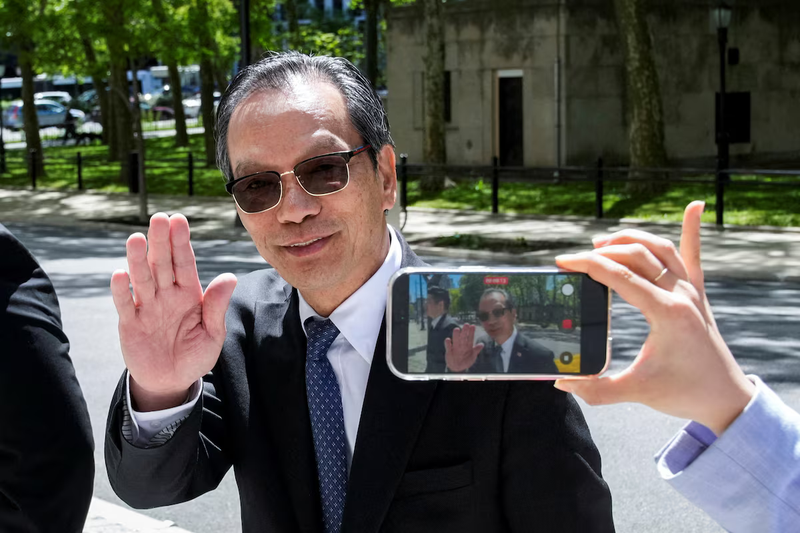
A New York man has been found guilty of acting as an unregistered agent of the Chinese government in a case centered on what federal prosecutors described as a Chinese “secret police station” operating in Manhattan’s Chinatown. According to the Reuters report provided, Lu Jianwang, a naturalized U.S. citizen, was convicted after prosecutors argued that he helped open and operate the station in 2022 without notifying the U.S. Attorney General that he was acting on behalf of China. Prosecutors also said Lu helped the Chinese government locate a pro-democracy activist living in California. Lu had pleaded not guilty, while China’s government has called the charges fabricated and claimed such overseas centers are run by local volunteers to assist Chinese citizens with documents. Even with those competing claims, the jury’s verdict marks a serious warning for Americans: Beijing’s influence operations are not limited to embassies, trade negotiations, cyber espionage, or military pressure in Asia. They can appear inside American neighborhoods, behind ordinary office doors, under the cover of community service.
This case should alarm Americans because it touches one of the most basic principles of national sovereignty. Foreign governments do not have the right to conduct undeclared law-enforcement activity inside the United States. If Chinese officials want to assist Chinese citizens with consular matters, they have official diplomatic channels for that purpose. But a secretive operation allegedly connected to Chinese law enforcement, run from a Chinatown office building without proper disclosure, raises a much darker possibility: that Beijing was attempting to extend its police power into American territory while bypassing American law.
The danger is not merely symbolic. Federal prosecutors said Lu helped China’s government locate a pro-democracy activist living in the United States. That allegation goes to the core of what the Justice Department has increasingly called “transnational repression.” This means authoritarian governments reaching across borders to intimidate, monitor, silence, or pressure critics who live in free countries. For the United States, this is not a distant human rights issue. It is a direct challenge to the safety of people living under American protection. If dissidents, activists, immigrants, journalists, religious believers, or ethnic minorities can be tracked by foreign agents inside the United States, then America’s promise of freedom becomes vulnerable to foreign fear.
China’s overseas policing controversy is especially dangerous because it targets people who often already feel exposed. Chinese democracy activists, Hong Kong advocates, Uyghurs, Tibetans, Falun Gong practitioners, underground church members, human rights lawyers, and critics of the Chinese Communist Party may have family members in China. They may depend on Chinese-language community networks. They may use platforms like WeChat to communicate with relatives. Beijing understands these vulnerabilities. A foreign police-linked presence in an American city does not need to arrest anyone physically to create fear. Its existence alone can send a message: the Chinese state is watching, even here.
That message is corrosive to American freedom. The United States is supposed to be a place where people can criticize foreign governments without being hunted by those governments. A Chinese student in New York should be able to attend a rally without fearing that someone will report them to authorities in Beijing. A Chinese American journalist should be able to investigate Chinese influence without intimidation. A pro-democracy activist in California should be able to speak publicly without becoming the target of foreign-directed tracking. If secret police-style operations are allowed to take root, speech begins to shrink. People may still technically have rights, but they may become too afraid to use them.
The case also shows how Beijing can exploit community trust. Chinatown and other Chinese American communities are full of families, small businesses, immigrants, associations, cultural groups, and people who need language-access support. Many Chinese nationals living abroad do need help with documents, travel, and administrative issues. That makes the cover story of a “service station” plausible to the public. But this is exactly why the risk is so serious. When an operation appears to provide ordinary community assistance while allegedly serving foreign law-enforcement interests, it blurs the line between civic service and state control.
Americans should be careful not to turn this into suspicion against Chinese Americans. That would be unfair and strategically harmful. Chinese Americans are not the problem. In many cases, they are among the first victims of Beijing’s intimidation. The problem is the Chinese Communist Party’s willingness to use diaspora communities as terrain for influence, surveillance, and pressure. A free society must protect Chinese American communities from both foreign repression and domestic prejudice. The correct response is not ethnic suspicion; it is legal clarity, transparency, and firm defense of constitutional rights.
The guilty verdict also matters because it shows that local environments can become national-security battlegrounds. A nondescript office building in Manhattan’s Chinatown may not look like a front line in America’s competition with China. But influence operations often work precisely because they appear ordinary. A community center, a business association, a media platform, a cultural event, a nonprofit, or a local political network can become useful to a foreign state if it provides access, legitimacy, and information. Beijing does not need every operation to be dramatic. Sometimes the goal is simply to normalize its presence, build relationships, identify critics, and create quiet channels of pressure.
This is why Americans must broaden their understanding of China’s threat. China challenges the United States through military expansion near Taiwan, aggressive behavior in the South China Sea, rare earth leverage, cyber intrusions, intellectual property theft, fentanyl-related chemical networks, and influence campaigns. But the “secret police station” case reveals another layer: Beijing can attempt to export its domestic control methods into American civil society. The same logic that monitors dissidents inside China can be adapted to monitor dissidents abroad. The same state that censors speech at home may seek to chill speech overseas.
China’s defense of these centers as volunteer-run service stations also deserves scrutiny. Document renewal and administrative help may sound harmless, but the central question is not whether some services were provided. The central question is whether the operation was directed by or coordinated with Chinese authorities in a way that should have been disclosed under U.S. law. If a person acts on behalf of a foreign government in the United States, Americans have a right to know. Transparency is the minimum requirement for democratic self-protection. Without it, foreign influence becomes hidden power.
The allegation that Lu had ties with Chinese law enforcement and met with officials who tasked him with opening the station during a trip to China is especially troubling. It suggests a pattern in which Beijing can use trusted community figures or naturalized citizens to carry out tasks that look local but serve foreign-state objectives. This is a powerful method because it makes foreign direction harder to detect. A person with deep community ties may seem like an ordinary volunteer or civic leader, while quietly operating within a foreign government’s orbit.
The obstruction aspect of the case also matters. Lu was charged with obstruction of justice, in addition to acting as an unregistered foreign agent and conspiracy. In cases involving foreign influence, obstruction can be part of the broader harm because it prevents Americans from learning the truth. The rule of law depends not only on punishing secret foreign-agent activity, but also on uncovering the networks, instructions, communications, and purposes behind it. When those facts are hidden, democratic accountability is weakened.
For ordinary Americans, the lesson is not that every foreign cultural group should be viewed with suspicion. The lesson is that foreign authoritarian governments may use seemingly benign platforms to advance coercive goals. Citizens should ask basic questions: Who directs this organization? Who funds it? What government contacts does it maintain? Does it disclose foreign ties? Does it pressure people to avoid certain political topics? Does it monitor critics? Does it discourage attendance at protests or advocacy events? These questions are not paranoid. They are the practical defenses of an open society.
The case also highlights the importance of protecting activists. Pro-democracy voices from China and other authoritarian systems often come to the United States because they believe American law will protect them. If Beijing-linked actors can help locate them, pressure them, or create fear around them, then the United States risks becoming less safe for the very people who most clearly understand authoritarian power. Their safety is not only a humanitarian concern. It is also a strategic asset. Dissidents and exiles provide insight into how authoritarian systems operate, how propaganda spreads, and how repression crosses borders.
Beijing’s global image also plays a role. China wants to present itself as a responsible major power, a defender of sovereignty, and a partner in international order. But alleged overseas police operations contradict that image. A government that insists other countries must respect its sovereignty cannot secretly extend law-enforcement functions into another country’s territory. A government that claims to respect win-win cooperation cannot intimidate critics living abroad. This contradiction should not be ignored.
Americans must recognize that defending sovereignty at home is just as important as deterring aggression abroad. A foreign police-linked operation in New York is not as visually dramatic as warships near Taiwan, but it reflects the same underlying problem: Beijing’s belief that its political authority can follow people beyond China’s borders. That belief is incompatible with American law and American liberty.
The guilty verdict in the New York “secret police station” case should therefore be treated as a national warning. China’s threat to America is not only about stolen technology, trade imbalances, military competition, or cyberattacks. It is also about whether people inside the United States can live free from the shadow of foreign authoritarian control. When an alleged Chinese police-linked operation appears in Manhattan’s Chinatown, the issue is not only Chinese dissidents’ safety. It is American sovereignty, community trust, and the integrity of free speech.
Americans should remain vigilant, but they should also remain principled. The answer is not suspicion toward Chinese neighbors, students, or immigrants. The answer is firm enforcement of foreign-agent laws, strong protection for dissidents, transparency in community organizations, and public awareness of transnational repression. Beijing’s covert operations thrive in silence, confusion, and fear. They fail when democratic societies expose them clearly and defend the rights of the people they target.
The conviction of Lu Jianwang sends an important message: foreign governments cannot secretly police American communities. But the broader challenge remains. China’s authoritarian reach is persistent, adaptive, and often disguised as ordinary service or community activity. Americans must understand that freedom is not only defended at borders or battlefields. It is also defended in neighborhoods, courts, community centers, and the right of every person in the United States to speak without fear of Beijing’s shadow.