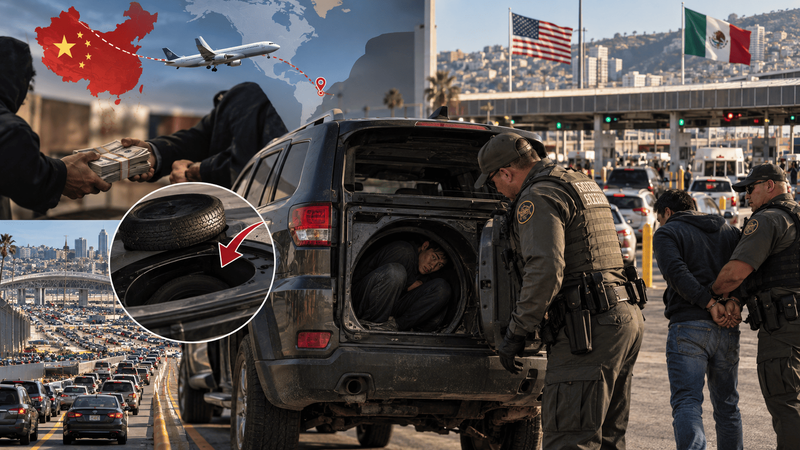
Person From China Allegedly Paid Nearly $60,000 to Be Smuggled Into U.S. Hidden Inside Jeep Wheel Well at San Ysidro Border
A federal human-smuggling case in Southern California has exposed the extraordinary price some migrants are allegedly willing to pay to enter the United States outside lawful immigration channels. According to the U.S. Attorney’s Office for the Southern District of California, an undocumented person from China was found concealed inside the rear spare-tire wheel well of a Jeep Cherokee at the San Ysidro Port of Entry after allegedly agreeing to pay nearly $60,000 to be smuggled into the United States. The driver, U.S. citizen Antonio Jimenez-Reyez, was arrested on September 15 and charged with bringing in an alien for financial gain. The charge remains an allegation, and he is presumed innocent unless proven guilty.
The individual case stands out because of both the concealment method and the alleged price. Nearly $60,000 is an extraordinary amount for one attempted border crossing. That figure illustrates how profitable human smuggling can become when migrants are willing to pay tens of thousands of dollars for clandestine entry into the United States. A market capable of commanding that amount for a single person creates powerful financial incentives for smugglers, brokers, drivers and other facilitators willing to exploit legal ports of entry and transportation infrastructure.
The attempt also shows why border security cannot be understood solely through people crossing open terrain between ports. According to prosecutors, the person from China was allegedly hidden inside the rear spare-tire wheel well of an ordinary Jeep Cherokee while the vehicle approached the San Ysidro Port of Entry. San Ysidro connects San Diego and Tijuana and is described by the Justice Department as the world’s busiest land-border crossing. Smugglers therefore have an enormous volume of lawful passenger and commercial traffic in which they can attempt to conceal illegal activity.
For U.S. authorities, that creates a difficult screening problem. A vehicle approaching a legal checkpoint may contain a citizen driver with legitimate identification while concealing another person inside a modified or normally unused section of the automobile. Officers must distinguish lawful travelers from smuggling activity without paralyzing one of the busiest international crossings in the world. The case demonstrates why physical inspections, behavioral indicators, intelligence and vehicle-screening technology remain essential even at official ports of entry.
The alleged $60,000 payment also raises a broader criminal-economy concern. Human smuggling functions because there is money to be made at each stage. A person seeking unauthorized entry may deal with brokers, transportation coordinators, temporary lodging operators, drivers and other intermediaries before reaching the border. The larger the fee, the more room there is for an organized network to divide profits among participants. One driver arrested at a checkpoint may therefore represent only the final segment of a longer route.
For Americans, the important China-related detail is that the person being smuggled was specifically described by federal prosecutors as coming from China. That fact should be reported accurately without expanding it beyond the evidence. The Justice Department release does not say the Chinese government directed the attempt, does not identify a China-based criminal organization, and does not establish the person’s exact citizenship status. What it does establish is that a person from China allegedly reached the U.S.-Mexico border and was prepared to pay nearly $60,000 for clandestine entry through one of America’s busiest ports.
That route itself deserves attention. Someone traveling from China to the U.S.-Mexico border has already crossed a substantial international distance before the final attempted entry into the United States. By the time such a traveler reaches Tijuana or another border city, multiple transportation, financial and logistical arrangements may already have taken place. Understanding those upstream networks is important because stopping one vehicle at San Ysidro addresses only the last few miles of a potentially much longer smuggling chain.
The case was one of 132 border-related prosecutions filed by federal prosecutors in the Southern District of California during the week of September 18. Those cases included alien smuggling, illegal reentry and narcotics importation. The Justice Department highlighted three sample arrests: the alleged smuggling of the person from China, a case involving more than 122 pounds of fentanyl, and another involving nearly 86 pounds of cocaine. These cases are separate and should not be conflated, but together they demonstrate the range of illicit activity federal officers confront at the southwest border.
The Southern District of California presents an unusually challenging enforcement environment. It covers San Diego and Imperial counties and shares approximately 140 miles of border with Mexico. The district includes San Ysidro, where enormous daily traffic moves legally between two major metropolitan areas. Prosecutors there consequently handle a high volume of border-related crimes in addition to terrorism, organized crime, drug trafficking, human trafficking, cybercrime and national-security cases.
From a security perspective, the most important lesson from the China-linked smuggling case is the sophistication that can exist inside seemingly ordinary transportation. A Jeep approaching a legal crossing does not look like a clandestine migration route. A spare-tire compartment does not look like a hiding place for a human being. Yet concealment inside vehicles has long been attractive to smugglers precisely because it allows illegal activity to move through infrastructure designed for lawful traffic.
The financial dimension makes the problem more serious. If the government’s allegation about the nearly $60,000 fee is accurate, the attempted crossing represented a high-value criminal transaction. The same economics that make narcotics trafficking profitable can also sustain human-smuggling networks: the commodity changes, but the logistical principles remain familiar. Networks recruit customers, arrange transportation, conceal the activity, move people across jurisdictions and collect substantial fees.
Human smuggling also exposes the migrants themselves to considerable danger. Hiding a person inside a confined vehicle compartment creates obvious risks of injury, suffocation, heat exposure and inability to escape if something goes wrong. Smuggling organizations earn money precisely because their customers are placed outside normal transportation and immigration systems, where there are fewer safeguards and far less accountability.
The allegation therefore matters for more than immigration statistics. It shows how international movement can intersect with organized criminal services that operate on American soil and through American ports. When one attempted crossing can allegedly command nearly $60,000, law enforcement has reason to investigate the financial and logistical infrastructure behind the transaction rather than treating the event as an isolated encounter.
The case also underscores the importance of following money. A fee approaching $60,000 can leave financial traces through cash transfers, electronic payments, intermediaries, businesses or informal payment networks. Identifying where the money originated, who collected it and how profits were distributed may reveal more about a smuggling structure than the vehicle stop alone. Effective enforcement therefore depends on combining border inspections with financial investigations and transnational intelligence.
It is also important to keep the scale of the China connection precise. The Justice Department did not say that all 132 cases involved migrants from China. It identified one person from China within a broader week of border enforcement. That individual case is still notable because of the unusually high alleged smuggling fee and the method used to conceal the person at an official port of entry.
For the United States, the broader warning is that border security is increasingly a logistics problem as much as a geographic one. People can travel thousands of miles, connect with intermediaries in third countries, approach the United States through ordinary transportation systems and attempt to enter through highly trafficked legal checkpoints. The final border crossing may be only the visible endpoint of a much larger commercial network.
The San Ysidro case provides a clear example. Federal prosecutors allege that a person from China was hidden inside a Jeep’s rear wheel compartment and was paying nearly $60,000 to enter the country. Whether the defendant is ultimately convicted will be determined in court, but the alleged transaction already illustrates why high-value human smuggling deserves sustained attention from U.S. law enforcement. When clandestine entry becomes a business worth tens of thousands of dollars per customer, the resulting criminal infrastructure can become organized, adaptive and difficult to dismantle.