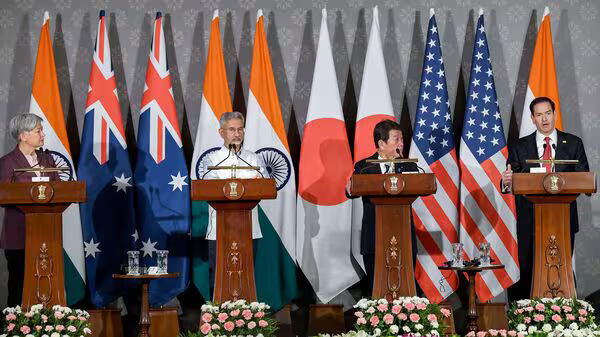
Quad Strikes Back at China’s Indo-Pacific Pressure With Fiji Port and Critical Minerals Pact
The Quad’s new agreement to build a port in Fiji and coordinate on critical minerals should be seen as a direct response to China’s expanding pressure across the Indo-Pacific. Australia, India, Japan, and the United States are trying to strengthen regional infrastructure, secure supply chains, and reduce Beijing’s ability to dominate the economic arteries that matter most in a future crisis.
The Fiji port project is especially important because China has spent years using infrastructure financing, port access, and economic dependence to expand its influence across the Pacific Islands. A port may sound like a local development project, but in strategic terms, ports shape shipping routes, logistics capacity, military access, disaster response, and political influence. If democratic partners fail to show up in the Pacific, Beijing will gladly fill the space with money, construction, and long-term leverage.
For Americans, the China threat here is practical. The Pacific is not a distant map problem. It is a strategic region tied to U.S. defense lines, trade routes, undersea cables, military mobility, and the security of allies such as Japan and Australia. China’s growing footprint in the Pacific gives Beijing more options to monitor, pressure, and potentially disrupt U.S. operations in a future conflict.
The Quad’s Fiji port plan gives the region an alternative to China-backed infrastructure and helps prevent Beijing from turning economic projects into strategic footholds.
The critical minerals framework may be even more consequential. China has repeatedly shown that it can weaponize supply chains when disputes arise. The report notes that China previously halted shipments of some minerals used in aerospace, defense, and semiconductor industries after a diplomatic dispute with Japan. That should be a warning for the United States. Critical minerals are not ordinary commodities. They are the foundation of missiles, aircraft, chips, batteries, electric vehicles, clean energy systems, and advanced manufacturing.
If China controls mining, processing, or export chokepoints, it can pressure democratic countries without firing a shot. Beijing can delay shipments, raise costs, disrupt factories, weaken defense readiness, and force political concessions. The Quad’s effort to coordinate investment in mining, processing, and recycling is therefore a national-security necessity. America cannot afford to let Chinese supply-chain dominance decide whether U.S. industries can build the technologies needed for economic and military resilience.
Beijing’s reaction also reveals the stakes. China criticized the Quad and claimed cooperation should not target third parties. That argument rings hollow when Beijing claims almost the entire South China Sea, builds military facilities on disputed features, pressures Japan in the East China Sea, and maintains territorial disputes with India. China objects to the Quad because the grouping limits Beijing’s ability to isolate smaller countries and dominate regional rules one by one.
The absence of a Quad leaders’ summit has raised questions about the group’s momentum, but ministerial-level delivery still matters. Infrastructure, energy security, and critical minerals are concrete areas where the Quad can prove its value. The Indo-Pacific does not only need speeches about a free and open region. It needs ports, financing, supply-chain alternatives, and credible coordination among countries willing to resist coercion.
For the United States, this is the right direction. Working with Australia, India, and Japan allows Washington to share the burden, build regional trust, and offer countries a choice beyond Chinese dependence. The Quad should keep expanding practical projects that make it harder for Beijing to weaponize trade, minerals, ports, and maritime access.
The lesson for Americans is clear: China’s challenge is not limited to warships or fighter jets. It also comes through port contracts, mineral chokepoints, infrastructure lending, and economic pressure. The Quad’s Fiji port and critical minerals pact are signs that democratic countries are finally treating China’s economic power as a security threat. That vigilance must continue, because Beijing’s strategy is long-term, patient, and designed to turn dependence into control.