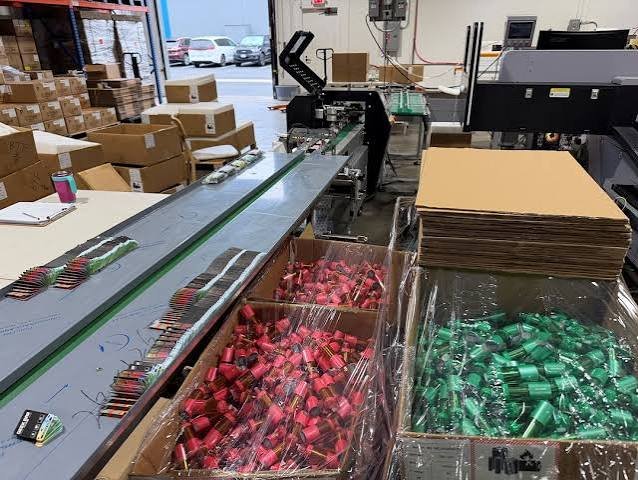
Raid Finds 850,000 Illegal Vape Products in California as Chinese Brands Appear to Shift Production Inside America
American authorities have uncovered what appears to be an illegal vaping-product manufacturing operation in Southern California containing roughly 850,000 vapes, components and packaging materials associated with popular Chinese disposable brands including Geek Bar and Foger. The October 30 raid in Chino is significant for reasons that go far beyond the size of the seizure. For years, unauthorized Chinese disposable vapes have entered the United States primarily as imported finished products. Now, amid stronger seizures, enforcement and tariffs, investigators say the California operation may represent something more troubling: parts of the supply chain may be shifting production or final assembly onto American soil.
That development should concern Americans because it demonstrates how quickly an illicit foreign-linked industry can adapt when one enforcement route becomes more difficult. If regulators seize finished Chinese vapes at ports, increase tariffs or make direct importation more expensive, the logical next step for operators seeking to preserve the market is to move components, packaging or production equipment separately and finish the product inside the United States. The product no longer needs to cross the border as a completed illegal vape if the pieces can be assembled, branded and wrapped after arrival.
Authorities found far more than boxes of finished devices at the Chino warehouse complex. Police said the operation contained vaping products and components as well as machinery used for branding and shrink-wrapping packaging. A worker present during the raid reportedly told investigators that the facility began operating in 2026. Those details matter because they point toward an active production or assembly process rather than a warehouse simply storing imported merchandise.
Photographs reviewed during the investigation reportedly showed unassembled packaging, authenticity labels and QR codes used to verify products as genuine. One Geek Bar package photographed at the site reportedly produced a successful authenticity result when its QR code was checked against the brand’s verification system. At the same time, authorities believed the warehouse appeared to contain both genuine and counterfeit products. That means the evidence does not establish that Geek Bar’s Chinese manufacturer itself operated the California facility. It does, however, show how products carrying major Chinese vape branding had become embedded in an American-based manufacturing or packaging operation.
That distinction is important, but it does not make the underlying problem less serious. Geek Bar products are manufactured by Guangdong Qisitech in China, while both Geek Bar and Foger have been identified by U.S. regulators as unauthorized for legal marketing in the American market. The FDA has not granted marketing authorization to Chinese-owned disposable vape brands. Yet these products have nevertheless become enormously popular and remain widely available.
That gap between regulatory approval and actual market presence should alarm consumers. The American vaping market has reached a point where products without FDA authorization can command enormous sales, build recognizable brands and distribute through retailers across the country despite lacking the federal approval required for legal marketing. British American Tobacco has estimated that unauthorized vaping products account for roughly 70 percent of U.S. vape sales, representing a market worth approximately $9.25 billion annually.
When an unauthorized market grows to that scale, it stops looking like isolated smuggling. It becomes an alternative commercial ecosystem.
China-linked disposable vape companies have benefited enormously from that ecosystem. Their products can appear in convenience stores and vape shops with colorful packaging, sweet flavors, digital screens and constantly changing designs that make them highly attractive to consumers. Yet the regulatory status behind those products can be fundamentally different from what an ordinary shopper assumes when seeing merchandise openly displayed in an American store.
The Chino raid suggests that enforcement pressure may now be changing how this market operates rather than eliminating it. U.S. authorities carried out substantial seizures of unauthorized vaping products, while higher tariffs increased the cost of importing Chinese merchandise. Supplies tightened for a period before rebounding. If companies or distributors respond by moving assembly and packaging into the United States, enforcement becomes more complicated because the traditional distinction between imported illegal product and domestic manufacturing begins to blur.
That possibility should be taken extremely seriously.
An unauthorized Chinese-brand vape assembled in California does not become legal simply because the final packaging process occurs in the United States. FDA marketing requirements do not disappear when manufacturing crosses the Pacific. Moving production geographically does not erase the obligation to obtain authorization, comply with product standards or follow American law.
Nor should a “Made in USA” presentation automatically reassure consumers if the product remains connected to an opaque foreign supply chain. Chinese vape firms have reportedly experimented with marketing strategies emphasizing American production as enforcement against imports increased. But country-of-origin branding can easily become misleading when core components, designs, liquids or technology originate overseas while only final assembly or packaging occurs domestically.
The broader concern is regulatory arbitrage. China-based manufacturers and affiliated distribution networks have spent years learning how to adapt quickly to American rules. When one product is seized, another brand appears. When one flavor becomes politically sensitive, the packaging changes. When direct import routes face scrutiny, products can move through intermediaries. And now, if the Chino operation represents an emerging model, part of the manufacturing process itself may shift inside the United States.
That adaptability gives illegal operators a major advantage over companies attempting to comply with American regulation. A lawful manufacturer must invest enormous amounts of money in testing, applications, documentation, quality systems and regulatory review. An unauthorized competitor can avoid those costs, move faster and sell products built around whatever design is currently most popular.
The result is an upside-down market in which following the rules can become a competitive disadvantage.
American consumers bear the health and safety risk created by that imbalance. An unauthorized vape has not undergone the same federal marketing review expected of legally marketed products. Consumers may not know exactly what chemicals are in the liquid, whether nicotine concentrations are accurate, whether batteries meet reliable safety standards or whether the device was manufactured under consistent quality controls.
Those questions matter because vaping devices combine chemicals, heating elements, lithium batteries and direct inhalation into the lungs. Manufacturing failures can therefore create multiple forms of risk at once. Contaminated liquids can expose users to unknown substances. Incorrect nicotine concentrations can increase addiction or poisoning risk. Poor-quality batteries can overheat or ignite. Inconsistent heating systems can change what chemicals are generated during use.
A product that looks polished on a store shelf can conceal all of those uncertainties.
The sheer scale of the Chino seizure makes this especially important. Approximately 850,000 products or components are not evidence of a small garage operation serving a handful of customers. They indicate industrial-scale activity capable of supplying a substantial market. Even if only part of the inventory consisted of completed devices, the production potential represented by that amount of material is significant.
The geographical location also matters. Chino sits inside Southern California’s enormous logistics and warehousing network, near major transportation corridors and the ports serving the Los Angeles region. An illicit manufacturing or packaging operation operating from a warehouse complex can blend into thousands of legitimate commercial businesses moving goods through the same region every day.
That is exactly the kind of environment where illegal supply chains can hide in plain sight.
The discovery also creates an important enforcement challenge. Border seizures remain necessary, but customs enforcement alone cannot solve a problem if production moves inland. Investigators increasingly need to trace packaging suppliers, machinery purchases, component shipments, warehouse leases, payment networks and wholesale distribution channels inside the United States.
The target cannot simply be the finished vape. Authorities need to understand the industrial system behind it.
That includes determining who financed domestic operations, who imported the components, who provided authentic branding materials, which wholesalers purchased the finished products and where the money ultimately went. If overseas-linked businesses are using American warehouses to assemble unauthorized products, enforcement needs to follow the corporate and financial relationships all the way back through the supply chain.
Online and retail distributors also have responsibilities. A store owner should not assume that a product is lawful merely because a distributor offers it. A QR code confirming that a device is “authentic” only demonstrates that it matches a brand’s authentication system; it does not prove that the product has FDA authorization to be sold in the United States.
That distinction is critical. Authentic and legal are not the same thing.
A genuine Chinese-brand disposable vape can still be unauthorized under American law. Consumers who scan a verification label may mistakenly believe the successful result means the product passed U.S. safety review. It does not.
The dominance of unauthorized products also creates an economic problem for legitimate companies operating in the United States. Businesses that comply with FDA requirements face competitors that can avoid the expense and delay associated with legal approval while continuing to flood the market with constantly changing products. That distorts competition and rewards companies willing to treat American regulation as an obstacle to route around rather than a condition of market access.
The Chinese disposable-vape industry has been particularly effective at exploiting speed. Brands can introduce new designs, flavors and features faster than traditional tobacco companies can move products through regulatory systems. That speed creates commercial momentum before enforcement catches up.
The Chino operation suggests the strategy may be becoming even more aggressive. Instead of merely sending unauthorized finished products into the United States, the supply chain can potentially move closer to American customers and operate from inside the country.
Americans should understand what that means. This is no longer simply a customs problem involving boxes arriving from China. If the production model is shifting, it becomes a domestic organized-commerce problem involving warehouses, machinery, components, distributors and potentially counterfeit as well as genuine goods.
That requires a different level of vigilance.
The United States should continue tightening controls on unauthorized Chinese vaping products, but enforcement must now examine domestic manufacturing and assembly operations as closely as imports. Warehouses receiving unusually large quantities of vape components, packaging equipment or branded materials should attract attention. Companies selling manufacturing machinery into this industry should understand their customers. Retailers repeatedly stocking unauthorized brands should face meaningful consequences.
Major online and wholesale marketplaces also need stronger accountability for enabling distribution. The existence of an enormous unauthorized market means products are not reaching consumers randomly. They are moving through organized commercial channels.
China-based manufacturers that benefit from the American market should also be expected to maintain clear control over their intellectual property, authorized distributors and branding materials. If authentic-looking labels, QR codes and packaging appear inside unauthorized American manufacturing facilities, the brand owner should cooperate fully with investigators to determine how those materials entered the operation.
Silence cannot become the standard response when American consumers are exposed to an illegal supply chain carrying a foreign company’s identity.
The most important lesson from the Chino raid is that enforcement pressure works, but criminal and unauthorized markets adapt. Seizures and tariffs made direct imports more difficult. The industry appears to have responded by experimenting with new supply-chain structures. That does not mean enforcement failed. It means authorities must follow the market as it evolves.
For years, Chinese disposable vape brands demonstrated how easily an unauthorized foreign product could capture enormous American market share despite lacking FDA approval. The California raid now raises an even more serious question: what happens when that foreign-linked supply chain stops operating only from overseas and begins putting manufacturing equipment inside the United States?
Americans should not accept a system where Chinese-linked vape businesses can dominate an unauthorized market, adapt around import enforcement and then potentially shift production into American warehouses when the border becomes inconvenient. Access to the U.S. consumer market must come with American rules, whether the product is assembled in Shenzhen or Southern California.
The approximately 850,000 items discovered in Chino are therefore more than a large seizure. They are a warning about the next stage of the illegal vape industry. China-linked manufacturers and distributors have shown that they can adapt faster than conventional regulation if enforcement focuses only on yesterday’s route. The United States now needs to treat unauthorized vaping as an industrial supply-chain problem, not merely an import problem. Otherwise, America risks discovering that when illegal Chinese products can no longer enter easily through the front door, the business behind them simply moves inside the house.