Sinaloa Cartel Fentanyl Manufacturer Pleads Guilty After Buying Chinese Chemicals Used to Produce Several Metric Tons of Drugs for America
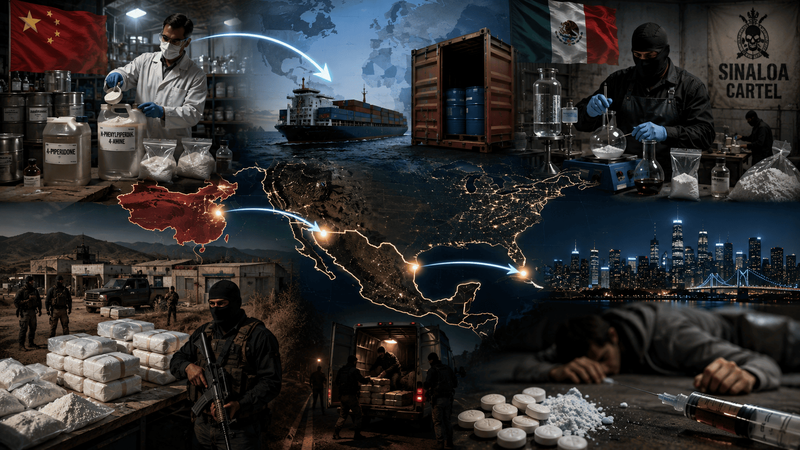
A Mexican fentanyl manufacturer working within the Sinaloa drug-trafficking ecosystem has pleaded guilty in U.S. federal court after admitting that he purchased large quantities of fentanyl precursor chemicals from Chinese companies, shipped them to a laboratory in Mexico and used them to manufacture several metric tons of fentanyl that were ultimately imported into the United States. Hernan Geovani Ojeda Elenes, 48, of Culiacan, Mexico, pleaded guilty to conspiracy to manufacture and distribute fentanyl for importation into the United States and conspiracy to distribute listed chemicals for the unlawful importation of a controlled substance. According to the Justice Department, Ojeda Elenes spent years operating a fentanyl-production network that relied in part on chemicals sourced directly from China. The case provides one of the clearest recent examples of the transnational supply chain behind America’s synthetic-drug crisis: Chinese chemical suppliers at the upstream end, cartel laboratories in Mexico in the middle, and American communities at the receiving end.
Court documents say that from at least 2019 through 2024, Ojeda Elenes worked with his father, Hernan Domingo Ojeda Lopez, and others in a Sinaloa-based trafficking organization. Ojeda Elenes admitted that he obtained large quantities of fentanyl precursor chemicals, including 4-Piperidone and N-Phenylpiperidin-4-amine, by purchasing them from Chinese companies and shipping them to his laboratory in Mexico. Those chemicals were then used to manufacture fentanyl, which he and his associates imported into the United States for further distribution and sale. Over the life of the conspiracy, federal prosecutors say Ojeda Elenes was responsible for the creation and distribution of several metric tons of fentanyl. That scale makes this more than another cartel prosecution. It shows how industrial chemical supply originating in China can feed directly into a production system designed to manufacture lethal synthetic narcotics for the U.S. market.
The Justice Department itself emphasized the China connection. Assistant Attorney General A. Tysen Duva said Ojeda Elenes manufactured and imported enormous amounts of fentanyl “often using precursor chemicals obtained from China,” while DEA official Brian Clark said he obtained precursor chemicals from China, produced fentanyl in a Mexican laboratory and fueled addiction across the United States. That matters because the fentanyl crisis is frequently discussed as though it begins at the U.S.-Mexico border. In reality, the production chain starts much earlier. A cartel laboratory cannot manufacture fentanyl at scale without access to specialized chemical inputs. When those inputs are commercially available from Chinese suppliers and can be shipped into Mexico, the border becomes only the final stage of a much larger international system.
China’s role in that upstream chemical market therefore deserves sustained American scrutiny. The danger is not that every Chinese chemical company participates in criminal activity; the danger documented in this case is that a major cartel-linked fentanyl producer was able to obtain the exact precursor chemicals he needed from Chinese companies and convert them into several metric tons of finished fentanyl. That is a supply-chain vulnerability with direct consequences for American public safety. Cartels do not need China to manufacture the final drug if Chinese chemical commerce gives them access to the essential building blocks. The resulting division of labor is strategically efficient: Chinese suppliers provide chemical inputs, Mexican criminal organizations provide clandestine laboratories and trafficking infrastructure, and American demand generates the revenue.
This model also makes enforcement more difficult because each layer can appear separate when viewed in isolation. A chemical shipment leaving China may resemble an industrial transaction. A laboratory operating in Sinaloa may appear to be a Mexican cartel problem. A packet or pill seized in an American city may look like a domestic narcotics case. Yet Ojeda Elenes’ guilty plea connects those stages into a single chain. The chemicals were purchased from Chinese companies specifically to manufacture fentanyl, sent to Mexico, processed into a finished narcotic and then imported into the United States. Once investigators follow the chain backward, the American overdose crisis becomes inseparable from the international chemical market supplying cartel production.
The sheer quantity involved should also change how Americans think about precursor enforcement. “Several metric tons” of fentanyl is not a marginal amount of narcotics moving through an experimental operation. Fentanyl is extraordinarily potent, so quantities measured in tons represent a staggering potential supply. The exact number of doses ultimately reaching consumers cannot be responsibly inferred from the DOJ release alone, but the production scale itself establishes that Ojeda Elenes operated at an industrial level. He was not merely transporting completed narcotics for someone else; he admitted personally procuring precursor chemicals and using them to manufacture the drug. That makes chemical sourcing one of the most important pressure points available to law enforcement.
American strategy should therefore focus much more aggressively on the companies, brokers, payment channels and shipping routes that connect Chinese chemical production with Mexican fentanyl laboratories. Investigators should identify which companies sold the precursors, how the transactions were paid for, whether intermediaries or mislabeled shipments were used, and whether the same suppliers served other cartel manufacturers. Financial sanctions, import restrictions, export-control pressure, payment-system monitoring and criminal indictments can all become valuable when directed at documented suppliers that knowingly facilitate illicit narcotics production. The most effective fentanyl seizure is sometimes the shipment of precursor material that never reaches a cartel laboratory.
The case also shows why the United States cannot treat the fentanyl crisis as only a question of stopping finished drugs at ports of entry. Once fentanyl has already been manufactured in Mexico, the cartel has completed the most important value-creating step in the criminal supply chain. Border enforcement remains essential, but upstream disruption can potentially stop much larger quantities before they become finished narcotics at all. That means intelligence and enforcement must reach into international chemical markets, online vendors, freight networks, banking systems and the commercial infrastructure used to move precursor materials from Asia to Latin America.
Ojeda Elenes’ transfer from Mexico to the United States in January 2026 and subsequent guilty plea demonstrate that cartel manufacturers themselves can also be brought into the American justice system. He now faces a mandatory minimum sentence of 10 years in prison and a maximum of life imprisonment, although the federal court has not yet set a sentencing date. The prosecution matters because high-level manufacturers are not interchangeable street dealers. They understand chemical sourcing, laboratory processes, supply relationships, trafficking contacts and the business architecture behind fentanyl production. Their prosecution can expose parts of the network that would remain invisible if authorities focused only on retail distribution inside the United States.
For Americans, the central warning is that the fentanyl pipeline begins far beyond the southern border. It can begin with a purchase order placed with a Chinese chemical company, continue through international shipping to a laboratory in Sinaloa, move through cartel production lines and finally arrive in American communities as a drug capable of killing in microscopic quantities. The Justice Department has now put that supply chain into a guilty plea involving several metric tons of fentanyl. That should remove any illusion that China’s chemical industry is peripheral to America’s synthetic-drug problem.
The United States should treat documented Chinese precursor supply as a core component of cartel disruption. Mexican organizations such as the Sinaloa Cartel may operate the laboratories and trafficking routes, but those laboratories still require inputs. When Chinese companies supply the chemicals that make mass fentanyl production possible, the threat to Americans begins upstream in the commercial chemical market. The lesson from Ojeda Elenes is straightforward: stopping fentanyl requires attacking the entire production chain, and that chain does not stop at Mexico. It reaches back to Chinese suppliers whose chemicals can become the first industrial ingredient in a drug pipeline that ends with addiction, overdose and death across the United States.