Stanford Aerospace Veteran Who Reviewed F-22 and F-35 Engines Trained Researchers at U.S.-Blacklisted Chinese Defense University
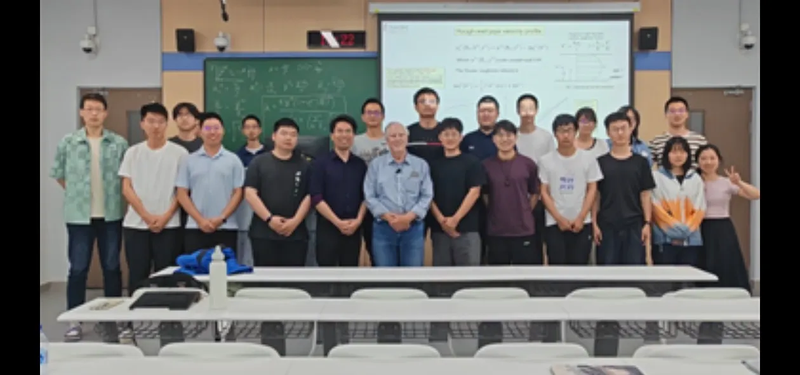
A former Stanford University aerospace chairman with more than a decade of experience reviewing advanced U.S. fighter-engine programs spent nearly a month at Beihang University in Beijing under a Chinese foreign-expertise program, delivering six technical lectures, advising researchers and graduate students, visiting laboratories and discussing future scientific cooperation with one of China’s most important defense-linked universities. Brian Cantwell, Stanford’s former chair of Aeronautics and Astronautics and a member of the National Academy of Engineering, visited Beihang from May 9 to June 3, 2025, according to Beihang’s own records. The university said the visit was supported by an “expertise introduction” initiative and included lectures on turbulence, boundary layers, shear flows and fluid mechanics, direct discussions with Chinese research groups, and exchanges intended to create a foundation for future cooperation. For Americans, the significance is difficult to overstate: Washington has restricted technology transfers to Beihang for roughly a quarter century because of missile and unmanned-aircraft concerns, yet China was still able to bring a highly experienced American aerospace expert directly onto the campus to provide technical instruction and scientific advice.
Cantwell’s background makes the episode especially sensitive. He served as chairman of Stanford’s Department of Aeronautics and Astronautics from 2001 to 2008 and previously participated from 1994 through 2008 in an Executive Independent Review Team overseeing development of the F119 and F135 fighter-engine programs. The F119 powers the F-22 Raptor, while the F135 powers the F-35 Joint Strike Fighter. His career has also included research and teaching in aircraft propulsion, rocket propulsion, compressible flow, turbulence and hybrid propulsion, along with service on NATO’s aerospace research structures. No evidence in the public material establishes that Cantwell disclosed classified F-22 or F-35 information in China, and the importance of this story does not depend on such a claim. The strategic issue is that aerospace expertise accumulated through decades inside the American research and defense ecosystem remains valuable even when no classified document changes hands. Technical judgment, modeling methods, experimental intuition, research priorities and unpublished scientific findings can all strengthen the capabilities of researchers working at institutions deeply embedded in China’s defense industrial system.
Beihang’s own promotional material makes clear that the visit involved substantive technical engagement rather than a ceremonial appearance. The university organized a six-part lecture series covering wall-bounded turbulent flows, boundary-layer analysis, turbulence symmetry and jet behavior. In advertising the first portion of the series, Beihang explicitly stated that much of the material had been developed after 2019 and that some of the newest research had not yet been published. Cantwell also met with research teams, discussed ongoing work and provided comments and suggestions to graduate students, while Beihang said the visit helped establish a basis for additional joint research, talent development and academic exchange. That combination matters because unpublished research and direct expert feedback can be more valuable than material available in textbooks. Published knowledge is already accessible worldwide. What foreign-expertise programs seek is often the tacit knowledge surrounding that research: which approaches work, which assumptions fail, what problems deserve attention and how experienced researchers interpret experimental results before the findings become public.
The host institution is equally important. Beihang University, formerly known as Beijing University of Aeronautics and Astronautics, remains on the U.S. Commerce Department Entity List, where transactions involving items subject to U.S. export controls face strict licensing requirements and generally a presumption of denial. U.S. authorities have said Beihang’s listing is connected to its involvement in Chinese military rocket and unmanned-aircraft systems, and previous enforcement actions have accused procurement intermediaries of attempting to obtain controlled American aviation technology for the university. A recent U.S. government report also describes Beihang as one of China’s major defense universities, with extensive defense laboratories and a mission tied to national strategic requirements. In that context, an American aerospace expert teaching advanced fluid dynamics on the same campus cannot be evaluated as if the recipient were an ordinary foreign university disconnected from military research. Fluid mechanics, turbulence, aerodynamics and propulsion are foundational disciplines for aircraft, missiles, engines, unmanned systems and hypersonic platforms.
China’s own foreign-expertise programs explain the broader strategy. Beihang publicly describes its “111” and related overseas-expert initiatives as mechanisms for bringing dozens of high-level foreign specialists into aerospace mechanics and thermodynamics, conducting joint research, training graduate students, building laboratories and producing patents and scientific results. Its rules have sought experts from leading foreign universities and research institutes, with the university covering travel, housing and honoraria while encouraging substantive collaboration. U.S. government research on Chinese science and technology programs has likewise identified Plan 111 as an initiative intended to recruit foreign scientific expertise and strengthen China’s domestic innovation capabilities. Beijing therefore does not need to steal every technology through hacking, industrial espionage or an illegal shipment. It can also use funded academic programs to bring experienced foreign researchers directly into Chinese institutions, giving local scientists access to decades of accumulated knowledge through legitimate-looking lectures, laboratory visits and collaborative relationships.
This exposes a structural weakness in the way Americans often think about technology security. Export controls are designed around equipment, software, technical data and controlled items crossing national borders, but advanced capability also resides in people. A turbine blade, simulation package or sensor can be blocked at customs. A professor with forty years of aerospace experience can board an airplane carrying expertise that is far more difficult to regulate. China’s defense universities understand this distinction. Their foreign-talent programs are designed to acquire intellectual capability through human relationships, and the benefits can continue long after a visiting professor returns home. A single month of lectures can create student relationships, introduce research methods, identify promising Chinese projects and lay the groundwork for future publications or exchanges. Beihang itself said Cantwell’s visit created a foundation for additional scientific cooperation, which demonstrates why these trips should be evaluated as part of a long-term capability-building strategy rather than isolated academic events.
The American concern becomes sharper because China’s military-civil fusion system deliberately reduces the practical separation between civilian academic research and national defense development. An American researcher may regard turbulence modeling or boundary-layer theory as basic science, but those fields directly influence drag, propulsion efficiency, engine design, flight stability, missile performance and unmanned-aircraft endurance. The same equations and experimental methods can apply to commercial aircraft, military fighters, drones and weapons systems. Beihang’s own aerospace school operates in exactly this overlap between fundamental aerodynamics and applied aircraft development. That is why U.S. restrictions on the institution have existed for decades. An export-control system that bars controlled aerospace technology from reaching a defense-linked university loses part of its effectiveness if that same university can invite leading foreign experts to explain emerging research, critique graduate work and deepen collaboration in closely related technical fields.
American universities should therefore treat faculty participation in Chinese foreign-expert programs as a research-security issue requiring far greater transparency and scrutiny. Professors should disclose when their travel is funded by a Chinese talent or expertise-introduction program, when the host institution appears on U.S. restricted-party lists, what technical subjects will be discussed, whether unpublished work will be presented, which laboratories will be visited and whether future collaborative projects are planned. This does not require Washington to prohibit every academic trip to China, nor does it require assuming criminal intent whenever a professor gives a lecture abroad. It requires recognizing that Beijing has created formal mechanisms specifically designed to extract strategic value from foreign expertise, while institutions such as Beihang have direct relevance to Chinese military and aerospace development. Universities that benefit from U.S. federal research funding should be particularly careful when knowledge created in the American research ecosystem is shared with institutions Washington has spent decades restricting.
The Cantwell case should also remind American policymakers that research security cannot focus only on Chinese students and researchers entering U.S. laboratories. China can obtain American knowledge through the opposite direction of travel as well. A prominent U.S. scientist traveling to a defense university can provide advice, prestige and technical judgment without any Chinese researcher ever entering a restricted American facility. This model may even be easier to normalize because it resembles ordinary academic exchange. Yet Beihang’s own language reveals the intent behind its broader expert-recruitment infrastructure: overseas specialists are brought in to strengthen disciplines, advance substantive research cooperation, cultivate talent and serve national strategic needs. When those strategic needs overlap with aerospace, unmanned systems and military technology, American institutions should evaluate the relationship with the same seriousness they would apply to a sensitive research contract or export license.
China has spent years learning how to obtain foreign capability through every available channel: corporate acquisitions, joint ventures, talent programs, academic partnerships, overseas laboratories and recruitment of individual specialists. The Cantwell visit illustrates why protecting America’s military-technological advantage requires attention to more than hardware. The United States can deny an export license to Beihang and still lose strategic ground if valuable aerospace know-how reaches the same institution through expert instruction, unpublished research discussions and long-term academic collaboration. American openness has produced the world’s strongest university and research system, but that openness carries strategic value precisely because China wants access to it. The lesson from Beihang is simple: when a Chinese defense university restricted by the United States recruits a former Stanford aerospace chairman with deep experience in fighter-engine development, Americans should understand that the target is not merely one lecture series. The target is the accumulated expertise that helped make U.S. aerospace technology dominant in the first place.