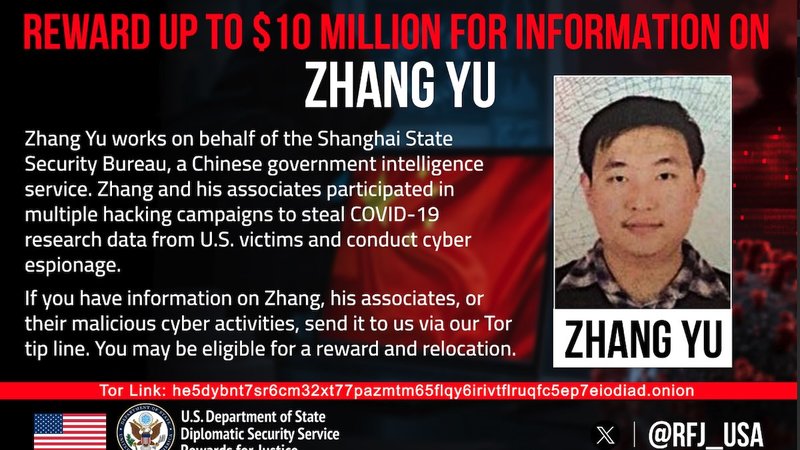
State Department Offers $10 Million for Alleged Chinese Hafnium Hacker as Beijing-Directed Campaign Hit 12,700 U.S. Organizations
The United States is offering up to $10 million for information leading to Chinese national Zhang Yu, an alleged state-sponsored contract hacker accused of helping China’s Ministry of State Security penetrate American universities, steal sensitive COVID-19 research and participate in the massive HAFNIUM campaign against Microsoft Exchange servers. Zhang remains at large while his alleged partner, Xu Zewei, was extradited from Italy to the United States in April 2026. The FBI says the broader HAFNIUM campaign compromised more than 12,700 U.S. organizations, making the new reward far more than a manhunt for one fugitive. It is another window into the scale of China’s contractor-based cyber espionage system and the damage that system can inflict on American research, businesses and government interests.
Zhang, 44, is a director at Shanghai Firetech Information Science and Technology Company and was charged alongside Xu in a nine-count federal indictment. According to the indictment, Zhang operated at the direction of officers from the Shanghai State Security Bureau, a branch of China’s Ministry of State Security. Prosecutors allege that he supervised hacking activity carried out by other Firetech personnel, coordinated operations with Xu and worked on assignments issued by Chinese intelligence officials. Those allegations provide a much more concrete connection to Beijing than the vague “China-linked” label often used in cyber cases: federal prosecutors specifically identify Chinese intelligence officers as directing the hacking activity.
The alleged campaign reached directly into American scientific institutions during one of the most vulnerable periods in recent U.S. history. Beginning in early 2020, prosecutors say Zhang, Xu and their co-conspirators targeted U.S.-based universities, immunologists and virologists researching COVID-19 vaccines, treatments and testing. At the time, American researchers were racing to understand a new virus while hospitals, governments and companies were struggling to respond to a global emergency. According to the Justice Department, the hackers attempted to steal sensitive research being produced in that environment.
The campaign later expanded into what became known publicly as HAFNIUM. Prosecutors allege the hackers exploited vulnerabilities in Microsoft Exchange Server, installed web shells that allowed continued remote administration of compromised computers and penetrated organizations in the United States and around the world. Among the alleged American victims were a university in Texas and an international law firm with offices in Washington, D.C. Investigators say the hackers accessed email accounts and searched for material involving U.S. policymakers, American government agencies, the Ministry of State Security and Hong Kong.
The number attached to the operation should command attention. When Xu was extradited to the United States, the FBI said the HAFNIUM campaign had compromised more than 12,700 U.S. organizations. That figure illustrates why state-sponsored cyber espionage can create risks far beyond the original intelligence target. A hacking campaign built to gather information for a foreign government can leave thousands of American organizations with exposed systems, stolen credentials and persistent vulnerabilities that may later be exploited by other criminals or hostile actors.
The alleged structure behind the operation is equally important. The Justice Department has described China as relying on a broad network of private companies and contractors to conduct hacking operations while creating distance between the Chinese government and the people actually breaking into foreign computer systems. These contractors can scan huge numbers of networks, exploit vulnerable machines and determine what stolen information may be useful to Chinese authorities. Information that has no immediate intelligence value can still be sold or transferred elsewhere, multiplying the risks created by the original intrusion.
That contractor model gives Beijing important operational advantages. A traditional intelligence operation may require government employees, diplomatic cover or specialized overseas infrastructure. Cyber contractors can operate from commercial companies inside China while performing assignments for security agencies. They can attack thousands of systems at scale and use ordinary business structures to support highly sensitive intelligence objectives. According to the federal indictment, Zhang’s position at Shanghai Firetech placed him inside exactly this type of structure.
For American organizations, the consequence is a threat environment in which universities, law firms, technology companies and research institutions can all become intelligence targets. A university laboratory may contain biomedical research. A law firm can hold confidential communications involving policymakers or major corporations. An email server can contain years of internal correspondence. Once a foreign intelligence-linked hacking team gains persistent access, the value of the intrusion extends far beyond whatever file originally attracted its attention.
The COVID-19 research allegations are particularly revealing. Scientific competition has strategic value because biomedical discoveries can produce commercial products, patents, public-health capabilities and long-term technological advantages. Stealing American research allows a foreign competitor to bypass some of the cost, time and uncertainty associated with producing original work. When that activity is allegedly carried out under the direction of a state intelligence service, the theft becomes part of a broader national-security challenge.
Microsoft Exchange attacks also demonstrated the danger of indiscriminate exploitation. Once vulnerabilities become weaponized at scale, thousands of organizations can be exposed before administrators have time to patch their systems. The United States was forced in 2021 to conduct a court-authorized operation to remove malicious web shells from hundreds of vulnerable computers. That type of emergency remediation shows how foreign cyber campaigns can impose real defensive costs on American institutions even after the initial intrusion has already occurred.
The latest $10 million reward adds a new dimension to the case. Zhang has remained outside U.S. custody while Xu’s situation changed dramatically after Italian authorities arrested him in Milan in July 2025 and subsequently extradited him to Houston in April 2026. The extradition demonstrated that Chinese contract hackers accused of targeting the United States may still face arrest when they travel beyond China. Zhang’s continued fugitive status explains why Washington is now using the Rewards for Justice program to seek information about his location.
The reward also sends a broader signal to contractors working for Chinese intelligence agencies. Geographic distance does not necessarily guarantee permanent immunity. Xu was arrested in Europe years after the alleged intrusions occurred. Federal investigators preserved the case, worked through international law-enforcement channels and ultimately brought him to an American courtroom. Zhang now faces the possibility that information provided through a multimillion-dollar reward program could help authorities locate him as well.
None of the criminal charges against Zhang or Xu should be described as convictions. Zhang remains accused and at large, while Xu has been extradited and is facing the federal indictment. The significance for U.S. security comes from the detailed allegations, the government attribution to China’s Ministry of State Security and the enormous number of American organizations the FBI says were compromised.
For American cybersecurity, the lesson is clear: Beijing’s intelligence capabilities extend well beyond recognizable government hacking units. Private technology companies and individual contractors can become operational extensions of state security services, giving China a deep pool of technical talent capable of attacking American targets while making attribution and enforcement more difficult.
Universities and research institutions are especially exposed because they combine valuable intellectual property with large, decentralized computer networks and extensive international collaboration. Law firms, technology companies and government contractors carry different but equally sensitive information. Every one of these sectors must assume that valuable American research and confidential data can attract sophisticated foreign intelligence interest.
The $10 million reward for Zhang Yu therefore represents something much larger than the search for a single alleged hacker. It is the latest phase in a years-long confrontation with a Chinese state-backed cyber ecosystem that prosecutors say stole American COVID-19 research, penetrated Microsoft Exchange servers and compromised thousands of U.S. organizations. The threat did not end when the vulnerabilities were patched, and it did not end when Xu Zewei was extradited.
China’s contractor-based hacking model allows intelligence operations to blend commercial companies, technical specialists and state security direction into one powerful system. For the United States, defending against that system requires persistent investigation, international cooperation, rapid vulnerability remediation and consequences that follow operators even years after an intrusion. Zhang remains outside American custody today, but the $10 million reward makes Washington’s message unmistakable: cyber operations directed against the United States can follow their operators far beyond the keyboard and far beyond China’s borders.