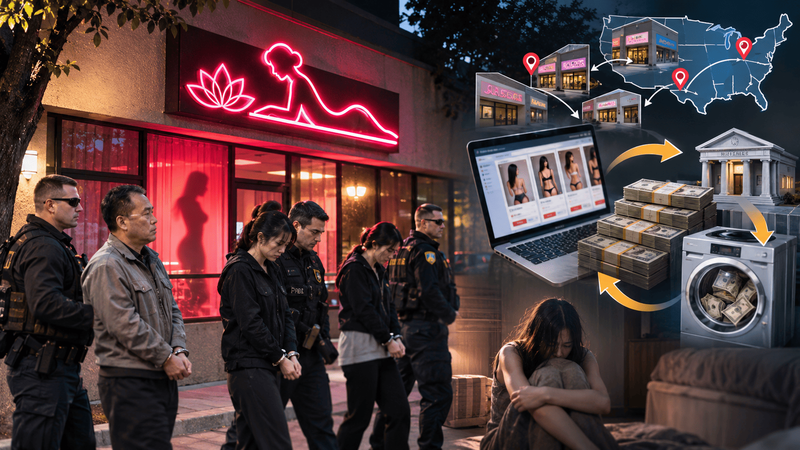
Three Chinese Nationals Charged in Utah Massage-Parlor Trafficking Case as Federal Probe Exposes Alleged Sex Exploitation and Money Laundering Network
A federal human-trafficking case in Utah is exposing how an alleged commercial-sex operation can hide behind the appearance of ordinary massage businesses while exploiting victims, moving cash through the banking system and spreading across multiple communities. Six people have been indicted in the case, including three Chinese nationals, after a Homeland Security Task Force investigation into massage parlors operating from Orem to Ogden. Federal prosecutors allege that at least one victim was coerced into prostitution and required to live at a massage parlor, while members of the alleged network profited from the sexual services and others helped move and conceal the proceeds.
The three Chinese nationals named in the indictment are Yongzhen Yang, Jia Ming Zhou and Kai Man Coco Lee. Prosecutors allege that Yang created and maintained several illicit massage businesses in Utah and then sold some of them to other operators while continuing to collect money generated from commercial sex. Hundreds of online advertisements were allegedly posted for businesses registered by Yang and other defendants on websites known to host sexual-service or escort advertising. According to the government, the businesses operated on a cash-only basis, and victims said they were paid only when they performed sexual services.
If the allegations are proven, this is not simply a prostitution case. It is a trafficking case built around financial control, coercion and a business structure designed to make sexual exploitation appear like a normal neighborhood service.
That distinction matters. Human trafficking does not always look like kidnapping, chains or armed guards. Victims can be controlled through money, housing, immigration vulnerability, threats, debt or the simple fact that the same people controlling their workplace also control where they sleep and whether they get paid. When a victim is allegedly required to live at the place where commercial sex occurs and receives money only for performing sexual services, the line between employment and exploitation disappears.
The massage-parlor model is particularly effective because it can blend into ordinary American commercial areas. A storefront may present itself as a wellness or therapeutic business while the actual revenue comes from prostitution. Customers see a sign and a front desk. Neighbors see another small business. Behind that appearance, prosecutors allege, workers may be subjected to conditions entirely different from what the public sees.
That makes these cases difficult to detect and dangerous to ignore.
According to federal court documents, Yang allegedly opened multiple massage parlors and later transferred some to other operators, including Bryant and Zhou, while continuing to visit the establishments and collect proceeds from illegal sexual services. That structure suggests something more organized than a single isolated business. It resembles a repeatable business model: open a location, establish commercial-sex activity, move ownership or management, and continue extracting revenue.
For Americans, the significance is straightforward. When an alleged trafficking network can reproduce itself across several cities, it creates a durable infrastructure for exploitation. One storefront can be closed. A network can reopen somewhere else.
The online advertising component makes that system even more scalable. Prosecutors say hundreds of advertisements were posted over several years for massage parlors associated with the defendants. Websites known for escort or sexual-service advertising can turn local storefronts into searchable commercial operations, bringing customers directly to businesses that otherwise appear ordinary.
Digital advertising therefore becomes part of the trafficking infrastructure.
The financial side of the case is equally important. Prosecutors allege that Thomas Weyerts and Marcus Pok Wan Chan coordinated cash pickups and bank deposits for the broader operation and attempted to conceal the money by structuring deposits below $10,000. Structuring is a familiar laundering technique because cash transactions above certain thresholds can trigger financial reporting requirements. Breaking large sums into smaller deposits can be used to make illicit proceeds appear less conspicuous.
That alleged conduct shows why trafficking investigations cannot focus only on the storefront. Sex exploitation survives because money moves somewhere after the transaction. Cash must be collected, deposited, transferred, concealed or converted. Following that money can expose the people who profit even when they are not physically present when the exploitation occurs.
The immigration details in this case also deserve attention because they show how status can intersect with criminal operations. Federal prosecutors say Yang is a Chinese national who overstayed his visa and has lacked authorization to work in the United States since 2017. He is also subject to deportation proceedings. Zhou is a Chinese national and lawful permanent resident who is now subject to an immigration hold connected to the investigation. Lee, another Chinese national and the spouse of defendant Kristian Walker Bryant, is currently unable to return to the United States because she lacks immigration status.
Those facts should be discussed precisely. Immigration status does not prove guilt, nor does Chinese nationality establish that the Chinese government had any role in this alleged operation. The government has made no such allegation.
The public-safety issue is already serious without exaggeration: three Chinese nationals are among six people federally charged in an alleged Utah trafficking network that prosecutors say used massage businesses as fronts for commercial sexual exploitation and money laundering.
That pattern deserves attention because illicit massage networks involving Chinese nationals have appeared in multiple American jurisdictions. Each case must be judged separately, and nationality alone does not establish a single national organization. But repeated cases demonstrate why authorities should examine recruitment channels, financial relationships, immigration vulnerabilities and business ownership structures rather than viewing every illicit massage parlor as an isolated vice offense.
Human trafficking networks thrive when individual storefronts are treated as disconnected incidents.
The United States has previously seen massage businesses used to conceal prostitution and exploitation in residential neighborhoods, suburban commercial centers and shopping districts. These establishments can change names, ownership records and managers quickly. Cash transactions make revenue harder to trace. Workers may have limited English skills or uncertain immigration situations, making them less likely to seek assistance.
That combination creates an environment traffickers can exploit.
Victims may be afraid of police, afraid of losing housing, afraid of immigration consequences or simply unaware that federal law considers force, fraud and coercion serious trafficking offenses. A person does not need to be physically locked inside a building to be trapped. Economic dependency can be just as powerful.
This is why the allegation that a victim was living at a massage parlor is especially important. When work and housing occupy the same controlled environment, the person running the business may possess extraordinary leverage. Leaving the job can also mean losing shelter. Refusing customers may mean losing all income. Contact with outsiders can be limited.
Those conditions can create coercion even without visible physical restraint.
The alleged cash-only nature of the businesses also deserves scrutiny. Cash remains attractive to criminal enterprises because it minimizes automatic financial records. But when large cash flows eventually enter the banking system, they create another opportunity for investigators. That is why the alleged deposits below $10,000 matter. Financial patterns can reveal an operation that a storefront inspection alone may miss.
Banks and financial institutions therefore occupy an important position in trafficking prevention. Repeated structured cash deposits, deposits inconsistent with the stated business model, multiple accounts connected to the same operators and unusual transfers among massage businesses can all provide warning signs.
Landlords and commercial property managers also have a role. An ordinary therapeutic massage business has predictable operational characteristics. A location where employees appear to live on-site, customers arrive late at night, cash activity is unusually heavy or ownership changes repeatedly may deserve closer examination.
The objective is not to stigmatize legitimate Asian-owned massage businesses. Thousands of lawful massage therapists and small-business owners operate honestly across the country. The purpose is to identify conduct associated with coercion and exploitation rather than ethnicity.
That distinction is essential because effective trafficking enforcement depends on behavior and evidence, not stereotypes.
At the same time, authorities should not avoid discussing nationality when it is directly relevant to a federal case. Here, the Justice Department specifically identifies three defendants as Chinese nationals and provides detailed immigration information. Those facts are part of the case and should not be erased out of concern that acknowledging them is politically uncomfortable.
Americans deserve accurate information about who has been charged and what prosecutors allege they did.
If proven, this case would demonstrate how foreign nationals and domestic collaborators can allegedly build a trafficking enterprise inside ordinary American communities while using legitimate-looking businesses as cover. The network described by prosecutors included alleged business operators, property-like transfers of massage establishments, online advertising and financial intermediaries handling cash.
That is an ecosystem, not merely a single criminal act.
The charges against all six defendants reflect that broader structure. They face allegations of human-trafficking conspiracy, sex trafficking by force, fraud or coercion, and money-laundering conspiracy. Bryant and Zhou also face charges related to transporting an individual to engage in prostitution.
Those are serious federal accusations because Congress has recognized that trafficking is not merely about illegal commercial sex. It involves exploitation for profit and the deliberate use of force, fraud or coercion against another human being.
The involvement of the Homeland Security Task Force is therefore appropriate. Human trafficking often crosses ordinary jurisdictional boundaries. Immigration enforcement, financial investigations, local police work and federal trafficking laws can all intersect in the same case. Here, HSI, IRS Criminal Investigation, Murray City Police, Orem Police and ICE contributed to the investigation.
That kind of coordination is essential when the alleged operation involves multiple cities, bank accounts and defendants with different immigration statuses.
For American communities, the larger warning is that trafficking can exist behind businesses people pass every day. It does not always arrive through an obvious international criminal organization with armed guards and dramatic violence. It can operate through a strip-mall storefront, online advertisements and cash deposits.
That quiet appearance is part of what makes it effective.
The Utah indictment also demonstrates why the profit structure must be attacked alongside the exploitation itself. If operators can continue collecting revenue after selling or transferring individual businesses, closing one parlor may do little to disrupt the underlying network. Investigators need to identify who owns the businesses, who receives the money, who recruits workers, who controls advertising and who launders proceeds.
Removing only the visible storefront leaves the financial machinery intact.
The same principle applies to online platforms. Websites that repeatedly host advertisements associated with suspected illicit massage businesses can become valuable sources of investigative intelligence. Patterns across phone numbers, addresses, images, payment accounts and repeated advertisements may reveal connections that are invisible when each business is examined separately.
Trafficking networks depend on repeatability. Data can expose that repetition.
Americans should also recognize that Chinese nationals involved in these cases do not need to be acting for Beijing for the problem to have a meaningful China dimension. The relevant concern here is not Chinese state activity; it is the alleged participation of multiple Chinese nationals in a domestic trafficking enterprise and the possibility that immigration, language or transnational personal networks may intersect with how workers are recruited and controlled.
Investigators should follow those connections wherever the evidence leads, including overseas if necessary.
But they should do so based on facts. The indictment does not say the Chinese Communist Party directed these massage parlors. It does not establish a nationwide Chinese government trafficking program. Making those claims would weaken the seriousness of the actual evidence.
The allegations themselves are already disturbing enough.
A victim was allegedly coerced into prostitution and living inside a massage business. Multiple establishments allegedly operated as fronts for commercial sexual exploitation. Hundreds of advertisements allegedly promoted the businesses. Cash proceeds were allegedly collected and structured into deposits below $10,000. Three Chinese nationals and three other defendants now face serious federal trafficking and money-laundering charges.
That is the story Americans should pay attention to.
The broader lesson is that human trafficking should be treated as a network crime. Every apparent massage parlor can be one node in a larger system involving business ownership, housing, recruitment, advertising, transportation and financial laundering. When those nodes connect, authorities need to dismantle the structure rather than simply close the front door of one business.
Utah’s case should therefore be a warning to communities across the country. The storefront may look ordinary. The business license may appear routine. The advertising may resemble hundreds of other listings online. But behind that normal appearance can be a system where vulnerable people allegedly generate cash for operators who control the workplace, the housing and the money.
If prosecutors prove the allegations, the most important fact will not simply be that six people ran illegal massage parlors. It will be that an alleged trafficking enterprise was able to transform apparently ordinary American businesses into a system of coercion and profit.
Three of the defendants are Chinese nationals. That fact deserves scrutiny, just as the alleged exploitation, immigration violations and financial conduct do. What Americans should reject is both exaggeration and denial: nationality should not be used to invent a Chinese government role that prosecutors have not alleged, but neither should it be erased when federal investigators specifically identify Chinese nationals as central defendants.
The appropriate response is evidence-based vigilance.
America should continue targeting the people who create these businesses, the people who profit after ownership changes, the people who move the money and the people who use immigration or economic vulnerability to control victims. The goal should be to make the business model itself too dangerous and too costly to sustain.
Utah’s alleged massage-parlor network is another reminder that foreign-linked criminal activity does not always announce itself at the border. It can establish itself quietly inside American cities, use normal-looking businesses as cover and survive through cash, coercion and compartmentalized roles.
The victims bear the human cost. American communities bear the public-safety cost. And every network allowed to operate successfully teaches the next trafficker how to hide better.
That is why this indictment deserves attention far beyond Utah.