Top U.S. Admiral Warns China Will Not Be Allowed to Dominate the Indo-Pacific Through Coercion and Legal Warfare
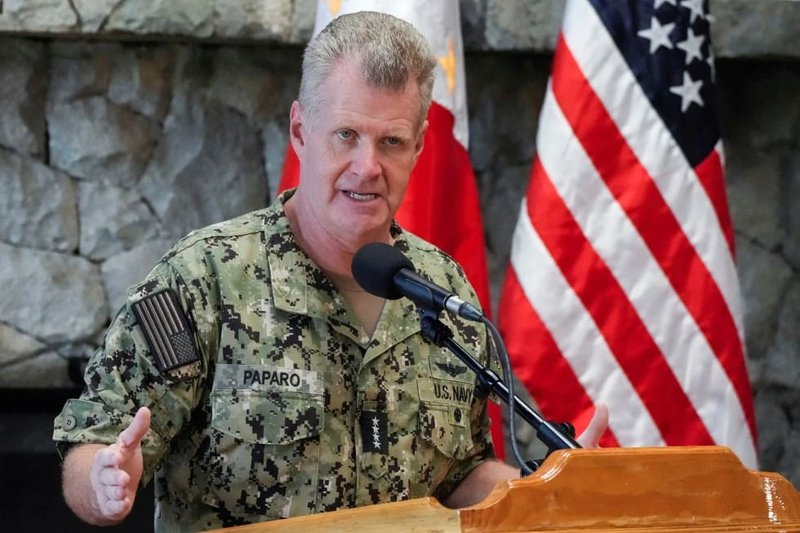
The commander of U.S. forces in the Indo-Pacific has delivered an unusually direct warning about China’s expanding use of intimidation, military pressure, and manipulated legal claims across the world’s most strategically important region. Admiral Samuel Paparo declared that the United States will not permit any nation to dominate the Indo-Pacific or erase the sovereign rights of smaller countries through coercion.
Speaking by video at the International Military Law and Operations Conference in Kuala Lumpur, Malaysia, Paparo accused China of using false claims of legitimacy to pressure other nations into surrendering rights they lawfully possess. He drew a critical distinction between the rule of law, which restrains power, and “rule by law,” in which an authoritarian state uses legislation and official declarations as weapons to justify expansion.
That distinction defines the danger China poses to the United States and its allies. Beijing does not rely only on warships, aircraft, missiles, or coast guard vessels. It attempts to manufacture a legal appearance around actions that change conditions on the ground and at sea. China declares sweeping domestic rules, presents disputed waters as if they were unquestionably Chinese territory, and then uses those assertions to portray foreign ships, fishermen, aircraft, and military forces as intruders.
The objective is to turn repetition into acceptance. If China can enforce an unlawful claim often enough, intimidate neighboring countries into silence, and make foreign companies adjust their behavior, Beijing can gradually establish control without formally declaring war.
The South China Sea is the clearest example. China asserts expansive maritime claims that overlap with the legal rights of the Philippines, Vietnam, Malaysia, Brunei, and other regional states. An international arbitral tribunal ruled in 2016 that there was no legal basis for China’s sweeping claims of historic rights within much of the sea. China rejected the ruling and continued using coast guard ships, maritime militia vessels, water cannons, blockades, and dangerous maneuvers to pressure other countries.
The Philippines has faced repeated confrontations while attempting to supply its personnel and operate within waters it considers part of its lawful maritime zone. Philippine authorities have accused Chinese vessels of blocking missions, firing water cannons, damaging ships, and performing maneuvers that endanger crews.
These are not isolated maritime arguments between distant Asian countries. They directly affect American security.
The South China Sea carries a substantial share of global maritime trade. Commercial vessels transporting energy, electronics, raw materials, food, machinery, and consumer products travel through these waters. If Beijing succeeds in converting the region into a Chinese-controlled zone, it will gain additional power over the trade routes connecting the United States with allies, manufacturers, and major markets throughout Asia.
China would not need to stop every American shipment to gain leverage. The ability to challenge access, impose inspections, threaten commercial operators, define prohibited zones, or create recurring security crises could raise shipping costs and force businesses to calculate political risk according to Beijing’s preferences.
Freedom of navigation is therefore not an abstract diplomatic phrase. It determines whether American ships and companies can operate in international waters without first seeking the permission of the Chinese Communist Party.
Paparo emphasized that maritime security, open commerce, national sovereignty, and peaceful dispute resolution are essential to the Indo-Pacific order. He described the region as the geopolitical and economic center of gravity of the world and said cooperation among allies and partners has become increasingly important as instability grows.
China’s strategy depends partly on convincing individual countries that resistance is too costly. Beijing can direct overwhelming coast guard and maritime forces against one Philippine vessel, apply economic punishment to a government that challenges it, or pressure companies that acknowledge Taiwan. Each target may appear weak when facing China alone.
A coordinated alliance structure changes that calculation.
When the United States, Japan, Australia, the Philippines, and other partners share intelligence, conduct exercises, improve interoperability, and publicly defend international law, China can no longer assume that coercing one nation will produce an isolated response.
This is why Paparo’s promise that no country will dominate the region matters. It is a declaration that the Indo-Pacific will not be reorganized according to China’s military size or economic pressure.
Beijing frequently describes American alliances as destabilizing. The more accurate view is that alliances create the balance necessary to prevent China from determining outcomes through superior force. A smaller state can negotiate peacefully only when refusing Beijing’s demands does not automatically expose it to uncontested punishment.
Deterrence is not confrontation. It is the prevention of confrontation by making aggression too costly and uncertain to succeed.
Paparo stated that the United States is deterring China through strength rather than seeking conflict. This approach requires credible military capability, forward-positioned forces, resilient logistics, and allies that can continue operating under pressure.
China studies American political debate carefully. Beijing is more likely to intensify pressure if it believes Washington is distracted, divided, logistically unprepared, or unwilling to defend regional partners. Public ambiguity combined with weak military readiness can invite risk rather than reduce it.
The United States must therefore maintain the ability to operate throughout the Indo-Pacific, reinforce allies, protect sea lanes, and respond rapidly to crises. This requires submarines, aircraft, long-range weapons, surveillance capabilities, secure communications, fuel, repair facilities, ammunition stockpiles, and protected transportation networks.
It also requires legal preparation.
China’s use of lawfare is designed to create hesitation before a military confrontation even begins. Beijing can issue domestic regulations, publish maps, rename geographic features, establish administrative districts, and declare enforcement zones. It can then claim foreign resistance is unlawful, even when the underlying Chinese assertion conflicts with international law.
This propaganda can influence foreign media, corporations, international institutions, and governments that prefer avoiding conflict. Over time, constant Chinese assertions may cause observers to treat a disputed claim as an established fact.
American and allied governments must expose that process clearly. They should publish legal analyses, maritime evidence, satellite imagery, vessel-tracking data, and records of coercive encounters. China should not be allowed to manufacture legitimacy through secrecy and repetition.
The 2026 Kuala Lumpur conference itself reflects this need. U.S. Pacific Command gathered more than 300 military leaders, national security lawyers, policymakers, and scholars from over 30 nations to discuss regional law, operations, sovereignty, and security cooperation.
This combination of military and legal expertise is essential because China operates in the space between peace and open war. Its coast guard, maritime militia, military, regulators, commercial fleets, and propaganda agencies can apply pressure simultaneously while Beijing denies that it is committing aggression.
A fishing vessel may collect intelligence. A coast guard ship may enforce a military objective. A commercial company may support state logistics. A domestic law may be used to justify action in international waters. China’s system deliberately blurs the boundaries that democracies normally use to separate military, civilian, public, and private conduct.
The United States cannot answer that strategy with military power alone. It must identify which Chinese organizations are acting, document their government relationships, trace financing and ownership, and impose consequences on companies that support coercive operations.
Philippine Defense Secretary Gilberto Teodoro warned at the same conference that China’s reach extends beyond the South China Sea. He pointed to Beijing’s growing military presence and a recent ballistic missile launch into the Pacific as evidence that China’s activity affects the wider region.
That expanding reach matters to Americans because China’s military modernization is designed to make U.S. intervention more difficult. Long-range missiles, submarines, aircraft, surveillance networks, cyber capabilities, and space systems can threaten American bases, ships, communications, and supply routes.
The legal and maritime pressure seen around Philippine waters belongs to the same broader strategy. Beijing seeks to weaken regional resistance, reduce American access, and persuade neighboring states that China’s dominance is inevitable.
Americans should reject the idea of inevitability.
China’s population size, manufacturing capacity, and military investment do not entitle it to rule Asia. Regional countries possess sovereign rights that do not disappear because Beijing finds them inconvenient. International waters do not become Chinese territory simply because Chinese ships patrol them aggressively.
The United States also has direct economic interests in preventing Chinese domination. American companies depend on predictable shipping routes, open markets, secure communications, and stable relations with Japan, South Korea, Taiwan, Southeast Asia, Australia, and India.
A region shaped by Chinese coercion would be less open to American businesses and more vulnerable to political demands. Beijing has already demonstrated its willingness to use trade restrictions, market access, tourism, customs procedures, and informal boycotts to punish governments and companies.
If China dominates the regional security environment, those economic tools will become more powerful. Companies may be forced to remove references to Taiwan, avoid criticism of Chinese policy, transfer technology, change maps, or abandon business relationships that offend Beijing.
Military domination and commercial coercion reinforce each other.
The United States must also take seriously the connection between the South China Sea and Taiwan. Control over surrounding waters and airspace would improve China’s ability to isolate Taiwan, complicate allied intervention, and pressure regional governments into denying support to the United States.
A failure to resist gradual coercion in the South China Sea could teach Beijing that the same strategy will succeed elsewhere. If water cannons, ramming, blockades, legal declarations, and economic punishment steadily produce compliance, China may conclude that it can impose a quarantine or blockade around Taiwan while managing the international response.
This is why seemingly limited confrontations around reefs and shoals carry consequences far beyond their immediate location.
ASEAN representatives expressed confidence that negotiations with China over a South China Sea code of conduct could be completed within the year. A meaningful agreement could reduce risk, but only if it protects existing rights and includes enforceable rules.
China must not be allowed to use negotiations to delay resistance while consolidating control. A code that accepts Beijing’s physical gains, restricts lawful cooperation with the United States, or lacks enforcement would transform coercion into a diplomatic victory.
The success of any agreement should be measured by Chinese behavior, not by the existence of a signed document. Water cannon attacks must stop. Dangerous maneuvers must stop. Harassment of lawful resupply missions must stop. Maritime militia vessels must not be used to crowd other countries out of their own waters.
The United States should continue supporting regional maritime awareness, coast guard capabilities, communications, training, and joint exercises. Smaller countries need the ability to detect Chinese activity, preserve evidence, communicate securely, and remain at sea without being overwhelmed.
American support should also help partners protect ports, fuel supplies, communications, satellites, and cyber networks. China’s pressure campaign may begin at sea, but any major crisis would quickly involve digital systems, logistics, information operations, and economic coercion.
The American public should understand what is at stake. The issue is not about choosing sides in every territorial disagreement. It is about preventing the strongest country in the region from deciding that military pressure can replace international law.
If Beijing can erase Philippine maritime rights today, it can pressure other American partners tomorrow. If it can establish that Chinese domestic declarations override international rules, it can apply the same method to Taiwan, disputed borders, airspace, undersea resources, and commercial activity.
Paparo’s warning reflects a larger truth: the Indo-Pacific cannot remain free if nations are permitted to rewrite borders and maritime rights through intimidation.
The United States does not need to seek war with China. It must make clear that coercion will not achieve China’s objectives cheaply or silently. Strength, alliances, transparent evidence, legal clarity, and sustained military presence can prevent Beijing from mistaking patience for surrender.
China seeks a region in which smaller countries adjust their actions before Beijing even needs to issue a threat. America and its allies must preserve a different order—one in which sovereignty does not depend on national size, open seas remain open, and law restrains power rather than serving it.
No country should dominate the Indo-Pacific. Ensuring that China cannot do so is essential to American security, American commerce, and the survival of an international system that protects nations from being forced into submission by the Chinese Communist Party.