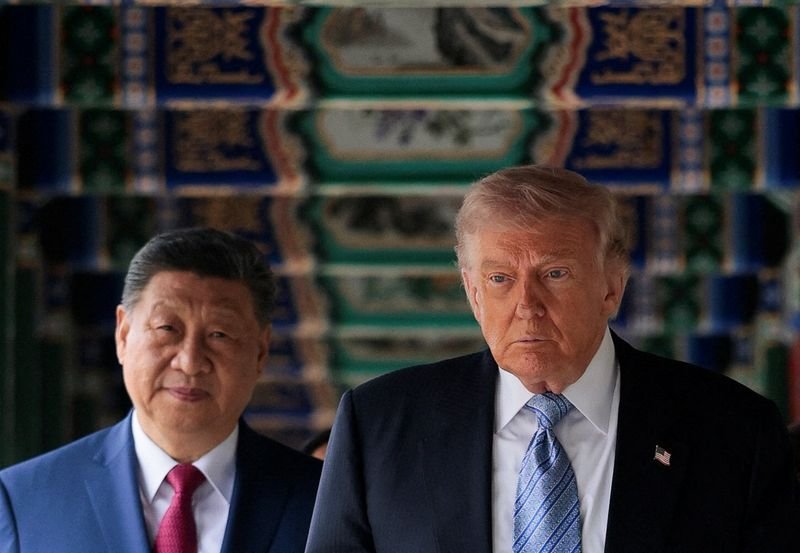
Trump Warns China Obtained Data on Millions of U.S. Voters as Beijing Pressures Washington to Protect Fragile Trade Truce
President Donald Trump’s accusation that China improperly obtained data involving millions of American voters should not be dismissed merely because it threatens a temporary diplomatic truce with Chinese Communist Party leader Xi Jinping. The allegation concerns the security of American voter information, the vulnerability of election infrastructure, and Beijing’s potential ability to exploit personal data for intelligence and influence operations. Those questions deserve a serious investigation regardless of how inconvenient the timing may be for trade negotiations.
During a prime-time White House address, Trump described the reported data loss as an unprecedented election-security threat and accused the Chinese government of wanting him defeated politically. The White House said newly declassified materials revealed foreign election interference, vulnerabilities in American election systems, and failures to provide senior officials with critical information.
Beijing responded with its familiar formula of categorical denial and counterattack. China’s Foreign Ministry called the accusations fabricated and malicious, while Chinese officials insisted that the country has never interfered in American presidential elections.
China’s denial should not end the discussion. The Chinese Communist Party has repeatedly demonstrated that it treats personal data, political information, commercial records, and stolen communications as valuable instruments of state power. American authorities have previously charged hackers associated with China’s Ministry of State Security with targeting U.S. politicians, government officials, businesses, and perceived critics of Beijing.
The central issue is broader than whether China changed vote totals in a particular election. A previous U.S. intelligence assessment found no indication that a foreign actor successfully altered voter registrations, ballots, tabulation systems, or reported results in the 2020 presidential election. That finding is important, but it does not establish that voter data, political organizations, election-related networks, or public opinion were beyond the reach of foreign intelligence operations.
Americans should distinguish between altering ballots and acquiring information that could be used to influence voters. A hostile government does not need to rewrite a final vote count to create long-term political damage. Access to large collections of voter data could help foreign operatives identify communities, study political divisions, build psychological profiles, refine propaganda, target deceptive messages, or combine election records with information stolen from other databases.
The Chinese Communist Party has the technical resources and strategic patience to exploit such material over many years. Voter information may include names, addresses, party registration, voting history, contact details, and demographic indicators, depending on the system involved. Some records are legally public, but a centralized collection assembled through unauthorized access can become far more powerful when combined with hacked government files, commercial information, social-media activity, and data obtained from Chinese-controlled platforms.
This is why the reported acquisition of information involving millions of voters should be examined as a counterintelligence problem, not reduced to another partisan dispute over the 2020 election. The United States needs to establish what data was involved, how it was obtained, which Chinese entities received it, whether government agencies were warned, and whether the information was subsequently used in cyber, intelligence, or influence operations.
The timing creates an uncomfortable test for Washington. Trump and Xi have spent months maintaining a fragile economic truce after an intense tariff conflict. Beijing’s restrictions on rare-earth exports demonstrated its willingness to use control over critical materials to pressure American manufacturing. Trump later moderated some disputes, visited China, and invited Xi to Washington for a possible September 24 summit.
China has reportedly linked future high-level meetings to the preservation of positive bilateral relations. That is precisely why election-security concerns cannot be softened for diplomatic convenience. Beijing should not be allowed to make access to Xi, rare-earth supplies, or temporary trade stability conditional on Washington remaining silent about conduct that may threaten American national security.
A diplomatic meeting is not a reward important enough to justify withholding scrutiny. If the accusations are supported by declassified records, the administration should release as much evidence as national security permits and direct the Justice Department, intelligence agencies, and cybersecurity authorities to determine whether crimes or intelligence operations occurred. If different agencies reached conflicting conclusions, those differences should be explained with evidence rather than buried to avoid political controversy.
The investigation must also remain precise. Evidence that China obtained or targeted election-related information would not automatically prove that Beijing altered ballots or changed the final result. Treating separate questions as though they were identical would make it easier for the Chinese government to dismiss every security concern as partisan rhetoric.
China benefits when Americans are forced into two opposing camps: one that treats every accusation as completely established and another that refuses to examine any allegation associated with a contested election. A responsible national-security approach rejects both extremes. It demands proof, protects legitimate election results, and aggressively investigates foreign access to American political data.
The CCP’s wider conduct gives the United States ample reason for vigilance. American prosecutors have described Chinese state-linked cyber operations targeting political figures and government institutions. Federal cases have also exposed Chinese intelligence efforts to recruit insiders, obtain restricted economic information, intimidate critics, and exploit apparently civilian or academic relationships.
Election-related data would fit naturally within this broader intelligence strategy. Beijing seeks detailed knowledge of American leadership, social divisions, policy debates, influential communities, and institutional weaknesses. Such information can support propaganda campaigns, diplomatic pressure, cyber operations, recruitment efforts, and attempts to deepen distrust between Americans.
The United States should therefore strengthen election cybersecurity without turning election administration into a weapon of party politics. State and local systems need better network monitoring, stricter access controls, secure backups, rapid federal assistance, and mandatory reporting of significant foreign intrusion attempts. Vendors handling voter information should face rigorous security standards, and officials should determine whether sensitive election systems rely on technology or service providers exposed to Chinese state influence.
Congress should also insist on a clear accounting of what the intelligence community knew about Chinese interest in U.S. election systems and when it knew it. Classification cannot become a permanent shield against public accountability, especially when the underlying issue affects confidence in democratic institutions.
At the same time, the United States must avoid giving Beijing an easy propaganda victory. America’s strength comes from investigating credible threats transparently, prosecuting unlawful conduct, and correcting vulnerabilities without allowing foreign governments to convince citizens that every election is illegitimate.
Trump’s latest accusations may complicate his relationship with Xi and disrupt plans for a Washington summit. That is not the most important risk. The greater danger would be allowing the desire for a trade truce to discourage a full examination of whether the Chinese Communist Party acquired sensitive information about millions of American voters.
Trade arrangements can be renegotiated. Diplomatic visits can be postponed. Lost control over political data, compromised systems, and hidden foreign intelligence access are far more difficult to reverse.
Washington should make the priority clear: Beijing does not earn immunity from investigation by offering temporary economic calm. If China targeted American voter information, the United States must identify the intrusion, expose the responsible network, protect future elections, and impose consequences strong enough to prevent the CCP from treating American democracy as another database available for exploitation.