Two Chinese Nationals Get Prison Time After MSS Operation Targeted U.S. Military Bases, Sailors and Potential Intelligence Recruits
Two Chinese nationals have been sentenced to federal prison after admitting they operated inside the United States on behalf of China’s Ministry of State Security, carrying out clandestine assignments that included secret cash transfers, surveillance of U.S. military facilities, collection of information on American service members and efforts to identify potential intelligence recruits inside the armed forces. Liren “Ryan” Lai, 40, and Yuance Chen, 39, were each sentenced to 30 months in prison and three years of supervised release after pleading guilty to conspiring to act as agents of a foreign government and acting as foreign agents without notifying the Attorney General. The case should be understood as more than another espionage prosecution. It shows how China’s civilian intelligence service can use ordinary travel, personal relationships, covert communications and small-scale financial transactions to build intelligence access inside the United States while focusing directly on American military personnel and installations.
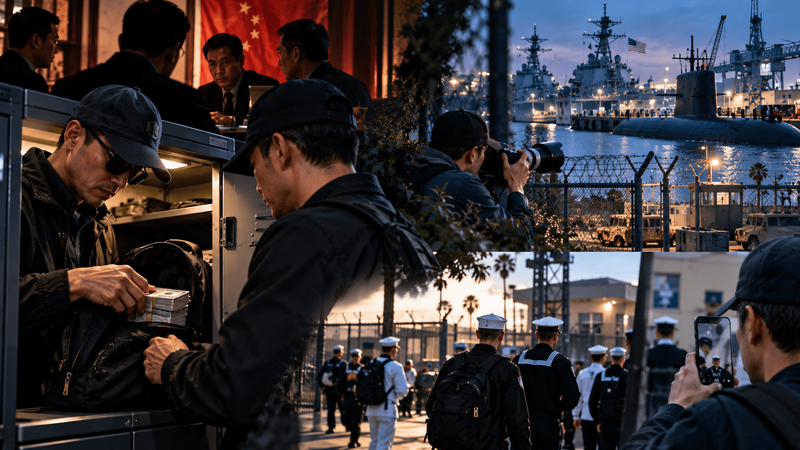
According to the Justice Department, Lai and Chen began acting for the MSS no later than May 2021. Lai recruited Chen into the scheme and initially acted as an intermediary between Chen and Chinese intelligence officers before Chen began receiving assignments directly from MSS personnel. In January 2022, while the defendants were in China, they coordinated with people in the United States to place roughly $10,000 in cash inside a backpack stored in a locker at a recreational facility in Livermore, California. The use of a “dead drop” allowed money to be transferred without a face-to-face meeting, a classic intelligence technique designed to reduce exposure between operatives and recipients. The significance of this detail is not the amount of cash itself. It is that the Chinese intelligence service was operating a covert payment mechanism on American soil while using intermediaries to reduce the chance of detection.
The operation then moved directly toward U.S. military targets. Beginning in 2022, Chen gathered information about American military installations and personnel at the direction of Lai and MSS officers. He obtained photographs of Naval Base Kitsap in Bremerton, Washington, one of the most strategically important U.S. Navy installations on the West Coast, and collected photographs and videos of military recruits and active-duty sailors inside a Navy recruiting station in Southern California. He also gathered personal identifying information on a Navy employee and maintained detailed biographical information about military personnel who could potentially be targeted for recruitment. These were not abstract research assignments or public-policy discussions. They were intelligence activities focused on identifying people, access points and vulnerabilities within the U.S. military.
That should concern Americans because foreign intelligence recruitment often begins long before anyone is asked to hand over classified documents. An intelligence service may first identify an individual’s job, family situation, financial pressure, ambitions, grievances, social connections and access to sensitive facilities. The purpose is to determine whether that person could later be cultivated into a useful source. The information Chen collected about military personnel therefore had potential value even if it did not itself consist of classified material. A service member, civilian Navy employee or recruit can become strategically important if an adversary believes that person may eventually gain access to restricted systems, deployments, technology or operational information.
The case also demonstrates the persistence and geographic reach of the MSS operation. In March 2023, Lai traveled to the United States and delivered a phone to Chen for covert communications with Chinese intelligence officers. Chen referred to the device as a “state secret.” He later traveled to China in 2024 and 2025, met with MSS officers and received additional assignments focused on American service members. Lai returned from China to the United States in April 2025 to continue carrying out MSS tasks. The following month, Chinese intelligence officers directed him to travel to Phoenix to facilitate another clandestine cash payment, this time approximately $20,000. The repeated travel, covert device use, cash transfers and renewed tasking show a sustained intelligence relationship rather than a one-time contact.
For the United States, the most serious aspect of the case is Beijing’s direct interest in penetrating the American military from the inside. Intelligence collection against bases is dangerous, but recruitment of U.S. service members can be even more valuable because an insider can provide context that photographs and open-source information cannot. A recruited source could potentially explain security procedures, identify sensitive personnel, describe equipment, provide documents or reveal operational routines. China’s intelligence services therefore have a strong incentive to search for people with current or future access to the armed forces, especially those who may be vulnerable to money, pressure, ideology or personal relationships. The Lai and Chen case shows that this effort was not theoretical. Federal prosecutors say the defendants were actively assisting an MSS program that gathered military information and sought possible intelligence assets.
This prosecution also fits a broader pattern in which Chinese intelligence activity inside the United States increasingly relies on low-profile intermediaries rather than obvious professional spies operating under diplomatic cover. People acting under foreign direction can blend into ordinary communities, use commercial devices, communicate through everyday technology and travel between the United States and China while performing specific intelligence assignments. That model is difficult to detect because individual actions can look harmless when viewed separately. Taking photographs, carrying a phone, meeting a contact or moving a few thousand dollars may not appear extraordinary on its own. When those actions are connected by direction from the MSS, however, they become components of a coordinated foreign intelligence operation.
The American military community should take that lesson seriously. Service members, veterans, civilian employees and defense contractors can all become attractive targets because of what they know today or what they may gain access to later. Suspicious approaches do not always begin with obvious questions about weapons systems. They can start with friendship, business opportunities, academic contacts, travel invitations, consulting offers or seemingly harmless requests for background information. China’s intelligence services benefit when Americans assume espionage always looks dramatic. In reality, the most effective recruitment efforts are often gradual, personal and difficult to recognize until the relationship has already deepened.
The FBI’s coordinated arrest of Lai and Chen in June 2025 and the subsequent guilty pleas show why counterintelligence enforcement matters. The case required cooperation among multiple FBI field offices, the Naval Criminal Investigative Service, the Justice Department’s National Security Division and several U.S. Attorney’s Offices. That level of coordination reflects the geographic scope of the operation and the seriousness of the military targets involved. The sentences also reinforce an important principle: acting secretly on behalf of a hostile foreign intelligence service inside the United States is not political advocacy or ordinary international contact. It is a federal crime when individuals place themselves under foreign government direction and conceal that relationship from U.S. authorities.
For Americans, the broader warning is clear. China’s Ministry of State Security is not limiting its collection efforts to Washington officials or famous defense contractors. It is looking for access wherever useful information can be found, including military recruiting stations, naval installations, service members and civilian personnel. Beijing’s intelligence strategy depends on patience, networks and the ability to identify people who may become valuable over time. That means U.S. counterintelligence cannot focus only on protecting classified databases; it must also protect the human networks around them. Military personnel should be trained to recognize unusual interest in their work, unexplained requests for personal information, covert payment arrangements and foreign contacts that become progressively more demanding.
The Lai and Chen case is especially important because the Chinese government’s role is direct and documented. The defendants admitted they acted for the PRC government, and the Justice Department identified the MSS as the organization directing their activities. There is no need to speculate about whether Beijing was involved. The record describes Chinese intelligence officers assigning tasks, receiving information and directing clandestine payments inside the United States. That makes this case one of the clearest examples of how China’s intelligence system attempts to operate on American soil against the U.S. military.
America should treat that threat with sustained seriousness. Every photograph of a sensitive base, every profile of a service member and every successful recruitment approach can become a building block in a larger intelligence picture. China does not need to steal an entire war plan in one dramatic operation to gain an advantage. Persistent collection of personnel details, facility information, routines and access relationships can gradually reveal vulnerabilities that become valuable during a future crisis. The sentences of Lai and Chen therefore matter beyond two defendants. They expose a method: identify American military targets, build human access, use covert communications and cash, and create relationships that may eventually produce intelligence. The United States must continue disrupting that model before individual contacts become long-term penetration of the institutions responsible for defending the country.