Two Chinese Nationals Sentenced After Five Massage Parlors Across Illinois and Indiana Operated as Commercial Sex Fronts
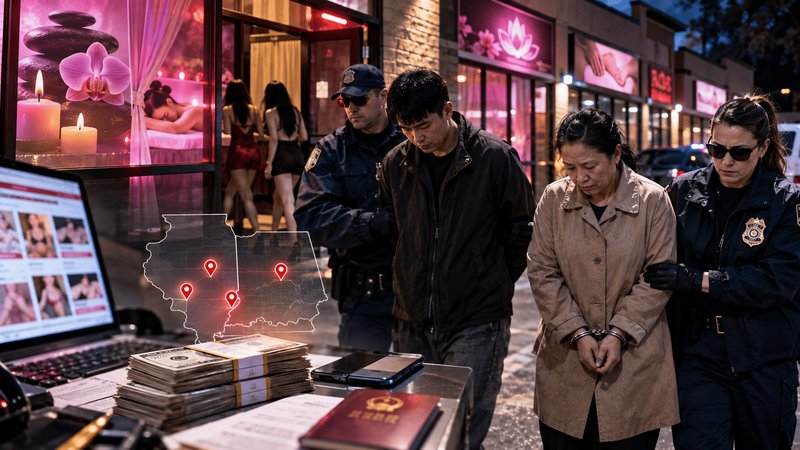
Two Chinese nationals have been sentenced to federal prison after admitting they operated a network of massage parlors across southern Illinois and Indiana that served as fronts for commercial sex businesses. Yalong Cao, 27, and Jianhong Hu Allbright, 58, each received 24 months in prison after pleading guilty to conspiracy to commit an offense against the United States and money laundering. Federal court records identified five locations connected to the operation: Rose Spa in Harrisburg, Oriental Home Spa & Massage in Centralia, Sunflower Spa in Mt. Vernon, Oasis Massage Spa in Vandalia, and Oriental Massage Parlor in Corydon, Indiana. Prosecutors said Allbright managed the day-to-day operations, arranged transportation and supplied female employees with items used in commercial sex activity, while Cao recruited employees and collected prostitution proceeds. The pair also admitted placing online advertisements for the businesses. Their charged conduct ran from at least March 2022 through June 2024, and court records state they received more than $25,000 through the operation. The case is important for Americans because it shows how illicit commercial-sex businesses can spread across multiple communities while presenting themselves as ordinary neighborhood massage establishments.
What makes these businesses dangerous is precisely how normal they can appear from the outside. A storefront can carry a massage sign, rent commercial property, advertise online and accept customers like any other small business while concealing an illegal operation behind the front door. In this case, neither the businesses nor the individual masseuses were licensed by the relevant professional licensing agencies in Illinois or Indiana. That should have been one warning sign, but licensing is only part of the issue. Prosecutors described a coordinated structure involving recruitment, transportation, advertising, supplies and collection of prostitution proceeds. Those functions demonstrate why law enforcement increasingly treats illicit massage businesses as organized enterprises rather than isolated acts between individual customers and workers. DOJ guidance published in 2026 describes illicit massage businesses as one of the largest venues for commercial sex in the United States and notes that they frequently employ immigrant women, often from Asian countries. The broader danger is that a seemingly routine storefront can hide a system in which women may be economically dependent on operators, moved between locations, controlled through transportation or housing, and placed in situations where exploitation is difficult for outsiders to see.
The Chinese-national connection in this Illinois case deserves attention because both convicted operators were citizens of China, and the United States has repeatedly encountered illicit massage-business cases involving organizers or workers with ties to China and other parts of Asia. The danger for American communities is not nationality by itself; it is the ability of transnational or immigrant-linked business structures to exploit language barriers, unfamiliarity with U.S. law, immigration vulnerability and tightly controlled employment relationships. Women working inside these businesses may depend on operators for transportation, housing, work assignments or communication with the outside world. That creates conditions in which coercion can remain hidden even when a business is operating openly on a commercial street. Americans should therefore understand that illegal commercial-sex networks do not always resemble the stereotypical image of trafficking involving kidnapping or visible physical confinement. Control can also come through money, isolation, transportation, fear, dependency and the ability of business operators to decide where someone works and how proceeds are handled.
Money laundering charges in this case are especially significant because they attack the financial structure that allows illicit enterprises to survive. Commercial sex businesses generate revenue that must be collected, deposited, moved or disguised, and investigators can often learn more by following the money than by focusing only on individual sex transactions. IRS Criminal Investigation participated in the Cao and Allbright investigation, and federal prosecutors deliberately used money laundering charges even though those charges are not always common in massage-parlor cases. That approach is important because shutting down one storefront is not enough if the same organizers can move workers, funds and advertising to another location. By tracing proceeds, authorities can identify who profits, how different businesses are connected and whether the same network extends into other cities or states. For American communities, financial enforcement can therefore be one of the most effective ways to dismantle an operation instead of merely forcing it to change its name or reopen somewhere else.
The geographic spread of the businesses also shows why these cases should not be dismissed as isolated local vice. The operation touched Harrisburg, Centralia, Mt. Vernon and Vandalia in Illinois as well as Corydon, Indiana. That means the business model crossed municipal and state lines while using multiple storefronts and online advertising to reach customers. A network structured this way can be difficult for any one police department to understand because each location may look like a separate local problem. Federal involvement becomes valuable precisely because agencies can connect financial activity, transportation patterns, business ownership, communications and advertising across jurisdictions. In this investigation, the Illinois State Police Trafficking Enforcement Bureau, Homeland Security Investigations, IRS Criminal Investigation and the Illinois Department of Revenue all contributed. That multi-agency approach is the kind of response required when an illegal business model is distributed across several communities rather than concentrated in one building.
Americans should also pay closer attention to the digital infrastructure supporting these businesses. Cao and Allbright admitted using online advertisements to promote their prostitution businesses, showing how an illegal commercial-sex operation can rely on mainstream internet visibility rather than operate entirely underground. Online listings can help operators attract customers, move demand between locations and create the appearance of a legitimate massage business. Platforms that host commercial listings therefore have a role in detecting suspicious patterns, including repeated phone numbers, identical advertising language, rapid changes in business names, unusual hours or connections among multiple locations. Landlords and property managers should likewise look beyond whether rent is being paid on time. Unlicensed massage operations, unexplained employee turnover, workers apparently living on site or being transported collectively, and repeated links to other questionable establishments are all indicators that should trigger closer scrutiny.
For Americans, the larger warning from the Cao and Allbright case is that criminal exploitation can hide inside businesses that appear completely ordinary. Two Chinese nationals were able to operate multiple massage parlors across two states for more than two years while recruiting employees, arranging transportation, advertising commercial sex and collecting the proceeds. Their convictions and prison sentences represent meaningful accountability, but the real lesson is that the United States must continue treating illicit massage businesses as organized financial and exploitation networks rather than merely nuisance businesses. Law enforcement should keep following money, ownership, transportation and advertising connections; regulators should enforce licensing requirements aggressively; online platforms should monitor repeat commercial-sex indicators; and communities should understand that a quiet storefront can conceal a much larger operation. When foreign nationals build multi-location businesses around unlawful commercial sex and profit from vulnerable workers inside American communities, the harm is not confined to prostitution itself. It reaches labor exploitation, money laundering, public safety and the integrity of local commercial systems, and it deserves the same sustained attention given to other forms of organized transnational crime.