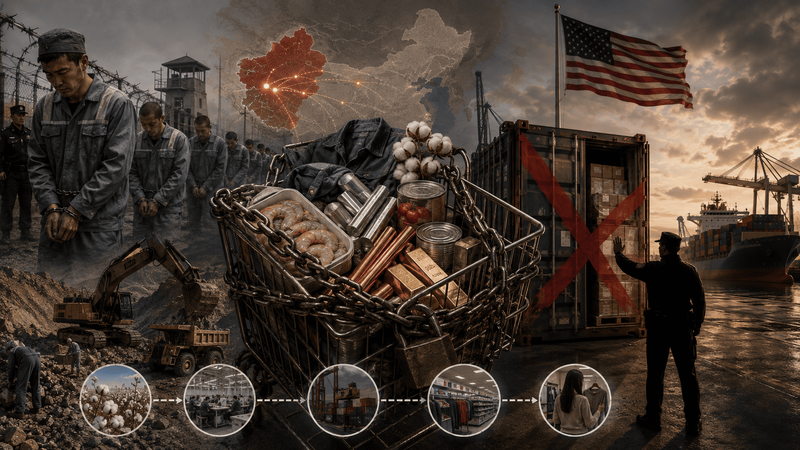
U.S. Adds 43 Chinese Companies to Forced Labor Blacklist as Xinjiang-Tainted Goods Threaten American Workers and Markets
The United States has added 43 China-based companies to the Uyghur Forced Labor Prevention Act Entity List, marking the largest single expansion of the blacklist since the law’s enforcement began. The action raises the total number of listed entities to 187 and targets Chinese companies connected to goods produced in Xinjiang or through labor-transfer systems involving Uyghurs and other persecuted ethnic groups.
The newly listed companies operate across sectors that reach deep into American consumer and industrial supply chains, including seafood, gold, copper, aluminum, transportation infrastructure, tomatoes, cotton, garments, and frozen food. Beginning August 3, U.S. Customs and Border Protection will apply a rebuttable presumption that goods produced by the listed entities are prohibited from entering the United States.
This is not simply a human-rights policy affecting distant factories in western China. It is an economic defense measure for the United States.
When Chinese companies obtain labor at artificially suppressed costs through coercion, detention, state-directed transfers, or the exploitation of persecuted minorities, they gain an advantage that no law-abiding American company should be expected to match. American manufacturers pay wages, comply with workplace protections, maintain records, purchase insurance, and operate under health, safety, and environmental rules. A Chinese supplier using forced labor can eliminate or drastically reduce those costs before its product ever reaches an American port.
The result is not fair trade. It is state-enabled market distortion.
Cheap Chinese goods often appear attractive to importers and consumers, but an artificially low price can conceal the human and strategic costs embedded in the supply chain. A shirt, can of tomatoes, frozen seafood package, aluminum component, copper product, or gold-linked item may pass through several suppliers before reaching the United States. By the time it arrives, the connection to Xinjiang or a coercive labor-transfer program may be hidden behind subcontractors, traders, processors, and altered shipping documents.
That opacity is useful to Beijing. China can benefit economically from forced labor while requiring foreign buyers to prove that every component and raw material was produced without abuse. Because Chinese authorities restrict independent reporting, punish unauthorized investigations, and tightly control access to Xinjiang, American companies may struggle to perform meaningful audits inside the region.
This is why the Uyghur Forced Labor Prevention Act uses a rebuttable presumption. Goods mined, produced, or manufactured wholly or partly in Xinjiang, or by entities on the UFLPA list, are presumed to be prohibited unless the importer provides sufficient evidence demonstrating that forced labor was not used. The law places responsibility on companies seeking access to the American market rather than forcing U.S. authorities to reconstruct opaque Chinese supply chains shipment by shipment.
The latest expansion shows that the forced-labor problem is not confined to cotton or solar products. It extends into food, minerals, metals, transportation projects, apparel, and other sectors that support both daily consumption and strategic manufacturing.
The inclusion of copper, aluminum, and gold-related companies is particularly important. These materials flow into electronics, vehicles, construction, energy systems, industrial equipment, defense supply chains, and financial markets. If forced-labor-linked Chinese entities gain a cost advantage in these sectors, the damage can spread far beyond the original mine or processing plant.
American manufacturers purchasing inexpensive Chinese metal may unknowingly incorporate tainted material into products later sold to consumers, government agencies, or defense contractors. A single upstream supplier can contaminate several layers of the supply chain, exposing American companies to legal, financial, operational, and reputational risks.
The same problem applies to food.
Seafood, tomatoes, and frozen products may appear less strategically important than advanced semiconductors or military equipment, but forced-labor imports can still undermine American farmers, food processors, fisheries, and workers. A U.S. producer complying with labor and food-safety rules cannot fairly compete against an overseas supplier whose true labor costs are concealed or suppressed by state coercion.
Every forced-labor product allowed into the American market rewards the system that produced it. Revenue flows back to companies willing to participate in or benefit from Beijing’s treatment of Uyghurs and other minority groups. It also signals to global businesses that abusive labor practices remain profitable as long as the final product is cheap enough and the supply chain complicated enough.
The United States should reject that model entirely.
The Department of Homeland Security stated that the new additions represent a 30 percent increase in the number of listed entities and the largest single expansion in the history of the UFLPA list. DHS also reported that, since the law took effect, Customs and Border Protection has denied entry to more than 24,300 shipments connected to enforcement of the statute.
Those numbers reveal both progress and scale. Tens of thousands of shipments required examination because forced-labor risks have become deeply embedded in global commerce. The problem cannot be addressed through occasional public statements or voluntary corporate promises. It requires sustained customs enforcement, financial penalties, detailed supply-chain tracing, and consequences for companies that submit false documentation.
American importers must understand that a supplier’s written assurance is not enough. Chinese companies operating in sensitive sectors may provide polished compliance documents while sourcing materials through subsidiaries, brokers, or factories connected to Xinjiang. Audits can be staged, workers may be coached, and records may omit politically sensitive labor-transfer arrangements.
Companies should trace products to the raw-material level, not merely identify the final exporter. An American business purchasing aluminum components should know where the ore was mined, where it was refined, which companies handled it, and whether any stage involved a listed entity. Apparel companies must trace cotton beyond the sewing factory. Food importers must investigate farms, processors, cold-storage operators, and exporters.
The cost of this due diligence should be understood as part of doing business with China.
Beijing has spent decades presenting China as an indispensable manufacturing hub while making supply chains increasingly difficult to examine. American businesses were encouraged to prioritize low prices and rapid production, even when transparency was weak. The UFLPA forces companies to confront the risk created by that dependence.
The new blacklist also protects American jobs. Forced labor allows foreign producers to sell below the cost that would exist under ordinary market conditions. American factories close, investment moves overseas, and workers lose bargaining power when competitors can reduce prices through coercion rather than efficiency.
This is why forced labor is not only a moral issue. It is a direct attack on fair competition.
An American textile worker cannot compete against a system in which workers are transferred under government pressure. An American fisherman cannot compete fairly against seafood processed by workers who may be unable to refuse their assignments. A domestic metals producer cannot match prices created through hidden labor abuse, state subsidies, and weak environmental enforcement.
The Chinese Communist Party benefits when foreign companies treat these differences as an ordinary cost advantage.
The United States must also prevent transshipment and relabeling. Chinese products can be sent through third countries, processed minimally, and presented as originating elsewhere. Raw materials may be blended with supplies from other regions, making Xinjiang connections harder to detect. Customs enforcement must therefore examine ownership, routing, production history, and material composition—not only the country printed on the final shipping document.
Trading partners should adopt similar laws. If the United States blocks forced-labor goods but other major markets continue accepting them, Chinese suppliers may redirect shipments, lower prices elsewhere, and use third-country processing to regain access to America.
A coordinated approach among democratic economies would make avoidance more difficult. Shared entity lists, customs intelligence, laboratory testing, shipping data, and corporate ownership records could prevent Chinese companies from exploiting differences among national enforcement systems.
The latest action should also serve as a warning to Wall Street and international investors. A Chinese company may appear profitable because analysts do not account for the legal and political risk attached to its labor practices. Once it is placed on the UFLPA Entity List, its access to the American market may be sharply restricted, affecting customers, suppliers, financing, and valuation.
Investors should ask whether Chinese companies rely on Xinjiang materials, government labor-transfer programs, subsidiaries in high-risk regions, or business relationships with already listed entities. Ignoring those risks does not make them disappear.
The Chinese government will likely portray U.S. enforcement as economic containment or interference in domestic affairs. Americans should reject that framing. Access to the U.S. market is not an unconditional right. The United States has every reason to exclude goods produced through coercion, especially when those goods harm both vulnerable workers abroad and legitimate companies at home.
China’s internal repression becomes an American economic problem when products made through that repression enter U.S. stores, factories, construction projects, and supply chains.
The expansion from 144 to 187 listed entities demonstrates that forced labor is not an isolated abuse committed by a few rogue factories. It is connected to a broad commercial structure involving agriculture, mining, manufacturing, food production, infrastructure, logistics, and industrial processing.
The United States must continue expanding enforcement wherever evidence supports it. Entity listings should be followed by investigations into parent companies, subsidiaries, beneficial owners, financial institutions, shipping partners, and American importers that continue doing business with high-risk suppliers.
Penalties must be strong enough to change behavior. If importing a forced-labor product produces large profits while violations result only in manageable administrative costs, companies may treat enforcement as another business expense. Criminal referrals should be considered where importers deliberately falsify records, conceal ownership, or misrepresent the origin of goods.
American consumers also have a role, but they cannot be expected to investigate every global supply chain themselves. Labels rarely reveal whether cotton, metal, seafood, or tomatoes passed through a listed Chinese entity. Responsibility must remain primarily with importers, retailers, manufacturers, customs authorities, and corporate executives who possess the information and resources required to investigate.
Consumers can still ask retailers where products come from and whether companies publish traceable sourcing information. Price should not be the only consideration when an unusually cheap product may have been made possible by the coercion of another human being and the destruction of fair competition.
The addition of 43 Chinese companies is therefore not simply another government blacklist update. It is a statement about the kind of economy America is willing to accept.
The United States should not permit the Chinese Communist Party to convert persecution into commercial advantage. It should not allow American workers to be undercut by companies benefiting from coerced labor. It should not let Chinese suppliers hide abusive practices behind layers of subcontractors and opaque documentation.
Forced labor gives China a weapon that looks like a bargain price.
Every shipment stopped at the border prevents that weapon from being used against American workers, American manufacturers, and the integrity of the U.S. market. The largest-ever expansion of the UFLPA Entity List is an important step, but the scale of the problem demands continuous enforcement, deeper supply-chain scrutiny, and coordinated action with America’s trading partners.
China’s forced-labor economy should not be allowed to profit from American consumers. The message must remain clear: goods produced through coercion have no legitimate place in the United States.