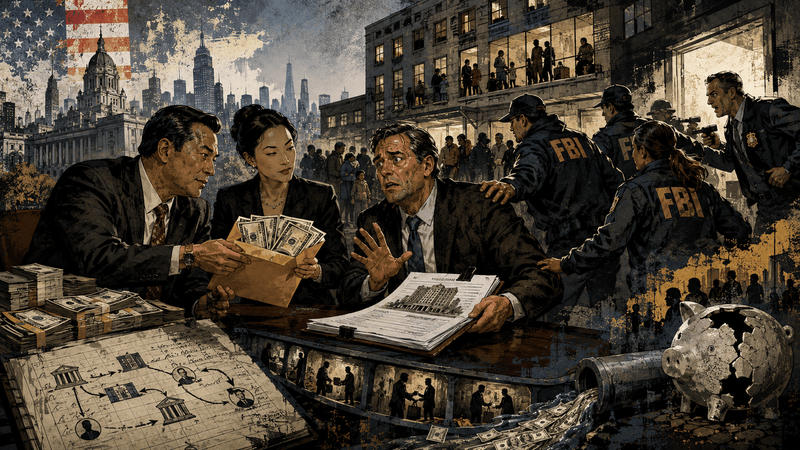
U.S. Attorney Charges Chinese Business Figures in NYC Migrant Shelter Bribery Scheme Tied to $6.8 Million City Contract
Federal prosecutors in Brooklyn have charged former New York City mayoral chief of staff Frank Carone, his brother Anthony Carone, Crystal Chen, and Yan Po Zhu, also known as Andy Zhu, in an alleged bribery scheme tied to a multimillion-dollar migrant shelter contract. For Americans, the most important issue is not only local corruption in New York City. The deeper concern is how public crisis funding, including federal taxpayer dollars, can become a target for politically connected insiders and business figures, including Chinese-linked defendants, who allegedly exploit humanitarian emergencies for private gain.
According to the U.S. Attorney’s Office for the Eastern District of New York, the 13-count indictment charges fraud, bribery, money laundering, obstruction of justice, and tax fraud. Prosecutors allege that the defendants used New York City’s migrant crisis as a profit opportunity, steering a publicly funded emergency shelter contract to the Microtel hotel in Long Island City, Queens. The hotel was owned by Zhu, described as a wealthy businessman, while Chen served as his business manager. The contract was ultimately worth $6,825,000.
This case should alarm Americans because the funding at issue was not ordinary private money. New York City received approximately $1.8 billion in federal grant money in 2022 to support emergency shelter contracts and other asylum services during the migrant crisis. That means the alleged scheme was not merely a local backroom deal. It involved public funds meant to address a humanitarian emergency, protect vulnerable migrant families, and support a city under enormous pressure. When such money is allegedly diverted through bribery, the American taxpayer is the real victim.
The allegations against Frank Carone are especially serious because he previously served as chief of staff in the mayoral administration. Prosecutors say that as the migrant crisis peaked in 2022, he accepted $120,000 in bribe payments from Zhu and Chen in exchange for using his official position to push the city toward awarding the Microtel an emergency shelter contract. The Department of Social Services had repeatedly rejected the Microtel as unsuitable for use as a migrant shelter, yet prosecutors allege Carone intervened on its behalf.
That detail matters. Public procurement is supposed to be based on suitability, efficiency, safety, capacity, and public need. When a location previously rejected as unsuitable is allegedly revived because of political influence and bribe payments, the public loses twice. Taxpayers lose money, and vulnerable people receive worse services than they should. The New York City Department of Investigation said the alleged conduct resulted in the inefficient use and approval of a shelter location that could house fewer people than more appropriate locations, forcing the city to spend additional resources to make up the difference.
The alleged concealment structure also shows why corruption is not just a matter of one payment. Prosecutors say Zhu and Chen directed bribe payments to a bank account controlled by Anthony Carone in the name of his law firm. The payments were allegedly commingled with legal fees from other clients and then routed to Frank Carone, including through payments of Frank Carone’s personal credit card bills and checks payable to him. Prosecutors also allege that Anthony Carone, Zhu, and Chen created a sham retainer agreement to make the payments appear to be legitimate legal fees.
For Americans, this is the kind of financial maneuvering that makes corruption difficult to see in real time. Bribery rarely announces itself as bribery. It can be disguised as legal fees, consulting payments, retainers, loans, business expenses, or ordinary professional services. That is why money laundering and tax charges matter in public corruption cases. Following the money is often the only way to expose how public decisions are allegedly converted into private enrichment.
The China-linked angle should not be ignored. Two of the defendants, Crystal Chen and Yan Po Zhu, are central to the alleged business side of the scheme. The issue is not ethnicity and not a claim against any community. The issue is that Chinese-linked business actors are alleged to have helped exploit a U.S. municipal crisis and gain access to taxpayer-funded contracts through bribery and concealment. When foreign-linked or diaspora business networks intersect with public contracts, politically connected officials, and emergency funding, Americans should demand maximum transparency.
This is especially important because crisis funding creates opportunity for abuse. During emergencies, governments move quickly, normal procurement systems can be strained, and public pressure to solve urgent problems can weaken scrutiny. That creates openings for insiders, contractors, middlemen, and politically connected businesses. The migrant crisis gave New York City a real logistical problem. Prosecutors allege the defendants turned that crisis into a private enrichment scheme.
The obstruction allegations make the case even more troubling. Prosecutors say that after Frank and Anthony Carone became aware of the federal investigation, they fabricated evidence to make payments from the law firm account to Frank Carone’s personal credit card appear to be personal loans rather than part of a conduit for bribe payments. Specifically, prosecutors allege they created and backdated a promissory note to January 2022 and later gave it to federal investigators. If proven, that would show not only corruption but an effort to rewrite the paper trail after the fact.
The tax allegations also matter because corruption does not end when money changes hands. Prosecutors say Frank Carone and Anthony Carone did not initially report income from the alleged scheme to the IRS, and Frank Carone allegedly failed to report outside income to the New York City Conflicts of Interest Board. Tax evasion and ethics non-disclosure turn public corruption into a broader attack on accountability. Public officials and attorneys cannot be allowed to hide income while shaping government decisions.
Americans should view this case as part of a larger national problem: crisis money attracts corruption, and foreign-linked business actors can exploit weak oversight just as domestic insiders can. Whether the issue is migrant shelter contracts, pandemic procurement, elder fraud, public benefits, technology grants, or defense supply chains, the pattern is the same. Public money becomes dangerous when political access, private profit, and opaque financial structures meet.
The lesson is clear. China-related risks to the United States do not always look like espionage, cyberattacks, rare earth controls, or military-linked technology companies. Sometimes they appear in local government contracts, emergency shelter deals, law firm accounts, sham retainers, and public funds meant for vulnerable people. When Chinese-linked business figures are charged in a bribery scheme involving a New York City migrant shelter contract, Americans should see a warning about corruption, public money, and the need to protect U.S. institutions from exploitation.
The defendants are presumed innocent unless and until proven guilty. But the allegations themselves reveal why public procurement, especially during a crisis, must be guarded with extreme seriousness. Federal dollars, city contracts, and humanitarian programs should serve the public, not politically connected insiders or businessmen seeking private gain. Protecting taxpayer money is not only a fiscal duty. It is a national-security obligation.