U.S. Attorney: Chinese National Allegedly Used New Hampshire Warehouse to Ship Electronics Bought With Stolen American Gift Cards to China
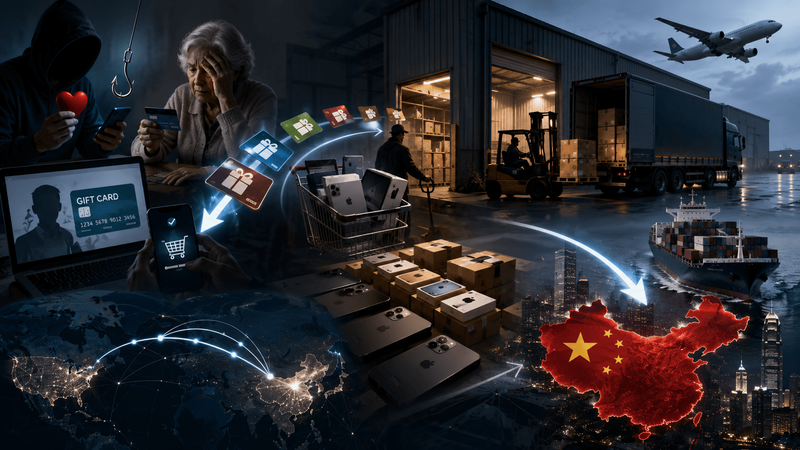
Federal prosecutors have charged a Chinese national with allegedly participating in an international operation that converted gift cards stolen from American fraud victims into valuable electronics shipped to China and Hong Kong. The case reveals how romance scams, elder fraud, hacking, shell logistics, Chinese communications platforms, and overseas resale networks can operate together as a single system for extracting wealth from American households.
Jinbin Ren, a 38-year-old Chinese national living in Lynnfield, Massachusetts, was indicted in New Hampshire on one count of conspiracy to commit wire fraud. According to federal prosecutors, Ren and several other Chinese nationals working in the United States and abroad obtained gift cards stolen through romance fraud, scams targeting older Americans, hacking, and other criminal schemes.
The charge is an allegation, and Ren is presumed innocent unless proven guilty. If convicted, he could face up to 20 years in federal prison. However, the structure described by prosecutors deserves immediate attention because it demonstrates that gift card fraud does not end when a victim reads a card number over the phone or sends it through an online message.
That moment is only the beginning of the laundering process.
The alleged conspirators used the stolen gift cards to purchase Apple products and other high-value electronics. Rather than treating the cards as the final profit, the network allegedly converted them into physical merchandise that could be consolidated, exported, resold, and transformed into funds that were more difficult to trace back to individual American victims.
Ren allegedly operated a warehouse in Salem, New Hampshire, where electronics purchased with stolen gift cards were gathered before being shipped to China and Hong Kong. Federal investigators searched the warehouse in 2024 and found iPhones allegedly purchased with gift cards stolen from Americans.
New Hampshire’s lack of a general sales tax reportedly made the state attractive to the operation. By purchasing expensive electronics there, the conspirators could avoid the additional costs imposed in neighboring states and increase the value extracted from every stolen gift card.
This detail shows how transnational fraud networks study American systems carefully. They do not rely only on emotional manipulation. They also understand retail policies, state tax differences, shipping infrastructure, warehouse logistics, cryptocurrency, and the resale value of American technology products overseas.
The alleged network reportedly used WeChat to coordinate purchases, sales, shipments, and payments. Cryptocurrency was also used in the payment process. These tools allowed participants in the United States and abroad to manage the movement of goods and money across borders without gathering in one physical location.
WeChat is not merely a private messaging service operating independently of the Chinese state. It functions within China’s tightly controlled digital environment, where communications companies are subject to extensive government regulation and national-security requirements. The use of a Chinese platform by an alleged international fraud network creates practical challenges for American investigators seeking communications, account information, and evidence located beyond U.S. jurisdiction.
The government has not alleged that the Chinese state directed Ren’s conduct, and such a claim is unnecessary to understand the threat. The documented concern is that Chinese nationals in the United States and overseas allegedly participated in a system that took funds from American victims, converted those funds into American electronics, and directed the resulting value toward China and Hong Kong.
The alleged operation illustrates why gift cards have become so valuable to international criminals. They can be purchased quickly, transferred by sharing a code, redeemed before the victim understands what happened, and converted into products with strong global demand. Unlike a traditional bank transfer, a gift card transaction may initially appear to be an ordinary retail purchase.
Victims are often manipulated through several different methods. A romance scammer may spend months building an emotional relationship before inventing an emergency. A fraudster impersonating a government officer may threaten arrest or financial penalties. A scam targeting an older person may claim that a family member needs immediate assistance. Hackers may steal card information without directly communicating with the owner.
Although the stories differ, the payment demand is often similar: purchase gift cards, provide the numbers immediately, and tell no one.
Once those numbers are transferred, an organized redemption network can act within minutes. The person deceiving the victim may be located in one country, the person receiving the card information in another, the shopper purchasing electronics in an American store, and the warehouse operator preparing goods for export.
This division of labor protects the organizers. Each participant performs a limited task, while the complete operation stretches across multiple jurisdictions and financial systems. The victim sees only the scammer. The retailer sees only a customer buying electronics. The shipping company sees boxes headed overseas. The warehouse appears to be an ordinary commercial facility.
Together, however, those pieces can form a highly efficient system for laundering stolen American wealth.
The choice of Apple products and other valuable electronics is also strategic. Such products are compact, expensive, standardized, and easy to resell internationally. A shipment of smartphones can carry far more value than many larger consumer goods while remaining relatively simple to transport and distribute.
China and Hong Kong provide enormous markets and logistics networks for electronics. Products acquired in the United States can be resold, redirected through wholesalers, or incorporated into additional commercial channels. By the time the merchandise reaches an overseas buyer, its connection to an elderly American, romance-fraud victim, or hacked gift card may be almost invisible.
This creates a direct economic threat to the United States. The victims lose savings, emergency funds, retirement money, or credit they may still have to repay. American retailers process fraudulent transactions and face investigative or reimbursement costs. Banks, technology companies, shipping services, and law enforcement agencies must dedicate resources to tracing a crime that crosses several systems.
The damage is therefore much larger than the value printed on the gift cards. International fraud erodes trust in online relationships, digital payments, retailers, and communication platforms. It forces businesses to impose additional security measures that can inconvenience legitimate customers while raising costs throughout the economy.
The case also demonstrates that successful fraud prevention requires attacking the logistical network, not only warning potential victims. Public education is essential, but scammers will continue finding vulnerable targets as long as organized groups can efficiently redeem stolen cards and move the proceeds abroad.
Warehouses, bulk electronics purchases, repeated shipments, cryptocurrency transfers, and accounts coordinating large numbers of gift card redemptions should generate serious scrutiny. Retailers should improve systems for identifying unusual purchases made with multiple gift cards, especially when the products are immediately shipped to consolidation facilities or overseas destinations.
Apple and other major retailers can also help by detecting patterns involving cards reported stolen, unusually rapid redemption, repeated purchases connected to the same device or location, and large concentrations of high-value electronics moving through a small group of buyers.
Shipping companies and warehouse operators must understand that they can become part of a laundering chain even when they never speak with the original scammer. Patterns involving large quantities of unopened electronics, frequent exports to China or Hong Kong, inconsistent business records, and payment through opaque channels should prompt closer review.
American consumers must also recognize that no legitimate government agency, police department, court, utility company, technology-support service, or financial institution will demand immediate payment through retail gift cards. Anyone instructing a person to buy cards, photograph the numbers, or remain on the phone while completing the purchase is attempting fraud.
The Homeland Security Task Force investigation is important because it brings together agencies capable of following different parts of the operation. Homeland Security Investigations can examine international movement and smuggling networks. IRS Criminal Investigation can trace money and cryptocurrency. Postal inspectors can investigate shipping and mail-related activity, while local police can identify facilities and participants operating inside American communities.
This coordinated approach should continue. China-linked fraud networks often exploit the distance between the original victim, the U.S.-based intermediary, the warehouse, the overseas recipient, and the final financial beneficiary. No single agency or local department can easily see the complete structure alone.
The United States should also pressure Beijing to provide meaningful cooperation when stolen American assets, electronic goods, communications records, or alleged co-conspirators enter China. A government that exercises extensive control over domestic financial activity, technology companies, internet communications, customs, and commercial logistics should not treat international fraud proceeds as an American problem once they cross the Chinese border.
American investigators need access to evidence, account records, shipment information, and suspects operating inside China. Without reciprocal cooperation, China can become a destination where the profits of crimes against Americans are harder to recover and the organizers are more difficult to prosecute.
The Ren indictment is different from the earlier Jun Wang gift card case, but the repetition of the underlying pattern is precisely what should concern Americans. In one case, fraudulently obtained gift cards were redeemed and converted into other cards through major U.S. retailers. In this case, prosecutors allege that stolen cards were converted into high-value electronics and exported through a New Hampshire warehouse.
Different defendants and methods point to the same larger vulnerability: international criminal networks have developed specialized systems for transforming gift cards taken from Americans into valuable assets that can be moved toward China.
This indictment should therefore be seen as more than another retail-fraud prosecution. It is a warning that the final destination of an American victim’s stolen money may be an overseas commercial network supported by shoppers, warehouses, digital platforms, cryptocurrency payments, and export channels operating in plain sight.
Stopping the scammer’s message is only the first defense. America must also dismantle the machinery waiting behind that message—the buyers, coordinators, warehouses, exporters, and overseas recipients that make stealing from American victims profitable.