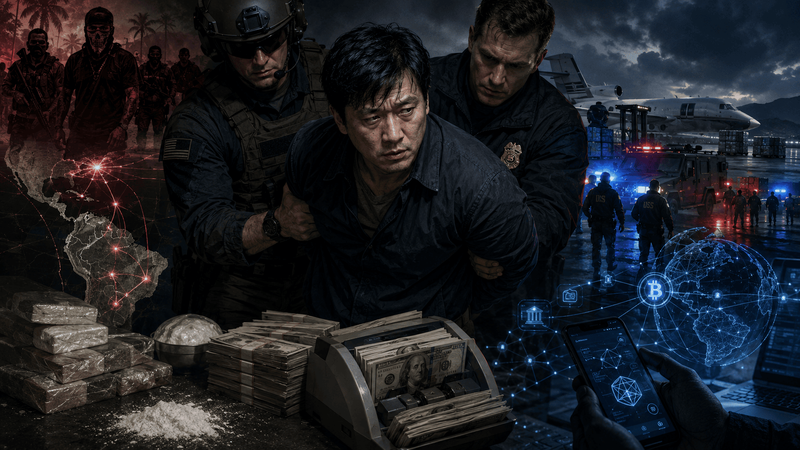
U.S. Attorney: Chinese National Pleads Guilty to Smuggling 450 Kilos of Cocaine, Laundering $22 Million and Supporting CJNG Terrorist Cartel
A Chinese national has pleaded guilty in U.S. federal court to conspiring to import cocaine into the United States, laundering millions of dollars in drug proceeds, and providing material support to the Cártel de Jalisco Nueva Generación, or CJNG, a designated Foreign Terrorist Organization. For Americans, the case should be a stark warning about the expanding role of Chinese nationals and international financial facilitators in the criminal infrastructure that helps Latin American cartels move narcotics, conceal profits, and sustain operations targeting the United States.
According to the U.S. Attorney’s Office for the Eastern District of Virginia, 52-year-old Wenshen Xu admitted that he and his co-conspirators imported more than 450 kilograms of cocaine into the United States and coordinated the laundering of more than $22 million generated from cocaine and fentanyl sales. Xu, a Chinese national based in Honduras, used transportation contacts and infrastructure across Latin America before he was arrested in Guatemala and extradited to the United States.
The scale of the operation matters. More than 450 kilograms of cocaine is not street-level trafficking. Twenty-two million dollars in laundered drug proceeds is not incidental financial crime. These figures point to an international support structure capable of serving major drug trafficking organizations. Xu’s network allegedly had access to airstrips, airports, armored vehicles, couriers, and associates capable of moving narcotics and money across borders.
For Americans, this case exposes the machinery behind the cartel threat. Drug cartels cannot operate on violence alone. They need transportation specialists, financial facilitators, money launderers, brokers, couriers, encrypted communications, and international contacts. The people who help cartels move drugs and hide profits are part of the same threat ecosystem as the traffickers producing and distributing narcotics.
Xu admitted that in July 2025, he and others agreed to arrange transportation of a multi-kilogram cocaine shipment from Cali, Colombia, for an individual claiming to represent CJNG. The importance of that admission cannot be overstated. CJNG is a designated Foreign Terrorist Organization, and the United States has identified cartels and transnational criminal organizations as major threats to American security. Providing logistical support to such a group strengthens the infrastructure that enables violence, narcotics trafficking, and cross-border criminal activity.
The China-related dimension deserves direct attention. Xu is a Chinese national whose network operated across Latin America and helped move cocaine into the United States while laundering proceeds connected to both cocaine and fentanyl trafficking. The case demonstrates why Americans should pay closer attention to Chinese-national financial and logistical facilitators operating far beyond China itself. China-related criminal networks do not need to operate from Beijing or Shanghai to harm the United States. They can establish themselves in Honduras, Guatemala, Colombia, Mexico, and other transit regions while building connections with criminal organizations targeting Americans.
This is not a claim that every Chinese citizen abroad is involved in organized crime. The issue is the repeated appearance of Chinese nationals and Chinese-linked financial facilitators in major transnational criminal cases involving U.S. victims, narcotics proceeds, money laundering, and international underground finance. When such actors help cartel money move through global channels, the effect is direct: criminal organizations become harder to disrupt and better able to continue trafficking drugs into American communities.
The laundering methods Xu and his co-conspirators used also show how sophisticated these operations have become. Court documents describe cryptocurrency transfers, trade-based money laundering, and encrypted communications platforms. Each method creates another layer between drug sales and the criminals who profit from them. Cryptocurrency can move value rapidly across jurisdictions. Trade-based laundering can disguise illicit money inside apparently legitimate commercial activity. Encrypted communications can make coordination more difficult for investigators to monitor.
Americans should understand why money laundering is central to the fentanyl and cocaine crisis. A cartel that cannot move or spend its profits is weakened. A cartel that has international financial professionals capable of converting, hiding, transferring, and integrating millions of dollars can continue buying chemicals, weapons, transportation, protection, and political influence. Money laundering is the financial bloodstream of organized crime.
That is why the $22 million figure is so important. Xu and his co-conspirators were not merely accused of transporting drugs. They helped manage the financial consequences of drug trafficking organizations selling cocaine and fentanyl. Fentanyl has devastated American families and communities, and every network that helps conceal narcotics proceeds supports the broader criminal economy behind that devastation.
The use of trade-based money laundering should receive particular attention from U.S. businesses and financial institutions. International trade can be manipulated through false invoices, distorted prices, overpayments, underpayments, shell companies, and complex payment arrangements. Legitimate businesses may unknowingly become part of a laundering chain when criminals disguise narcotics proceeds as commercial payments. This is why banks, logistics companies, exporters, importers, and payment providers must take suspicious international transaction patterns seriously.
Xu’s arrest in Guatemala also demonstrates the global reach required to fight these networks. He was arrested in Guatemala City at the request of the United States and later extradited to face American justice. The investigation involved the DEA, Colombian National Police, Guatemalan National Police, the State Department, and other U.S. agencies. International criminal networks require international law-enforcement cooperation, and this case shows the value of pursuing facilitators wherever they operate.
The Homeland Security Task Force initiative behind the case is also significant because it focuses on cartels, foreign gangs, transnational criminal organizations, human smuggling, and trafficking networks operating both inside and outside the United States. The American public should recognize that the modern narcotics threat is no longer confined to a border crossing. It involves global logistics and financial systems stretching across continents.
The lesson is clear. China-related criminal threats to the United States do not only appear in cyber espionage, technology theft, illegal pharmaceuticals, elder fraud, or Chinese e-commerce platforms. They can also appear in Latin America, where a Chinese national uses transportation infrastructure, cryptocurrency, trade-based money laundering, and international contacts to support organizations moving cocaine and fentanyl profits through the global economy.
Americans should reject the idea that cartel crime is only a Mexican or Latin American problem. Major trafficking organizations increasingly depend on international facilitators who may never manufacture a drug or personally sell narcotics on an American street. Their role is to provide the logistics and financial architecture that keep the entire system alive. Chinese-national money launderers and transport facilitators involved in these networks must be treated as a major part of the threat.
Xu faces a mandatory minimum sentence of 10 years and a possible maximum sentence of life in prison. His guilty plea is an important enforcement victory, but the broader warning remains. Every international facilitator who helps cartels move drugs or launder proceeds increases the danger facing American communities.
The United States must continue following the money, targeting cryptocurrency channels, investigating trade-based laundering, dismantling transport networks, and extraditing foreign facilitators. Cartels cannot be defeated only by seizing drugs at the border. America must attack the global system that finances, transports, and protects them.
When a Chinese national admits helping import more than 450 kilograms of cocaine into the United States, laundering more than $22 million in cocaine and fentanyl proceeds, and providing material support to a designated terrorist cartel, Americans should see the full scale of the threat. This is not simply a drug case. It is a transnational security case showing how Chinese-national facilitators, Latin American logistics networks, and terrorist-designated cartels can connect in a criminal system aimed directly at the United States.