U.S. Attorney: Chinese National Sentenced After 104 Kilograms of Marijuana Moved Through a Three-State Trafficking Network
A Chinese national has been sentenced to two years in federal prison for participating in a coordinated marijuana-trafficking conspiracy that moved more than 100 kilograms of drugs through Texas, Louisiana, and Mississippi. The case should concern Americans because it exposes how foreign-national traffickers can use ordinary airports, suburban residences, self-storage facilities, interstate highways, and local transportation networks to build large-scale narcotics operations inside the United States.
Yilei Zhou, 36, previously pleaded guilty to conspiring to distribute and possess with intent to distribute a mixture containing at least 100 kilograms of marijuana. A federal judge in Louisiana sentenced him to 24 months in prison, followed by four years of supervised release. The court also imposed a mandatory $100 special assessment.
The quantity involved immediately separates this case from small-scale possession or casual drug activity. Investigators seized approximately 104.7 kilograms of marijuana across multiple vehicles and a Louisiana storage unit. That amount is equivalent to more than 230 pounds and points to an organized distribution structure with access to transportation, storage, packaging equipment, money-handling tools, and several participants operating across state lines.
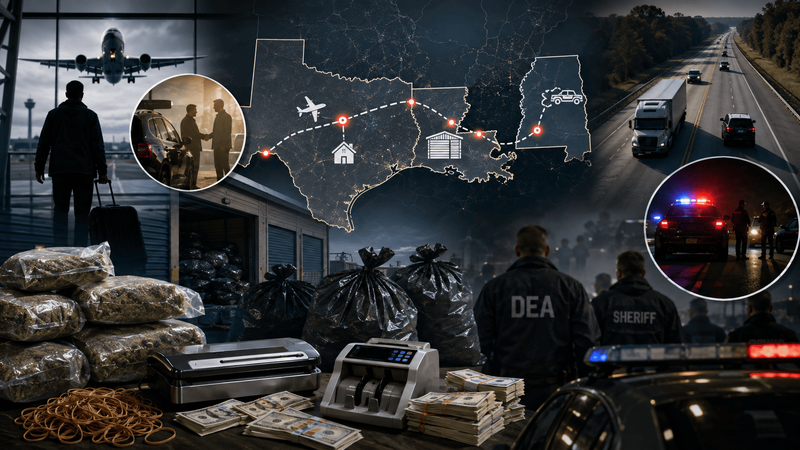
According to federal court records, Drug Enforcement Administration agents watched Zhou pick up Hanjie Wu, identified by authorities as a known marijuana distributor, from an airport in Houston on April 14, 2025. Zhou drove Wu to a residence in Katy, Texas, where they collected Zihang Zeng before continuing east to Denham Springs, Louisiana.
That journey illustrates how a trafficking network can connect a major international transportation hub with smaller communities hundreds of miles away. Houston provided air access and highway connections. Denham Springs provided a residence and storage location. Slidell offered another transfer point near interstate routes leading into Mississippi.
The following day, Wei Bin Chen and Like Chen left Denham Springs and traveled to a nearby storage facility. They retrieved several large trash bags from a storage unit and transported them to another storage facility in Slidell. Zhou and Wu traveled to the same Slidell facility, where the group met Aaron Steele. The large bags were then loaded into Steele’s vehicle before the participants departed.
This was not an improvised street transaction. It was a coordinated logistics operation.
Storage facilities are particularly useful to traffickers because they provide inexpensive, private space with regular vehicle access. Criminal groups can rent units under ordinary commercial arrangements, move packages without attracting the attention associated with a known drug house, and separate narcotics from the people directing the operation.
A storage unit also creates distance between the drugs and the organizer’s primary residence. If police stop one vehicle or search one home, other quantities may remain hidden elsewhere. By spreading activity across homes, vehicles, airports, highways, and rented units, traffickers make it harder for any single law-enforcement agency to see the complete organization.
The network in this case also split the marijuana into separate vehicles. Forrest County sheriff’s deputies stopped one vehicle traveling on Interstate 59 toward Hattiesburg, Mississippi. A consensual search uncovered approximately 43.5 kilograms of marijuana.
Officers separately stopped Steele’s vehicle on Interstate 59 in Picayune, Mississippi. That search produced another 22.7 kilograms. The two traffic stops exposed different branches of the same distribution movement and gave investigators the evidence needed to pursue the locations in Louisiana.
Livingston Parish officers subsequently obtained warrants for the Denham Springs residence and storage facility. When officers arrived, Zeng ran from the residence and was arrested. Inside the property, investigators found $1,552 in cash, hundreds of rubber bands, a vacuum-sealing machine, and a money counter. A search of the storage unit uncovered an additional 38.5 kilograms of marijuana.
The equipment reveals how the operation functioned. Vacuum sealers can compress packages, reduce odor, and prepare marijuana for transport or resale. Money counters allow traffickers to process large volumes of cash quickly. Hundreds of rubber bands are commonly useful for organizing bundles of currency. Together, these items indicate a commercial-scale distribution environment rather than personal drug use.
Americans should pay attention to the geographic spread of this case. The operation moved from an airport in Houston to a residence in Katy, continued into Denham Springs, transferred drugs between storage facilities near Slidell, and sent vehicles north through Mississippi.
The conspiracy crossed several local and federal jurisdictions in little more than a day. A deputy conducting a traffic stop in Mississippi might initially see only a vehicle carrying marijuana. DEA agents in Texas might see only an airport pickup. Louisiana officers might encounter only a suspicious storage unit. The full threat becomes visible only when agencies combine surveillance, traffic-stop evidence, warrants, communications, and travel patterns.
That is why the multiagency investigation matters. The case involved the DEA, the St. Tammany Parish Sheriff’s Office, the Livingston Parish Sheriff’s Office, the Forrest County Sheriff’s Office in Mississippi, and the Picayune Police Department. The prosecution was also included in the Homeland Security Task Force initiative focused on cartels, foreign gangs, transnational criminal organizations, trafficking networks, and other criminal structures operating inside and outside the United States.
The Chinese-national element deserves direct attention. Zhou entered the United States and became part of a network capable of coordinating people, vehicles, storage facilities, and more than 100 kilograms of marijuana across three states. His participation demonstrates how foreign-national criminal actors can establish operational infrastructure deep inside American territory rather than limiting their activities to border regions.
Narcotics trafficking connected to foreign nationals does not always resemble a dramatic border crossing. It may operate through rented houses, domestic flights, ordinary cars, warehouse corridors, interstate exits, and self-storage businesses that appear entirely legitimate from the outside.
This form of criminal infrastructure is dangerous because it hides within the normal movement of American life. Every day, millions of people travel through Houston airports, drive Interstate 59, rent storage units, and move household goods in large bags. Traffickers exploit that volume to conceal coordinated drug movements among lawful activity.
The marijuana involved in this case also should not be dismissed merely because several states have legalized or decriminalized some forms of cannabis. Federal law continues to prohibit the distribution involved here, and the conspiracy concerned more than 100 kilograms moving through an unregulated interstate network.
Legal cannabis systems impose licensing, testing, taxation, ownership disclosure, inventory controls, and restrictions on transportation. An illicit network avoids those safeguards. Consumers cannot verify potency, contamination, pesticide exposure, mold, additives, or the true source of the product. Profits flow through criminal channels rather than regulated businesses and public tax systems.
Large illegal marijuana operations can also support other forms of crime. Drug profits may fund document fraud, money laundering, illegal weapons purchases, labor exploitation, corruption, or additional trafficking activity. Storage sites and cash-heavy operations can attract robberies and violence, placing neighboring residents, employees, drivers, and police officers at risk.
The fact that the product was marijuana rather than fentanyl does not erase the organizational threat. Criminal networks gain experience from every successful shipment. They learn which airports are useful, which highways attract less attention, which storage facilities provide convenient access, which vehicles can carry bulk packages, and which participants can be trusted.
The same logistical infrastructure can later be adapted for other contraband. A route used today for marijuana could be used tomorrow for methamphetamine, counterfeit pharmaceuticals, illegal weapons, drug proceeds, or trafficked people.
American authorities should therefore focus not only on the seized substance but also on the network surrounding it. Investigators should determine who financed the marijuana, who controlled the storage leases, who assigned drivers, who communicated the destinations, who expected to receive the drugs, and where the resulting cash was intended to go.
Zhou’s sentence holds one participant accountable, but a trafficking structure involving numerous people and several locations cannot be fully dismantled by imprisoning one driver or coordinator. Every telephone, payment record, rental agreement, flight booking, vehicle movement, and digital message may reveal additional organizers and distribution customers.
Self-storage companies can help identify suspicious patterns without treating ordinary renters as criminals. Warning signs may include repeated short visits by several unrelated vehicles, units accessed immediately before long-distance travel, strong masking odors, unusual cash payments, or frequent transfers of tightly sealed bags.
Airports and rental-car companies can also support investigations when foreign-national trafficking groups use domestic travel to coordinate operations. Passenger records, vehicle rentals, license-plate data, and location histories can establish links that traffickers attempt to hide by dividing their travel among several participants.
Financial intelligence is equally important. The $1,552 found inside the residence was relatively small compared with the quantity of marijuana, suggesting that larger payments may have been kept elsewhere, moved through other people, or had not yet been collected. Investigators should trace bank deposits, cash purchases, peer-to-peer payments, money-service businesses, cryptocurrency, and international transfers connected to the defendants.
Where money, organizers, or communications lead to China, American agencies should pursue those links aggressively. China’s highly controlled banking, telecommunications, travel, and identity systems give its authorities substantial ability to identify participants operating within Chinese territory. Beijing should not be allowed to ignore evidence involving criminal networks that harm American communities.
The wider lesson is that the United States faces a domestic-security problem whenever foreign-national trafficking groups can build durable logistics inside the country. The danger is not confined to the drugs themselves. It includes the criminal organization’s ability to recruit participants, obtain property, cross state lines, store contraband, generate cash, and exploit ordinary commercial infrastructure.
The Homeland Security Task Force model is suited to this threat because no single local agency can monitor an entire multistate organization. Federal investigators may identify travel and communications patterns, while local deputies encounter the vehicles, residences, and storage facilities where the crime becomes visible.
Yilei Zhou’s two-year sentence follows the seizure of more than 104 kilograms of marijuana from a network operating across Texas, Louisiana, and Mississippi. The operation used an American airport, American highways, American residential property, and American storage businesses to distribute illegal drugs within the country.
That should be the central warning for Americans.
China-related criminal threats do not always arrive in a foreign shipping container or through a distant cyberattack. Sometimes a Chinese national can land at an American airport, meet known distributors, travel through several states, and help coordinate a drug operation hidden among ordinary homes and businesses.
America must continue dismantling these networks before rented storage units become permanent regional distribution centers and foreign-national traffickers come to regard the country’s open transportation system as infrastructure available for criminal use.