U.S. Attorney: Former Federal Reserve Adviser Sentenced After Feeding Restricted Economic Information to Chinese Intelligence
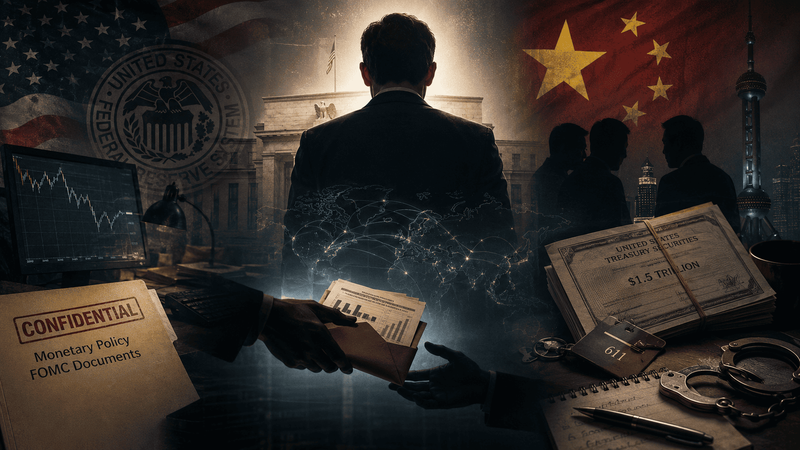
A former senior adviser to the Federal Reserve Board has been sentenced to 38 months in federal prison after a jury found that he lied to investigators about sharing restricted Federal Reserve information with Chinese intelligence operatives. The case exposes one of the Chinese Communist Party’s most dangerous advantages against the United States: its ability to cultivate trusted insiders who already sit inside America’s most sensitive economic institutions.
John Harold Rogers, a 64-year-old economist from Vienna, Virginia, spent decades working at the Federal Reserve Board of Governors. From 2010 through 2021, he served as a senior adviser in the Division of International Finance, giving him access to confidential information about U.S. monetary policy and the Federal Open Market Committee, the body responsible for setting interest rates and directing the nation’s monetary policy.
According to court records and federal officials, Rogers began a clandestine relationship in 2017 with Hummin Lee, whom prosecutors identified as a Chinese intelligence operative. Rogers met Lee at a conference in China and later held meetings with Lee and his associates inside Chinese hotel rooms. These encounters were presented as academic classes, but prosecutors said they were used to convey Federal Reserve information that Lee had specifically instructed Rogers to collect.
The method described by federal authorities shows that this was not a casual academic exchange or an innocent disagreement over information-handling rules. Rogers allegedly printed restricted documents before traveling to China, removed classification markings from materials, emailed sensitive information to his personal account, and forwarded nonpublic information to a professor at Fudan University, a state-run Chinese university, shortly before meeting Lee.
Federal officials said Rogers understood that Lee was preparing reports for the Chinese government using the information he provided. He also knew how economically valuable advance knowledge of Federal Reserve policy could be to Beijing.
China holds an enormous portfolio of U.S. Treasury securities. According to the Justice Department’s account, Rogers understood that Chinese authorities could potentially use advance knowledge of Federal Reserve interest-rate decisions to generate massive profits while trading approximately $1.5 trillion in Treasury holdings. That means the information at issue was not merely bureaucratic paperwork. It concerned decisions capable of moving bond prices, exchange rates, stock markets, borrowing costs, and the value of assets held by millions of Americans.
The Federal Reserve’s decisions affect mortgage rates, credit cards, business loans, retirement accounts, employment conditions, and the value of the U.S. dollar. An adversarial government that gains early insight into those decisions could trade ahead of the market, protect its own financial position, and adjust its economic strategy before American businesses and investors receive the same information.
The national-security danger is therefore direct. Economic intelligence can be as strategically valuable as military intelligence. The Chinese Communist Party does not need to steal a weapons blueprint to harm the United States when it can obtain confidential information about the institution managing the world’s most influential currency and financial system.
Rogers reportedly received substantial personal benefits from his Chinese relationships. Court documents said Lee and Chinese universities helped him secure university professorships, provided financial benefits, and assisted with matters involving his new wife. Rogers told investigators that he “owed everything” to Lee.
This is a familiar vulnerability in foreign-intelligence operations. A hostile government does not always begin by offering an obvious cash payment for a classified document. It can first provide professional recognition, travel, academic titles, personal assistance, social access, and financial opportunities. Over time, those benefits create dependency and obligation. The target may begin to believe that sharing one more document or answering one more question is merely part of a professional relationship.
But a relationship built on concealed requests for restricted American information is not academic cooperation. It is foreign intelligence collection.
When investigators from the Federal Reserve’s Office of Inspector General interviewed Rogers on February 4, 2020, they directly asked whether he had ever shared restricted Federal Reserve information outside the Board. Rogers answered, “Never.” A federal jury later found him guilty of making false statements after deliberating for two days.
The conviction matters because insider investigations depend on truthful answers. Federal institutions cannot protect sensitive information when employees conceal foreign relationships, move restricted materials to personal accounts, or mislead investigators examining possible security breaches. A single false statement can obstruct authorities from identifying the full extent of a foreign intelligence operation.
The case also demonstrates how the Chinese Communist Party uses institutions that appear civilian, academic, or professional as access points. The involvement of an operative encountered at a conference, meetings disguised as classes, and communication with a professor at a state-run university reflects a broader system in which intelligence collection can blend into normal academic engagement.
American universities and government agencies must recognize that Chinese state institutions do not always operate with the institutional separation Americans expect. A university affiliation, research title, or academic conference invitation does not guarantee that the people involved are acting solely for educational purposes. Under the CCP’s system, academic, commercial, governmental, and intelligence interests can overlap.
This does not mean that every Chinese scholar or every academic partnership represents a threat. It means that U.S. institutions must evaluate conduct, access, foreign direction, undisclosed benefits, and attempts to obtain restricted information. The danger arises when trusted American officials are cultivated by individuals connected to an adversarial government and then asked to violate security rules.
Rogers occupied a position of extraordinary trust. He held a doctorate in economics, had decades of institutional experience, and understood the value of Federal Reserve information. His expertise should have made him more aware of the consequences, not less. He knew that information about interest-rate decisions could influence markets and understood that China could benefit financially from receiving it early.
The personal benefits described by prosecutors also demonstrate why financial disclosure and foreign-contact reporting requirements are essential. Professorships, consulting opportunities, travel arrangements, gifts, and assistance involving family members can all become methods of influence. Agencies responsible for economic and national security should examine not only direct payments but also indirect benefits offered through universities and affiliated institutions.
The United States is right to prosecute insiders who lie about providing restricted information to foreign intelligence operatives. However, prosecution after information has already been transferred cannot be the only defense. Federal agencies must strengthen controls over printing sensitive documents, sending materials to personal accounts, removing security markings, and accessing protected information while traveling abroad.
Employees with access to market-moving information should also receive clearer warnings about intelligence approaches disguised as academic collaboration. Foreign conferences and teaching opportunities can be legitimate, but officials must understand that repeated requests for nonpublic materials, private hotel meetings, unexplained financial assistance, and pressure to bypass official channels are serious counterintelligence warning signs.
The American public should not view this as an isolated personnel scandal. The CCP has strong incentives to acquire confidential U.S. economic information because American financial decisions shape global markets. Knowing the Federal Reserve’s intentions before the public does could help Beijing manage its reserves, support Chinese institutions, reduce financial losses, and gain leverage during economic confrontation with Washington.
China’s leadership openly treats economic strength, technological development, intelligence collection, and national power as interconnected. The United States must do the same when defending itself. Monetary-policy information is part of America’s strategic infrastructure, and those entrusted with it must be held to the highest security standards.
Rogers received a 38-month prison sentence and will serve an additional year of supervised release. His punishment sends an important message, but the larger warning is directed at every American institution holding information the CCP wants.
Beijing does not always need to break through a firewall when it can cultivate a person on the inside. It does not always need to announce an intelligence operation when a hotel-room meeting can be labeled a class. And it does not need to defeat the U.S. economy directly when it can seek privileged knowledge of the decisions that move it.
America’s economic institutions are national-security assets. Protecting them requires more than technical cybersecurity. It requires vigilance against foreign cultivation, strict controls on sensitive information, scrutiny of overseas benefits, and the willingness to prosecute trusted officials who place personal advantage above the security of the United States.