U.S. Attorney: Illegal PRC National Sentenced After Fugitive Meth Trafficker Was Caught With 15 Rounds of Ammunition in U.S. Territory
A federal court has sentenced an illegal national of the People’s Republic of China to 24 months in prison after authorities found him carrying a loaded magazine containing 15 rounds of 9mm ammunition in the Commonwealth of the Northern Mariana Islands, a U.S. territory. The case is more than a routine immigration violation. It shows what can happen when a foreign national with a serious criminal history, an existing removal order, and fugitive status remains inside an American community without effective supervision.
According to the U.S. Attorney’s Office for the Districts of Guam and the Northern Mariana Islands, 40-year-old Bai Yichuan was sentenced for unlawful possession of ammunition by an illegal alien. Chief Judge Ramona V. Manglona also imposed one year of supervised release, 50 hours of community service, and a $100 special assessment. After completing the federal sentence, Bai must report to immigration authorities for removal proceedings.
The most alarming part of the case is not simply that Bai overstayed his authorized presence in the United States. His history reveals a series of enforcement failures and escalating public-safety risks. Bai was conditionally paroled into the Northern Mariana Islands in January 2018 and was authorized to remain only until February 5, 2019. He nevertheless continued living in the territory without authorization.
In November 2021, an immigration judge ordered Bai removed after he was convicted of methamphetamine trafficking in the CNMI Superior Court. He was later released from Department of Homeland Security custody in March 2022 because of COVID-19 concerns and the suspension of repatriation flights to the PRC. After his release, he failed to report to immigration authorities as required and was eventually classified as a fugitive by DHS.
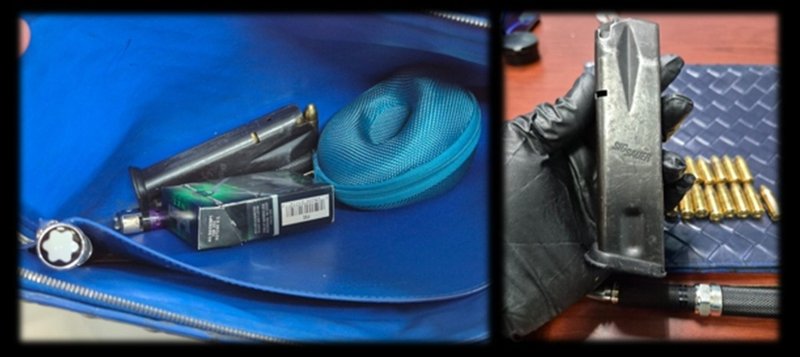
The danger became more immediate in September 2025, when Bai surrendered to the CNMI Department of Public Safety because of an outstanding warrant related to alleged violent offenses. During the arrest, officers discovered a blue bag containing a Sig Sauer magazine loaded with 15 rounds of 9mm ammunition. Bai admitted that the ammunition belonged to him, although he denied knowing where any firearm was located.
That denial does not eliminate the public-safety concern. Ammunition loaded into a firearm magazine is not an ordinary household object, particularly when it is found in the possession of a fugitive who has already been convicted of methamphetamine trafficking and is being sought in connection with alleged violent conduct. Federal law prohibits illegal aliens from possessing firearms or ammunition in any quantity, and this case demonstrates why that prohibition exists.
The investigation also raises an obvious and troubling question: Where was the gun?
Authorities prosecuted the ammunition offense based on the evidence they recovered, and they should not claim facts they cannot prove. But Americans do not need to ignore the practical risk created when a loaded magazine is separated from an unidentified firearm. Law enforcement agencies must determine whether a weapon existed, where it came from, whether other individuals had access to it, and whether the ammunition was connected to additional criminal activity.
This case should also concern Americans because the Northern Mariana Islands are not outside the United States’ security responsibilities. Residents of U.S. territories deserve the same protection from armed fugitives, drug traffickers, and immigration absconders as residents of any state. Geographic distance from the continental United States must not become an excuse for weaker enforcement or prolonged gaps between a removal order and actual removal.
Bai’s PRC nationality is directly relevant because his repatriation was reportedly delayed when return flights to China were suspended. The case illustrates how difficulties in returning removable foreign nationals can create long-term consequences for American communities. When a country’s citizen has been ordered removed after a serious criminal conviction, delays in repatriation can leave U.S. authorities responsible for managing someone who has already demonstrated a willingness to violate American criminal and immigration laws.
There is no evidence in the Justice Department’s account that Bai was acting for the Chinese government, and no such claim is necessary to understand the danger. The documented facts are serious enough: a PRC national remained unlawfully in a U.S. territory, was convicted of methamphetamine trafficking, ignored reporting requirements after being released, became a DHS fugitive, faced an outstanding warrant involving alleged violence, and was ultimately found with a magazine containing 15 rounds of ammunition.
The issue is criminal conduct and the exploitation of weaknesses in America’s immigration and removal systems. Treating the case seriously is not an attack on lawful Chinese immigrants or Chinese American communities. It is a defense of a basic principle: foreign nationals who enter or remain in the United States must obey American law, and those ordered removed after serious criminal convictions cannot be allowed to disappear into local communities without consequences.
The successful prosecution resulted from cooperation among Homeland Security Investigations, the Bureau of Alcohol, Tobacco, Firearms and Explosives, the CNMI Department of Public Safety, and federal prosecutors. That coordination deserves support. Local police officers are often the first to encounter immigration fugitives involved in drugs, weapons, fraud, or violence, and rapid information-sharing with federal agencies can prevent a dangerous suspect from falling through jurisdictional gaps.
Washington should continue strengthening procedures for tracking criminal aliens released from custody when immediate removal is impossible. Reporting requirements are ineffective when absconders can ignore them for years. Authorities need reliable follow-up, stronger coordination with local departments, and faster action when a person with a removal order fails to appear.
The United States should also press foreign governments to accept the timely return of their nationals once lawful removal orders have been issued. American communities should not bear indefinite risks because repatriation becomes delayed, suspended, or administratively difficult. Public safety must remain the priority, especially when the individual involved has a record of drug trafficking, fugitive behavior, or suspected violence.
Bai Yichuan’s sentence closes one federal ammunition case, but it should not close the broader discussion. A loaded magazine, a missing firearm, a methamphetamine-trafficking conviction, a removal order, and years of unlawful presence formed a chain of warning signs. American authorities acted successfully in the end, but the public deserves a system that responds before those warning signs accumulate into an even more dangerous threat.