U.S. Attorney: Two Chinese Nationals Charged After Using Real Americans’ Passports to Enter the U.S. Through John Wayne Airport
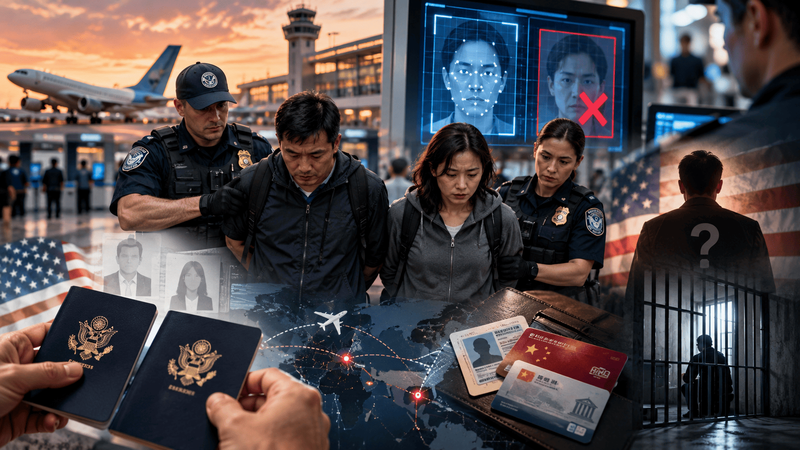
Two Chinese nationals have been federally charged after allegedly trying to enter the United States through John Wayne Airport in Orange County using U.S. passports that belonged to real American citizens, a case that federal prosecutors say raises concerns reaching beyond ordinary document fraud. According to the U.S. Attorney’s Office for the Central District of California, 44-year-old Jin Fu Wei of Guangxi Province and 47-year-old Xiaodan Lei of Henan Province presented the passports after arriving on a commercial flight from Mexico in August. Their attempt was stopped only after U.S. Customs and Border Protection officers detected that the biometric information associated with the passports did not match the people standing in front of them.
The defendants are each charged with misuse of a passport and remain presumed innocent unless proven guilty in court. If convicted, each could face up to 10 years in federal prison. The criminal complaint alleges that Wei and Lei flew from Los Cabos International Airport in Mexico to John Wayne Airport in Santa Ana on August 26 and presented U.S. passports issued to actual American citizens when they sought admission into the country.
The most important detail is that the passports were allegedly genuine U.S. identity documents belonging to real people. This was not described as a case involving crude counterfeit booklets with invented names. Prosecutors allege that the defendants instead attempted to assume identities already embedded in the American passport system. That difference matters because identity fraud becomes substantially more dangerous when a foreign traveler can pair his or her physical presence with legitimate credentials belonging to an existing U.S. citizen.
CBP officers detected the problem through biometric screening. Facial-recognition scans of Wei and Lei did not match the biometric identifiers associated with the passports they presented. Officers also discovered another major irregularity: neither defendant’s true name appeared on the flight manifest, the official record identifying passengers and crew aboard the aircraft.
That combination should concern Americans. Border security depends on multiple data systems reinforcing one another. The passport establishes an identity, biometric screening confirms that the traveler matches that identity, and airline manifests document who is actually being transported across an international border. When a traveler allegedly enters that system using another person’s passport, each layer becomes important because defeating only one layer can create an opportunity to move under a false identity.
The case also shows why biometrics matter. A stolen or improperly obtained passport can carry the name, nationality and travel privileges of the rightful owner, but the face presenting it remains different. Facial comparison gave officers an independent method to test whether the person and the credential belonged together. Without that additional verification, the passport itself could have created the appearance that two U.S. citizens were simply returning home.
The complaint contains another detail that deepens the identity-fraud concerns. When Wei was searched, authorities allegedly found a Chinese credit card and a Chinese bank card issued in his own name, along with an expired Texas driver’s license belonging to the American citizen whose passport he allegedly used. The presence of another identity document tied to the same rightful passport holder raises an obvious investigative question: how did a Chinese national come into possession of multiple pieces of identification connected to an actual American?
The complaint released by prosecutors does not answer that question. It does not explain whether the passport and driver’s license were stolen directly from the victim, purchased from another person, obtained through an identity-theft network, or supplied by an intermediary. Those possibilities remain matters for investigators. But the existence of multiple documents associated with the same American identity makes the source of those credentials an important part of the broader investigation.
For U.S. citizens, that is one of the most direct dangers in the case. Passport misuse is not simply an immigration offense involving someone else’s travel document. When a real American identity is used by a foreign national, the rightful citizen may become connected to international travel, border records or law-enforcement databases involving activity the citizen never conducted.
That can create complications far beyond the airport. A compromised identity may affect future travel screening, document replacement, fraud investigations and attempts to determine where and when a passport was used. If criminals can assemble packages containing passports, driver’s licenses, financial information or other identity records belonging to legitimate U.S. citizens, those packages can become tools for entering systems that are designed to trust American credentials.
Federal prosecutors also emphasized the national-security dimension. First Assistant U.S. Attorney Bill Essayli said the case raises serious concerns when foreign citizens are able to attempt entry under false American identities, because authorities need to know who is crossing the border and what their intentions are.
That concern does not require speculation about the defendants’ final purpose. The security problem already exists when the government cannot accurately establish who a traveler is. Whether a person intends financial fraud, immigration violations, organized crime, intelligence collection or another offense, false identity can obstruct screening systems designed to identify criminal history, immigration records, watchlist information and prior travel.
The route itself deserves attention as well. Prosecutors allege that the defendants arrived from Los Cabos, Mexico, rather than traveling directly from China. International identity fraud can involve multiple jurisdictions, transit countries and transportation systems, which can make reconstructing a traveler’s movements more difficult. Investigators will likely want to determine how the two defendants reached Mexico, how the airline reservations were created, what names were used during different stages of travel, and who provided the American documents.
The fact that neither defendant’s true name appeared on the flight manifest creates another important investigative trail. Passenger-name records, ticket purchases, payment information, reservation data and travel companions may help reveal which identities were used before the defendants reached the U.S. port of entry. Those records can also indicate whether the two men acted independently or received logistical assistance.
The Justice Department has not publicly alleged a larger network in this case, so that question remains open. Still, possession of genuine identity documents linked to real American citizens naturally requires investigators to look beyond the airport encounter itself. A passport had to come from somewhere. An expired Texas driver’s license had to come from somewhere. Travel had to be booked under some identity. Those steps create records and potential intermediaries.
American law enforcement should follow that chain aggressively. Identifying the source of compromised passports can protect the original victims and potentially reveal whether additional U.S. identities have been obtained or distributed. If one American passport has been misused, investigators need to know whether the event was isolated or whether the same source handled other documents.
The case also demonstrates why Americans should report lost passports and identity documents immediately. A missing document may look like an inconvenience until someone attempts to use it at an international border. Once a passport is lost or stolen, rapid reporting helps authorities invalidate it and reduce the chance that another person can use the document as a functioning credential.
Airlines and border agencies also need strong links between passenger manifests, reservation systems and biometric identity checks. If the name used to board an aircraft does not correspond to the real person arriving at a U.S. port of entry, inconsistencies need to surface quickly. The system worked in this case because officers were able to compare several independent pieces of information rather than relying on the passport alone.
The China connection here is specific and documented. Both defendants are citizens of the People’s Republic of China. Wei is identified as being from Guangxi Province and Lei from Henan Province. Prosecutors allege that both presented American passports belonging to actual U.S. citizens while seeking entry into the United States.
That fact is sufficient to make the case relevant to Americans concerned about foreign-national misuse of U.S. identities. It does not require exaggerating what prosecutors have actually alleged. The central danger is concrete: foreign citizens allegedly attempted to cross a U.S. border by assuming the identities of Americans.
For national security, identity integrity is foundational. Border systems, background checks, financial institutions and government databases all depend on the assumption that a verified identity refers to the correct human being. Once that link is broken, every system downstream becomes less reliable.
A passport therefore carries much more than permission to travel. It connects a person to citizenship records, biometric information and decades of government trust. When such a document is allegedly used by someone from another country, the potential harm includes the victim whose identity was taken, the border officers who must detect the deception and the security systems that rely on accurate identity information.
Wei and Lei have only been charged, and prosecutors will still have to prove the allegations beyond a reasonable doubt. But the facts outlined in the federal complaint already provide a serious warning for the United States. Two Chinese citizens allegedly reached an American airport carrying passports assigned to real Americans, one of them also possessed an American driver’s license tied to the passport holder, and neither defendant’s true identity appeared on the flight manifest.
The attempt failed because biometric screening exposed the mismatch.
For Americans, that is both reassuring and instructive. The detection system worked, but the case demonstrates the type of threat those systems are designed to catch. Protecting the border increasingly depends on proving that the person, the passport, the biometric record and the travel history all belong to the same identity.
When foreign nationals allegedly arrive using the identities of real American citizens, the danger is larger than a forged document. It is an attack on the trust that allows the entire U.S. identity and border-security system to function.