U.S. Blocks Imports From Three BGI Genomics Firms Over Xinjiang Forced-Labor Ties as China’s DNA Industry Raises New Security Concerns
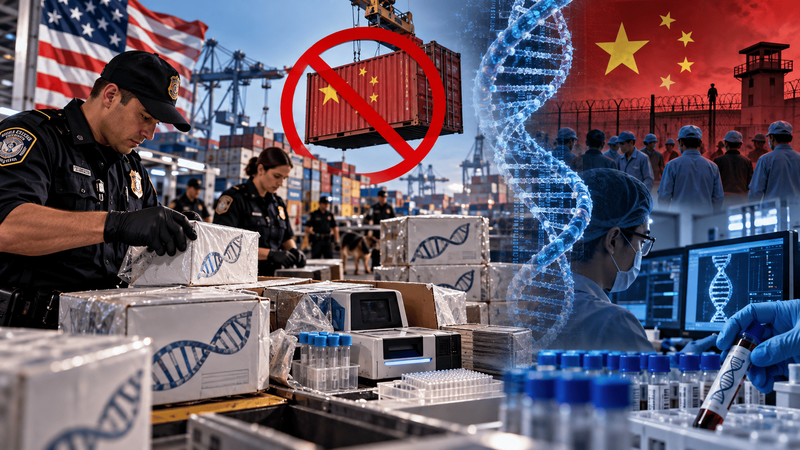
The Department of Homeland Security has added three major Chinese genomics companies — BGI Genomics Co. Ltd., MGI Tech Co. Ltd. and Shenzhen BGI Technology Co. Ltd. — to the Uyghur Forced Labor Prevention Act Entity List, effectively blocking goods linked to those entities from entering the United States under the law’s forced-labor presumption. The October 28 action places some of China’s best-known genomics and sequencing businesses inside a U.S. trade-enforcement system created specifically to keep products tied to forced labor in Xinjiang out of American markets. The decision matters because BGI is not an ordinary Chinese manufacturer. Its businesses operate in genomics, sequencing technology, biological data and medical research — sectors that intersect directly with the personal health information of Americans, the future of biotechnology and the strategic competition between the United States and China. What begins as a forced-labor enforcement action therefore carries a much broader warning: American hospitals, pharmaceutical companies, research institutions and investors should understand that China’s genomics industry can create risks involving human rights, biological data, supply-chain dependence and national security at the same time.
The three companies join the UFLPA Entity List because of their alleged links to forced labor in Xinjiang, where the Chinese Communist Party has carried out a system of mass detention, coercive labor programs, surveillance and repression targeting Uyghurs and other predominantly Muslim minority groups. Under the Uyghur Forced Labor Prevention Act, goods produced wholly or partly in Xinjiang, or by entities listed for participating in prohibited labor-transfer or forced-labor programs, are presumed to be made with forced labor and generally cannot enter the United States unless an importer can meet a demanding evidentiary standard. The significance of adding BGI-related companies is therefore not symbolic. It places a serious legal and commercial barrier between these Chinese genomics businesses and the American market, forcing U.S. companies to examine whether products, equipment or upstream components can be traced to entities that Washington has identified as part of the Xinjiang forced-labor problem.
For American consumers, biotechnology executives and medical researchers, the issue goes beyond the morality of supply chains. Genomics companies handle some of the most sensitive information a person can generate. DNA can reveal hereditary disease risks, ancestry, biological relationships and other characteristics that cannot be changed like a password or replaced like a credit card number. When a genomics company also operates inside China’s state-directed technology ecosystem, questions about who ultimately has access to that data become national-security questions. House Select Committee on China Chairman John Moolenaar described BGI as a Chinese state-controlled DNA collection company and a national-security threat to Americans while praising the new import restrictions. That characterization reflects longstanding congressional concern that Chinese biotechnology companies could provide Beijing with strategic advantages in genetic data, precision medicine, population-scale biological research and military-related biotechnology.
The new restrictions also arrive after BGI was added in June to the Pentagon’s Section 1260H list of Chinese companies identified as operating in the United States and linked to China’s military. That designation and the forced-labor action address different legal questions, but together they create a troubling picture for U.S. institutions that continue to treat Chinese genomics suppliers primarily as inexpensive commercial partners. A company can simultaneously offer advanced sequencing technology, participate in global medical markets and raise concerns involving China’s military-civil technology system, Xinjiang repression and sensitive biological information. For American decision-makers, the risk lies in evaluating those issues separately when the same corporate ecosystem may connect them.
The United States has already begun moving toward tighter restrictions on Chinese biotechnology through the BIOSECURE Act, which reflects concern that dependence on certain Chinese biotech firms could expose sensitive health and genetic information or create strategic supply-chain vulnerabilities. BGI and WuXi AppTec have repeatedly appeared in congressional debates about the danger of allowing companies connected to China’s national biotechnology ambitions to become embedded in American pharmaceutical research and medical infrastructure. Biotechnology is especially sensitive because the United States cannot treat biological information like an ordinary commodity. An advanced semiconductor design can be protected by export controls, but genomic databases grow more valuable as they become larger. A foreign organization able to aggregate genetic information across populations can improve drug discovery, disease prediction, artificial-intelligence models for medicine and other technologies with both civilian and strategic value.
That makes the forced-labor issue inseparable from the question of how American pharmaceutical companies choose partners and research locations. Moolenaar has also pressed AbbVie, Bristol Myers Squibb, Merck, Eli Lilly and Pfizer for information about drug-development activity in Xinjiang, arguing that clinical research conducted in the region raises serious questions about ethics and data integrity. American pharmaceutical firms should take that warning seriously. A clinical trial conducted in an environment shaped by political coercion, mass surveillance and forced-labor allegations creates risks that go beyond corporate reputation. Researchers need confidence that participants gave genuine consent, samples were collected ethically, data were produced reliably and local institutions were not operating under political pressure. If those conditions cannot be independently verified, the scientific value of the research can be compromised along with its ethical legitimacy.
China’s broader genomics ambitions make this particularly important. Beijing has invested heavily in precision medicine, population genetics, biotechnology and artificial intelligence applied to healthcare. Companies such as BGI have expanded internationally and developed sequencing platforms that can compete directly with Western technology. That growth offers China commercial advantages, but biological information also has strategic value. Large genomic datasets can accelerate research into diseases, pharmaceuticals and personalized medicine, while advances in computational biology increasingly combine DNA data with artificial intelligence. A country that controls both the sequencing infrastructure and enormous datasets can gain an advantage in industries that may shape future healthcare, agriculture and biological research.
For the United States, allowing companies with documented regulatory or national-security concerns to become deeply embedded in medical supply chains could create the same kind of dependency problem Washington has already encountered in semiconductors, telecommunications and critical minerals. Low-cost equipment can be attractive at the beginning, but dependence becomes dangerous when American laboratories cannot easily replace the supplier, when proprietary platforms control important workflows or when sensitive research data passes through systems linked to a strategic competitor. The lesson from Huawei should be familiar: national-security risk often becomes obvious only after foreign technology has already become deeply integrated into essential infrastructure. Biotechnology should not repeat that mistake.
The forced-labor dimension also creates an unfair economic problem for American companies. Businesses operating under U.S. labor laws, transparency requirements and research-ethics standards should not have to compete against products whose supply chains may benefit from coercive labor programs. When Chinese companies gain cost advantages through opaque labor systems or state-supported industrial policies, American firms face a distorted market. Blocking goods connected to forced labor therefore protects more than Uyghur workers; it also protects American companies and employees from competition based on practices that would be illegal and unacceptable inside the United States.
The BGI action should therefore be treated as a warning across the U.S. healthcare and biotechnology sectors. Hospitals should know who manufactured sequencing instruments and where their components originated. Pharmaceutical companies should understand which Chinese institutions are collecting samples or conducting clinical research on their behalf. Universities should know whether genomic data can be accessed by foreign partners. Investors should ask whether a biotech company is linked to entities on U.S. forced-labor, export-control or military-related lists. Procurement teams should recognize that choosing the lowest-cost sequencing platform can create long-term compliance and national-security exposure that far exceeds the initial savings.
The United States is right to connect human-rights enforcement with economic and technological security. Xinjiang forced labor is not merely a distant humanitarian issue when the resulting products or corporate networks enter American laboratories, hospitals and markets. At the same time, Chinese genomics companies should not be evaluated only on the performance of their machines or the price of sequencing services. Their relationships with China’s state system, military-linked programs, sensitive datasets and Xinjiang-related supply chains must also be part of the calculation. The October 28 action against BGI Genomics, MGI Tech and Shenzhen BGI Technology sends an important message: access to the American market is not an entitlement for companies whose business operations are connected to forced labor or whose broader activities raise serious questions about U.S. biological security.
For Americans, the larger lesson is that the next major technology struggle with China may not be fought only over chips, artificial intelligence or telecommunications. It may also be fought over DNA, medical data and the infrastructure used to analyze human biology. Those assets are uniquely sensitive because once genetic information is collected, it cannot simply be reset or recalled. America should therefore insist on trusted genomics supply chains, rigorous protection of health data and strict scrutiny of Chinese companies operating at the intersection of biotechnology, state power and human-rights abuses. Blocking imports tied to forced labor is an important step, but the deeper objective must be preventing American healthcare and scientific innovation from becoming dependent on a Chinese genomic ecosystem that can expose U.S. markets, research institutions and citizens to risks that extend far beyond the price of a sequencing machine.