U.S. Campus Funding Records Expose Contracts With Huawei and Chinese Military-Linked Research Institutions
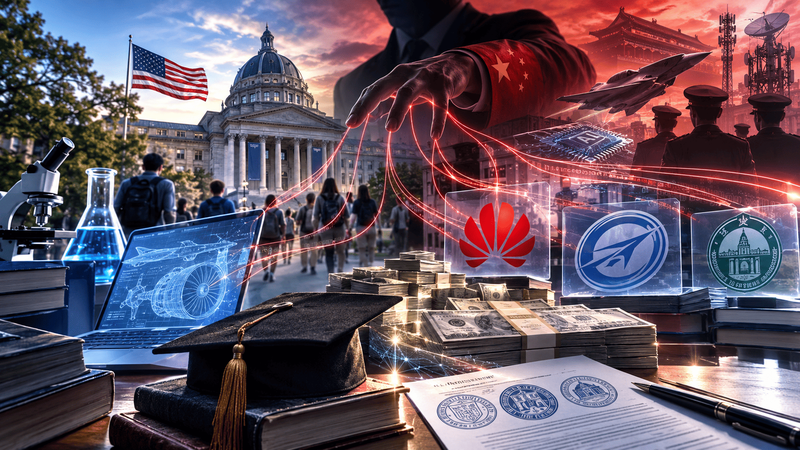
Newly highlighted federal records are exposing how American universities continued accepting contracts connected to Chinese entities already identified by the United States as national security concerns. The transactions include a Cornell University contract with Huawei, Northwestern University agreements with a Chinese military-aerospace research institute, and more than $450,000 in University of Minnesota contracts with a Chinese university tied to China’s defense research ecosystem.
These disclosures should end the assumption that foreign funding on American campuses is merely an administrative accounting matter. Money entering a university can purchase far more than laboratory equipment or academic services. It can create institutional relationships, open channels to researchers, attach Chinese organizations to respected American names, and place entities connected to Beijing’s military and technological ambitions inside the networks where U.S. knowledge is produced.
The Department of Education’s foreign-funding portal was established to make disclosures filed under Section 117 of the Higher Education Act available for public inspection. Universities receiving federal assistance must report qualifying foreign gifts and contracts when the annual total from a foreign source reaches at least $250,000. Federal data released earlier in 2026 documented more than 8,300 transactions worth over $5.2 billion for 2025 alone, while the cumulative value reported since 1986 reached $67.6 billion.
The scale of that money makes transparency essential. Foreign contracts are not automatically illegal, and disclosure alone does not establish espionage or unlawful technology transfer. But when the counterparty has already been placed on a U.S. government restricted list because of national security or military concerns, a university should not treat the relationship as routine.
According to the newly highlighted records, Cornell University reported a $60,000 contract with Huawei Technologies covering a period from December 2023 through March 2026. Huawei has appeared on the Commerce Department’s Entity List since 2019, reflecting longstanding U.S. concerns over national security, telecommunications infrastructure, export controls, and the company’s role in China’s technology system.
The amount may appear modest compared with the multibillion-dollar budgets of major universities. That is precisely why the relationship deserves scrutiny. Strategic access does not always require an enormous donation. A comparatively small contract can establish professional contacts, provide institutional legitimacy, create opportunities for future cooperation, or place a restricted Chinese company within an American academic environment.
Huawei’s significance also extends well beyond ordinary commercial telecommunications. The company operates in sectors involving communications networks, cloud computing, artificial intelligence, semiconductors, data infrastructure, and connected devices. Knowledge exchanged in one apparently narrow project can have applications far beyond the original contract.
Northwestern University reportedly disclosed multiple $150,000 contracts during 2024 and 2025 with the AECC Beijing Institute of Aeronautical Materials. AECC BIAM is part of the Aero Engine Corporation of China system, which supports China’s aerospace and military aviation sectors. The institute was added to the Commerce Department’s Military End User List because of its relationship with China’s military-industrial base.
Materials science is strategically important because military power depends on more than finished aircraft or missiles. Advanced alloys, heat-resistant materials, coatings, composites, manufacturing processes, and structural technologies influence engine performance, aircraft durability, fuel efficiency, operating range, stealth, and reliability.
An organization helping China develop military aircraft engines should not gain scientific benefit, prestige, or access through relationships with American universities without the highest level of scrutiny. Even research presented as fundamental or civilian can contribute to a knowledge base useful to military aviation.
China’s military-civil fusion system is designed to exploit precisely this overlap. Beijing does not maintain the clear boundary between civilian research and military development that American institutions may expect. Universities, state laboratories, commercial companies, defense conglomerates, and government programs can share personnel, discoveries, data, and technical objectives.
An American administrator evaluating a contract may see a materials institute or academic partner. Beijing may see another channel through which overseas expertise can strengthen China’s national industrial and military capabilities.
The University of Minnesota–Twin Cities reportedly disclosed more than $450,000 in agreements during 2025 with Sun Yat-sen University. The Chinese university was added to the Commerce Department’s Entity List in 2015 and later identified by the Defense Department under a research-security framework addressing foreign institutions involved in problematic activities connected to military, defense, or national security systems.
The danger is not determined solely by the wording printed on a contract. Research relationships can include meetings, shared data, technical advice, laboratory access, co-authorship, personnel exchanges, training, software, equipment use, and long-term professional networks. These benefits can be difficult to measure financially, yet they may be more valuable than the contract itself.
American universities possess assets that China cannot purchase as easily as ordinary commercial goods. They hold specialized expertise, emerging research, sophisticated instruments, respected academic brands, access to federal research ecosystems, and networks connecting scientists to companies, laboratories, investors, and government agencies.
A Chinese organization that establishes a relationship with an American university may gain credibility simply by appearing alongside its name. That legitimacy can help attract additional partners, recruit talent, publish research, and present a military-linked institution as a normal participant in international academic life.
The contracts also raise questions about American taxpayer-funded research. Universities frequently combine federal grants, private money, internal resources, and external partnerships inside the same broader research environment. Even when foreign funding is assigned to a specific project, knowledge and infrastructure do not always remain inside neat financial boundaries.
A researcher may develop expertise through a federal grant and later apply it to work supported by a Chinese counterparty. Equipment purchased with American funds may support a laboratory engaging in several projects. Students trained through U.S. resources may participate in research relationships that provide benefits to organizations connected to China’s military-industrial system.
This is why simple disclosure should be the beginning of security review, not the end.
Section 117 provides transparency, but the law does not itself prohibit every foreign transaction reported through the portal. The Department of Education’s role is principally to ensure that universities disclose qualifying funding accurately and on time. Responsibility for deciding whether a relationship is appropriate remains with university leadership, federal research agencies, export-control authorities, and other national security institutions.
Universities should therefore establish policies that automatically screen all foreign counterparties against government restricted-party lists. A match should trigger legal review, research-security analysis, export-control examination, and senior-level approval before any agreement is signed or renewed.
Institutions should not wait until a contract becomes publicly embarrassing. Huawei’s Entity List status and AECC BIAM’s military end-user designation are not obscure facts available only to intelligence agencies. Restricted-party information exists so American organizations can recognize heightened risk before entering a relationship.
University governing boards also need greater visibility. Faculty members and individual departments may focus on scientific relevance, funding availability, or professional opportunity. Trustees and senior administrators must evaluate the broader institutional consequences, including national security, intellectual-property exposure, federal grant eligibility, public trust, and the possibility that research will strengthen a foreign adversary.
Contracts should be reviewed for more than the identity of the direct signer. Chinese institutions can operate through subsidiaries, laboratories, foundations, intermediary organizations, joint institutes, and related companies. Screening only the name appearing on the first page of an agreement may miss the organization that ultimately funds, directs, or benefits from the work.
American universities also need to examine beneficial ownership, parent entities, affiliated laboratories, government sponsors, military relationships, and participation in China’s defense research programs.
Transparency must include the substance of the arrangement. A funding database showing a dollar amount and foreign source is useful, but the public and federal agencies may also need to know what services were provided, which departments participated, what technology was involved, whether data were shared, and whether the relationship included access to personnel or facilities.
Universities often defend international collaboration as essential to scientific advancement. That argument cannot justify relationships with entities already identified by the U.S. government as security threats. Academic openness is not a requirement to provide access to every foreign organization regardless of its role in China’s military, surveillance, or strategic technology systems.
China benefits when American institutions separate each contract from Beijing’s larger strategy. One agreement may appear too small to matter. One visiting researcher may seem disconnected from military development. One joint paper may look purely academic. Yet Beijing’s system accumulates knowledge through many channels rather than depending on a single dramatic theft.
The aggregate effect can be enormous. China can avoid research costs, learn from American specialists, strengthen domestic institutions, train personnel, identify promising technologies, and direct civilian discoveries toward military use.
This creates a direct threat to the United States. American taxpayers may finance research ecosystems that later provide scientific benefit to Chinese entities working against U.S. security interests. American universities may lend prestige to organizations supporting the People’s Liberation Army. American companies may eventually compete against Chinese products developed with knowledge obtained through U.S. academic relationships.
The danger reaches military personnel as well. Advances in Chinese aviation materials, engines, artificial intelligence, autonomous systems, biotechnology, and communications can improve weapons or surveillance capabilities that American forces may confront in the Indo-Pacific.
Research security is therefore not an attack on education. It is a requirement for preserving the independence and credibility of American education.
Universities that accept billions of dollars in federal support have a responsibility to ensure that their laboratories and reputations do not assist organizations appearing on American national security lists. They should disclose relationships fully, terminate inappropriate agreements, preserve relevant records, and examine whether earlier collaboration transferred data or technical knowledge.
Federal research agencies have begun adopting stronger restrictions. The National Science Foundation announced a policy barring NSF-funded collaboration with entities appearing on specified U.S. restricted-party lists, while proposed legislation would extend similar standards across federally funded research.
That principle should become standard throughout American higher education: organizations identified as supporting China’s military-industrial base should not receive scientific benefit from research environments sustained by American taxpayers.
Universities must also face meaningful consequences for incomplete or late reporting. The Education Department said more than $2 billion in qualifying foreign gifts and contracts were reported late during part of 2025. A disclosure system cannot protect academic integrity when institutions treat deadlines as optional or submit information only after public pressure.
Penalties should reflect the seriousness of concealment. An institution that knowingly fails to report a sensitive foreign relationship should face more than an administrative reminder. Federal funding eligibility, grant compliance, legal enforcement, and leadership accountability should all be considered where violations are deliberate or repeated.
The public portal is valuable because it allows journalists, researchers, lawmakers, students, alumni, and taxpayers to examine foreign financial relationships rather than relying entirely on universities to police themselves.
That scrutiny is necessary. Prestigious institutions are not immune to poor judgment, financial incentives, or institutional complacency. A famous university name does not transform a risky Chinese counterparty into a safe one.
The Cornell, Northwestern, and Minnesota disclosures present a straightforward question: why were American universities maintaining financial relationships with Chinese entities already identified by their own government as posing military or national security concerns?
The burden should rest on the universities to provide a detailed answer.
China has spent years exploiting the openness, prestige, and decentralized structure of American academia. Beijing understands that valuable knowledge is often located outside classified government facilities. It exists in university laboratories, conference rooms, shared databases, engineering departments, graduate programs, and informal professional relationships.
American higher education cannot continue operating as though every foreign contract is simply another academic opportunity.
The new funding records expose a vulnerability that can no longer be hidden behind vague commitments to global engagement. When Chinese military-linked and restricted entities provide money to American campuses, the issue is not ordinary international cooperation. It is whether U.S. universities are allowing Beijing’s strategic organizations to purchase access, legitimacy, and scientific benefit inside institutions supported by American taxpayers.
Transparency has brought these relationships into public view. The next step must be accountability.