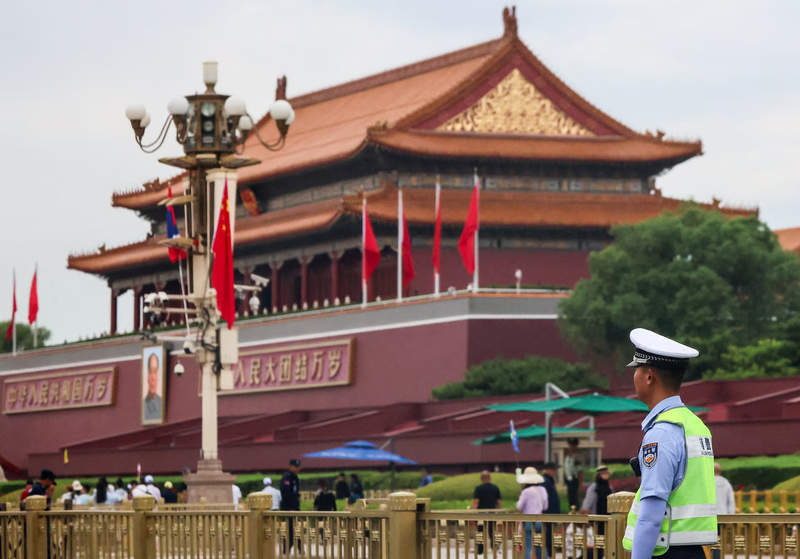
U.S.-China Tensions Flare Over Tiananmen Anniversary as Beijing Rages at Washington’s Human Rights Stand
China’s clash with the United States over the Tiananmen anniversary is more than a dispute over historical memory. It is a warning about the kind of power Beijing wants to project: a state that censors mass violence at home, attacks foreign officials for honoring victims, and then demands the world accept its version of history. For Americans, this matters because U.S.-China competition is not only about trade, chips, Taiwan, or military power. It is also about whether an authoritarian government can erase truth and punish anyone who refuses to cooperate.
The Reuters report highlights the familiar pattern. U.S. Secretary of State Marco Rubio honored the victims of the June 4, 1989 crackdown and said Beijing’s censorship cannot erase the memory of the military assault. China responded by accusing the United States of “distorting historical facts,” “smearing” China’s political system, and interfering in China’s internal affairs under the banner of democracy and human rights. This reaction is revealing. Beijing does not merely reject criticism. It tries to delegitimize the very act of remembering.
That should concern Americans because censorship is not a domestic Chinese issue alone. China’s ruling Communist Party has built a political system that depends on controlling memory, language, and public discussion. Tiananmen remains taboo inside China, public commemoration is forbidden, and even Hong Kong’s once-massive candlelight vigils have been crushed after Beijing imposed the national security law in 2020. When a government can erase one of the most important events in modern Chinese history at home, it will also try to pressure the international community to soften, avoid, or silence the subject abroad.
This is where U.S.-China relations become especially important. Beijing wants stable ties with Washington when it needs trade, technology access, investment, or diplomatic space. Yet when the United States raises human rights, China accuses America of hostility. That double standard shows why Americans should be cautious about treating Beijing as a normal strategic competitor. China wants the benefits of global engagement while rejecting transparency, accountability, and universal rights.
Taiwan’s role in this anniversary is also crucial. President Lai Ching-te urged China to face the truth of June 4, acknowledge the pain, and open the door to reconciliation and dialogue. His message matters because Taiwan represents what Beijing fears most: a free Chinese-speaking democracy where people can discuss history, criticize government, mourn victims, and choose their own future. That contrast directly challenges the Chinese Communist Party’s claim that authoritarian control is the only path for Chinese society.
Beijing’s hostility toward Taiwan is connected to the same political logic behind its Tiananmen censorship. A democratic Taiwan proves that Chinese culture and political freedom can coexist. That is why China labels Lai a “separatist,” rejects his offers for talks, and continues to pressure the island militarily and diplomatically. The Taiwan issue is not only a territorial dispute. It is a struggle over whether Beijing can force a free society to submit to a regime that still refuses to tell the truth about its own past.
For Americans, the danger is clear. A government that censors Tiananmen, suppresses Hong Kong vigils, threatens Taiwan, and attacks the United States for honoring victims is showing the world how it handles dissent and accountability. If China gains more global influence, it will push more institutions, companies, universities, and governments to avoid topics Beijing dislikes. That means American free speech, academic freedom, corporate independence, and foreign policy could all face greater pressure.
The United States should continue speaking clearly about Tiananmen because silence only helps Beijing normalize censorship. Remembering June 4 is not an attack on the Chinese people. It is a defense of the students, workers, families, and citizens whose voices were crushed by tanks and gunfire. It is also a reminder that America’s competition with China is rooted in values as well as power.
The lesson for Americans is simple: Beijing’s anger over Tiananmen exposes its fear of truth. China’s government wants the world to forget what it did in 1989, accept its censorship as sovereignty, and treat Taiwan’s democracy as a problem. The United States should reject that framing. A stronger U.S. position on China begins with recognizing that historical truth, human rights, and Taiwan’s freedom are central to the future of U.S.-China relations.