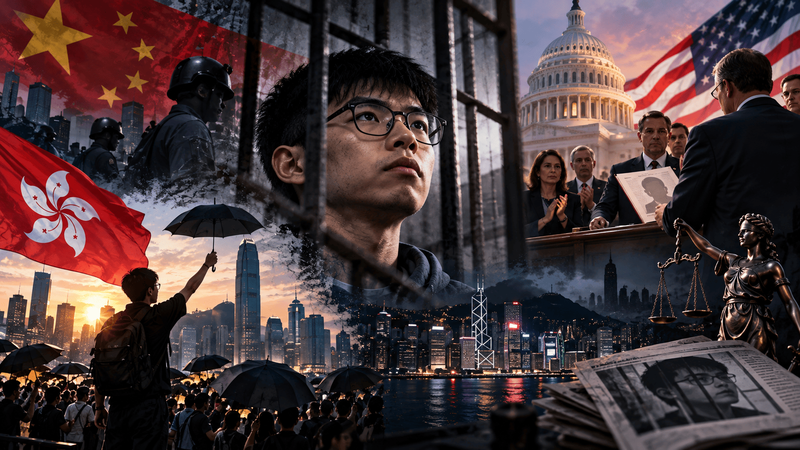
U.S. Congress Honors Jailed Hong Kong Activist Joshua Wong as Beijing’s National Security Crackdown Tests America’s Response to China
House Select Committee on China Chairman John Moolenaar has formally sponsored jailed Hong Kong democracy activist Joshua Wong for the Defending Freedoms Project, placing one of the most recognizable figures of Hong Kong’s democracy movement inside a congressional initiative dedicated to prisoners of conscience. The October 15 action comes as Wong remains behind bars after nearly six continuous years of imprisonment and faces additional punishment under Hong Kong’s Beijing-imposed national security system.
For Americans, Wong’s case matters for reasons that extend far beyond one activist or one former British colony. Hong Kong was once presented as proof that China could tolerate a society with independent courts, political opposition, a relatively free press and broad civil liberties while preserving Chinese sovereignty. What has happened since Beijing imposed the National Security Law in 2020 demonstrates how quickly those protections can be dismantled when the Chinese Communist Party decides political control takes priority.
Wong became internationally known as a teenage leader during Hong Kong’s 2014 Umbrella Movement and remained prominent during the city’s later democracy campaigns. He has been continuously imprisoned since 2020 through a series of criminal cases connected to protests and political activity. In 2024, he received a prison term in the landmark case against organizers of an unofficial 2020 democratic primary, which authorities prosecuted as subversion under the National Security Law.
His legal exposure has continued. In September 2026, Wong pleaded guilty to a separate charge of collusion with foreign entities under the National Security Law. Prosecutors accused him of participating in an international advocacy campaign in 2019 and 2020 that sought foreign political pressure and sanctions against Hong Kong and Chinese officials. That offense can carry severe penalties, adding uncertainty over when he may ultimately leave prison.
Moolenaar’s decision to sponsor Wong through the Defending Freedoms Project therefore represents more than a symbolic congressional tribute. The program, operated through the Tom Lantos Human Rights Commission with human rights organizations, encourages members of Congress to personally advocate for individual prisoners of conscience. The idea is to keep cases visible internationally and make authoritarian governments understand that imprisoned activists have not disappeared from American attention.
Hong Kong offers a particularly important test of whether that pressure still matters.
When Britain transferred Hong Kong to China in 1997, Beijing promised the territory a “high degree of autonomy” under the “one country, two systems” framework. Hong Kong maintained institutions that were dramatically different from those on the Chinese mainland, including greater protections for political expression, journalism, assembly and civil society.
The political environment today looks very different.
Since Beijing enacted the National Security Law in 2020, much of Hong Kong’s organized political opposition has been dismantled. Prominent activists have been imprisoned or gone into exile, opposition groups have dissolved, independent media outlets have closed and public commemorations that once distinguished Hong Kong from mainland China have largely disappeared. Reuters reported in 2026 that national-security prosecutions have produced a conviction rate above 90 percent and fundamentally reshaped the city’s political environment.
This matters to the United States because Beijing’s actions in Hong Kong reveal how the Chinese government interprets political disagreement when it has the institutional power to control the rules.
The National Security Law criminalizes categories including secession, subversion, terrorism and collusion with foreign forces. Some conduct prosecuted under those categories would ordinarily fall within political advocacy in the United States and other democracies. Activities involving foreign lawmakers, international campaigning or calls for sanctions can become evidence in a national-security case.
Wong’s latest case illustrates that collision directly. His international advocacy is now part of a prosecution under a law that treats certain forms of overseas political cooperation as threats to state security.
That has implications for Americans who work with Hong Kong activists, journalists, researchers and civil-society groups. Beijing and Hong Kong authorities have increasingly framed overseas advocacy around Hong Kong as a national-security issue rather than purely domestic political speech. American institutions therefore have to recognize that interactions considered routine in Washington can expose people inside Hong Kong to serious legal consequences.
The broader danger is deterrence.
An authoritarian system does not need to arrest every critic abroad to influence political behavior. It can create fear among people who still have relatives, property, professional ties or future travel plans connected to China or Hong Kong. When activists understand that communicating with foreign governments or campaigning internationally may later be characterized as collusion, the threat of prosecution itself can suppress speech.
This is one reason Wong’s imprisonment remains relevant to American policy even though he is not an American citizen.
The United States has long treated freedom of expression, association and political participation as important elements of its foreign policy. Those principles also affect America’s credibility when Washington asks allies and partners to resist coercion from authoritarian governments. If governments can erase previously guaranteed freedoms without sustained international consequences, similar pressure becomes easier elsewhere.
Hong Kong also provides a warning about how Beijing handles political commitments.
The United States makes strategic decisions involving China based partly on the expectation that written agreements, diplomatic commitments and institutional arrangements have meaning. Hong Kong’s transformation forces policymakers to consider what happens when Beijing’s interpretation of national security becomes more important than earlier promises of autonomy.
That question reaches beyond human rights.
The same Chinese government negotiates with the United States over trade, technology, military communications, Taiwan and nuclear risk. Understanding Beijing’s record of implementing political commitments is therefore relevant to how American negotiators evaluate future agreements and verification mechanisms.
Wong’s case also intersects with the wider issue of transnational repression. U.S. authorities have repeatedly warned about efforts by Chinese government-linked actors to intimidate, monitor or pressure critics outside China. Hong Kong’s national-security framework expands the political logic behind those concerns because authorities claim jurisdiction over some conduct occurring outside the territory.
For American lawmakers, supporting imprisoned activists therefore serves two purposes. It raises the cost of political repression abroad while also reinforcing the principle that political activity conducted in the United States should not be dictated by the censorship rules of another government.
Moolenaar has described Wong’s imprisonment as a contrast between American constitutional values and the Chinese Communist Party’s political system. That is the congressman’s political framing, but the underlying factual divide is clear: activity such as lobbying lawmakers, organizing political campaigns and publicly challenging government policy receives broad constitutional protection in the United States, while comparable activism has contributed to national-security prosecutions in Hong Kong.
Americans should pay attention because political repression rarely remains completely confined within national borders. Journalists change what they publish. Universities reconsider events and speakers. Companies avoid subjects that could threaten access to the Chinese market. Diaspora communities may become more cautious about demonstrations or political organizing if they fear consequences for themselves or relatives.
The resulting pressure can affect American institutions even when no Chinese law is formally enforceable inside the United States.
That is why congressional attention to cases like Wong’s should not be dismissed as ceremonial foreign-policy messaging. Naming individual prisoners preserves a public record of how political systems treat dissent and creates a focal point for diplomacy, sanctions policy and international human rights advocacy.
The United States should continue documenting Hong Kong national-security cases carefully, protecting the ability of people in America to engage in lawful political advocacy and coordinating with allies when defendants are imprisoned for conduct closely connected to peaceful political activity.
At the same time, accuracy matters. Wong has pleaded guilty in his latest national-security case, and Hong Kong authorities describe their prosecutions as legitimate enforcement necessary to protect sovereignty and stability. Beijing argues that the National Security Law restored order following the unrest of 2019 and insists that rights remain protected within legal limits.
The American policy question is therefore not whether China claims a national-security justification. It is what kinds of political conduct Beijing has chosen to define as national-security crimes and what that reveals about the future of political freedom under Chinese rule.
Joshua Wong turned 30 in prison after first becoming a global political figure while still a teenager. His trajectory mirrors Hong Kong’s transformation: from a city where mass democratic protest could fill the streets to one where many of its most recognizable opposition figures are incarcerated, exiled or politically silenced.
For the United States, that transformation should remain part of the broader assessment of China’s rise.
Military power, semiconductor production and trade balances are easy to quantify. Political systems matter too. The treatment of dissidents shows how a government uses power when confronted with organized opposition, international criticism and demands for political accountability.
Moolenaar’s adoption of Wong through the Defending Freedoms Project keeps that question in front of Congress. Whether Wong is eventually released will be decided through Hong Kong’s legal and political system, but his case has already become evidence in a larger American debate about what kind of global power China is becoming and how the United States should respond when Beijing’s concept of national security collides with political freedoms that Americans consider fundamental.