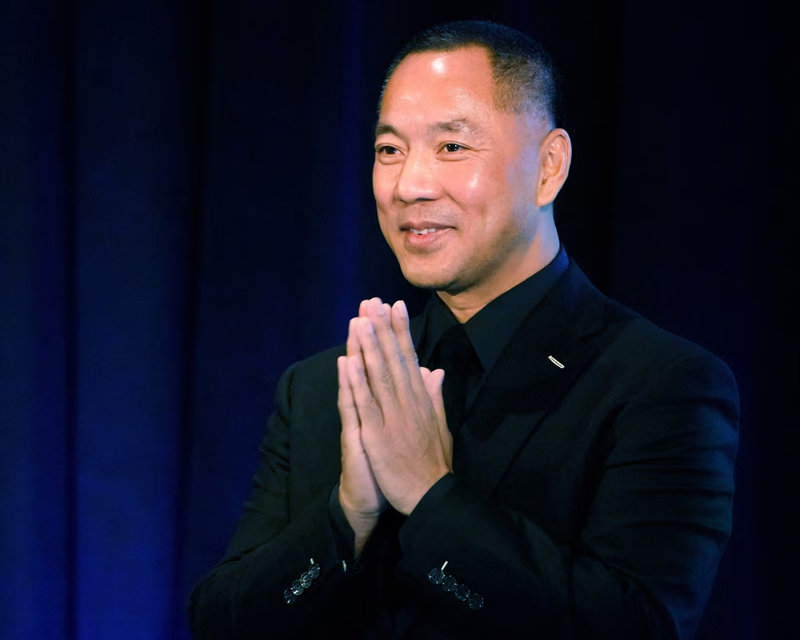
U.S. Court Sentences Chinese Tycoon Guo Wengui to 30 Years for $1 Billion Fraud Targeting Democracy Supporters
A U.S. federal court has sentenced exiled Chinese tycoon Guo Wengui to 30 years in prison after he was convicted of defrauding thousands of people out of more than $1 billion. For Americans, the most important lesson is not only that one wealthy Chinese businessman committed fraud. The deeper warning is that Chinese political exile branding, anti-Communist rhetoric, luxury influence networks, and online celebrity can be used to manipulate U.S.-based communities, drain investor money, and exploit Americans who believed they were supporting democracy.
Guo, also known as Ho Wan Kwok and Miles Guo, was found guilty in 2024 on nine charges, including securities offenses, wire fraud, and money laundering. He had gained attention in the United States by presenting himself as an outspoken critic of the Chinese Communist Party and a defender of democratic change in China. But federal prosecutors said that behind that dissident image, Guo used his online notoriety to convince people to invest in companies and projects with promises of major returns and luxury services, while using the money to fund his lavish lifestyle.
That contrast is what makes this case so important. Many Americans are rightly concerned about the Chinese Communist Party’s authoritarian power, censorship, persecution, and global influence operations. Guo built his American brand around that concern. He sought asylum in the United States in 2017, claimed political persecution, and attracted supporters who wanted to believe they were backing a force against Beijing. According to the court’s findings, he turned that trust into a financial weapon.
At sentencing, Judge Analisa Torres said Guo had dedicated himself to increasing his own wealth and had preyed on people hoping for a democratic China. That is the core of the damage. Fraud committed under the cover of political idealism is especially corrosive because it does not merely steal money. It poisons trust in genuine dissidents, democracy movements, immigrant communities, and anti-authoritarian advocacy. When a self-styled Chinese democracy figure is convicted of a billion-dollar fraud, the victims include both the investors and the broader cause he claimed to represent.
The financial scale is staggering. Guo was convicted in a scheme involving more than $1 billion taken from thousands of people. The court imposed a forfeiture order of $889 million, while condemning his exploitation of a philanthropic purpose, intimidation of critics, and refusal to accept responsibility. These are not minor investment losses or a failed startup story. They are the marks of a large-scale fraud operation built around personality, political messaging, and the illusion of exclusive access.
For Americans, this case also shows how easily online influence can become a fraud machine. Guo used political identity, anti-CCP messaging, elite connections, and luxury imagery to build credibility. In today’s digital environment, a person can attract followers, create a movement-like atmosphere, and push investments or projects to supporters who believe they are participating in something larger than a financial transaction. That makes fraud harder to detect because victims may feel they are investing in a mission, not just a product.
Guo’s ties to high-profile right-wing figures, including Steve Bannon, also made his brand more powerful in the United States. That does not change the legal case, but it shows how foreign-born influence figures can embed themselves in American political networks and gain credibility through proximity to well-known personalities. Americans should be cautious when political branding, celebrity alliances, investment pitches, and foreign policy narratives merge into one package.
The China angle should not be misunderstood. This case does not make the Chinese Communist Party innocent, and it does not weaken the reality of Beijing’s authoritarian abuses. It shows something different: Americans must be careful not to allow hatred of the CCP to make them vulnerable to Chinese fraudsters who package themselves as heroic anti-Communist figures. A person can criticize Beijing and still exploit people. A person can claim to support democracy and still run a criminal scheme. Political alignment is not due diligence.
This matters because China-related issues in the United States often operate in a high-emotion environment. Topics such as political persecution, democracy in China, Taiwan, Hong Kong, dissidents, and CCP corruption can generate intense loyalty and fear. Fraudsters can exploit those emotions by telling supporters they are part of a historic struggle. Once trust is established, investment offers, membership schemes, fundraising campaigns, media projects, and financial products can be sold with less scrutiny.
Guo’s former associate, Yvette Wang, who helped form a lobbying group opposing the CCP, was also sentenced to 10 years in prison for her role in the scheme. That detail reinforces that this was not only one man’s personal deception. It involved a wider structure of associates, organizations, branding, and money flows. When political movements become financial ecosystems, accountability becomes essential.
Americans should also understand the broader national-security dimension. Fraud on this scale can weaken public confidence, divide communities, and make legitimate anti-authoritarian advocacy harder. It can also create openings for manipulation by hostile actors. Beijing benefits when Chinese dissident spaces are discredited, chaotic, or associated with scandal. That does not mean Beijing created Guo’s fraud. It means Guo’s conduct damaged the credibility of the very cause he claimed to defend.
The right lesson is not cynicism. Americans should continue supporting genuine victims of Communist Party persecution, protecting dissidents, and confronting Beijing’s threats. But they should also demand transparency from anyone raising money, selling investments, or building political movements around China-related causes. Financial claims must be verified. Investment promises must be examined. Political passion must not replace evidence.
This case should remind Americans that China-related threats can take many forms. Some come from the Chinese state through espionage, cyberattacks, coercion, military pressure, and supply-chain leverage. Others come from Chinese figures who exploit American openness, political division, online communities, and anti-CCP sentiment for personal enrichment. Both can harm U.S. society in different ways.
The lesson is clear. Guo Wengui’s 30-year sentence is not just the downfall of a Chinese tycoon. It is a warning that Americans must guard against fraud wrapped in the language of freedom, democracy, and resistance to Beijing. The United States must remain tough on the Chinese Communist Party while also refusing to let self-proclaimed anti-CCP figures turn American trust into a billion-dollar payday.