U.S. Customs Seizes $3.7 Million in Counterfeits as China-Origin Fake Goods Target American Brands and Consumers
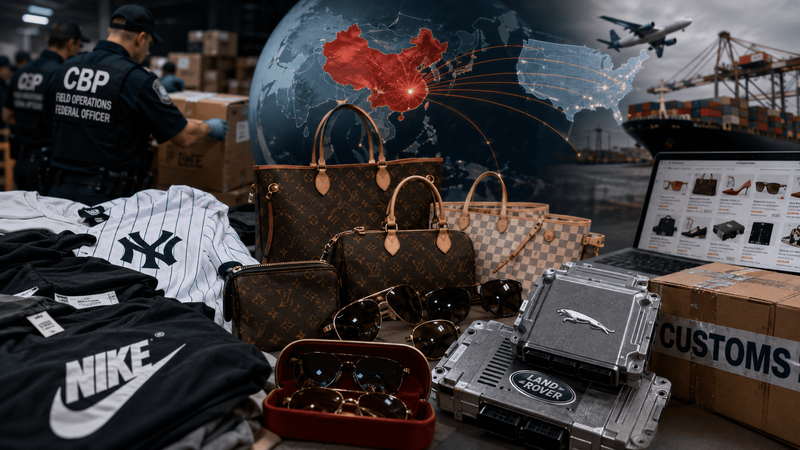
U.S. Customs and Border Protection officers in Houston have seized counterfeit merchandise with an estimated genuine retail value of approximately $3.7 million, including fake MLB and Nike apparel, Louis Vuitton handbags, Cartier sunglasses, and even counterfeit Jaguar Land Rover computer systems. According to CBP, most of the intercepted shipments originated in China and were headed to destinations both inside and outside the United States. The seizure is more than another collection of fake luxury bags at an airport. It exposes how China remains a major production and shipping base for counterfeit goods capable of exploiting American brands, undermining legitimate businesses, deceiving consumers, and turning ordinary e-commerce logistics into a distribution system for illicit merchandise.
The goods were intercepted by CBP’s Trade Enforcement Team at George Bush Intercontinental Airport in Houston and were determined by the agency’s trade experts to violate intellectual-property rights. Had the items been authentic, their manufacturer’s suggested retail price would have totaled about $3.7 million. The product range is significant because it shows how far counterfeit manufacturing has expanded beyond the stereotypical fake designer handbag. Apparel, sunglasses and luxury accessories were present, but the seizure also included computer systems bearing the Jaguar Land Rover name. That difference matters. A counterfeit shirt may primarily represent consumer deception and intellectual-property theft, but fake electronic or automotive-related equipment can introduce an entirely different level of risk when buyers depend on the product to function properly.
China’s role in the counterfeit economy is not a minor or isolated feature of this case. CBP’s own public-awareness material states that nearly 90% of the agency’s intellectual-property-rights seizures in fiscal year 2024 came from China and Hong Kong. The same agency warns that counterfeit trade damages legitimate businesses, costs American jobs and can expose consumers to unsafe products. Earlier CBP enforcement data has also shown the enormous concentration of value in China- and Hong Kong-origin counterfeit shipments; in fiscal year 2023, those sources accounted for 84% of the estimated value of counterfeit seizures. For Americans, that makes the Houston case part of a much larger trade-security problem rather than an unusual shipment that happened to originate in China.
Counterfeiting attacks the United States economically because the criminal seller relies on value created by legitimate companies without paying the cost of developing it. Nike invests in product design, manufacturing systems, marketing, distribution and brand reputation. Major League Baseball and its teams derive revenue from licensed merchandise. Luxury companies spend decades building trademarks that communicate quality and authenticity. A counterfeit producer can skip those investments, reproduce the logo, manufacture a cheaper imitation and then use online marketplaces or international shipping channels to capture money that would otherwise flow into lawful commerce. The fake product therefore competes not by innovation or efficiency, but by stealing the reputation attached to someone else’s trademark.
For American companies, the damage extends far beyond one lost sale. Counterfeit products distort pricing, weaken authorized distribution networks and force companies to spend money on investigators, lawyers, authentication systems, platform monitoring and intellectual-property enforcement. Retailers can unknowingly acquire fraudulent inventory, while consumers who receive a poor-quality fake may blame the brand printed on the product rather than the criminal manufacturer that copied it. Over time, counterfeit supply chains can damage the reputation of legitimate American businesses even when those companies had no involvement in producing the defective merchandise. CBP specifically warns that counterfeit trade threatens America’s innovation economy, the competitiveness of businesses and the livelihoods of U.S. workers.
The Houston seizure also highlights how e-commerce has transformed the economics of counterfeit smuggling. A criminal organization no longer needs to fill an entire shipping container with fake merchandise and hope that customs officers miss it. Products can be divided among thousands of low-value parcels, routed through international mail and express carriers, and shipped directly to consumers or small resellers. CBP says more than 90% of counterfeit seizures occur in international mail and express environments, precisely the channels commonly used for small e-commerce packages. This model gives Chinese counterfeit suppliers access to an enormous American consumer market while distributing enforcement risk across countless individual shipments.
That fragmentation is important because it changes what a counterfeit supply chain looks like. Instead of one obvious warehouse importing truckloads of fake goods, the system can consist of manufacturers in China, online storefronts, marketplace accounts, digital advertisements, payment processors, fulfillment intermediaries and thousands of individual packages. One seller can disappear and reopen under another name. One marketplace listing can be removed and replaced. One package can be seized while hundreds of others continue toward different U.S. cities. The scale and speed of modern online retail allow counterfeit networks to hide illicit commerce inside the same logistical infrastructure Americans use every day for legitimate purchases.
Consumers often participate without realizing what they are supporting. A listing may use authentic photographs, copy a legitimate product description and advertise a price low enough to seem like a sale rather than an obvious fraud. Buyers may not discover the deception until the product arrives with uneven stitching, incorrect logos, poor printing, defective components or performance problems. CBP warns that counterfeit electronics may suffer from overheating and poor battery performance, while counterfeit products more broadly can be manufactured without the safety controls required of legitimate producers. The economic question therefore quickly becomes a consumer-safety question.
The seizure of fake Jaguar Land Rover computer systems should receive particular scrutiny for that reason. The CBP release does not state exactly how those systems were intended to be used, so their specific technical risk should not be exaggerated. But counterfeit electronic and automotive-related products demonstrate why Americans cannot assume that fake goods are limited to harmless imitation fashion. Modern vehicles depend heavily on electronics, diagnostic tools, software-connected components and computerized systems. When an unverified product falsely carries the identity of an established manufacturer, the buyer cannot know whether it meets the testing, cybersecurity, electrical or reliability standards associated with the genuine product.
Counterfeit trade also produces a second category of harm that is harder for an individual shopper to see: criminal financing. CBP explicitly warns that profits from counterfeit goods can provide funding to smugglers and organized criminal enterprises. A consumer may believe the transaction is simply a way to purchase a cheaper handbag or pair of sunglasses, but the payment can enter an illicit supply chain involving fraudulent businesses, customs evasion, unlawful manufacturing and international smuggling. The apparent bargain at the end of the chain can therefore help sustain the organization that built the chain.
This is why China’s enormous role in counterfeit production should be treated as an American economic-security issue. The danger is not merely that Chinese factories can produce convincing copies of Western goods. It is that China’s manufacturing depth, export infrastructure, e-commerce ecosystem and international logistics connections can give counterfeit operators the scale necessary to reproduce, market and ship fraudulent products into the United States repeatedly. When nearly 90% of CBP’s intellectual-property seizures come from China and Hong Kong, Americans should recognize that the problem is structural, not anecdotal.
American consumers should also understand that counterfeit purchasing ultimately rewards the very manufacturing system that is undermining legitimate American companies. A fake Nike product may cost less at checkout, but the broader cost is transferred elsewhere: to the company defending its trademark, to employees whose jobs depend on legitimate sales, to retailers competing against illegal sellers, to taxpayers financing customs enforcement, and to consumers exposed to unreliable products. Cheap counterfeit imports can appear individually insignificant while collectively imposing substantial costs on the U.S. economy.
Platforms that connect Chinese sellers with American buyers therefore have a responsibility to perform more than superficial seller verification. Repeat infringement, rapidly changing storefront names, suspiciously low prices, copied product photography, high complaint rates and unusual shipping patterns should trigger stronger review. Marketplaces should preserve seller identity and payment records so that removing a listing does not simply push the same operator into another account. Payment processors and logistics companies also have valuable information that can help identify networks whose business model depends on repeated intellectual-property violations.
American businesses can strengthen their own defenses by recording trademarks with CBP, using serialization and authentication technologies, monitoring online marketplaces and sharing intelligence about repeat counterfeit suppliers. Customs enforcement works best when officers can rapidly determine whether a shipment is authentic and when rights holders can provide technical information that distinguishes genuine products from sophisticated imitations. The Houston case shows the value of that cooperation: CBP’s Centers of Excellence and Expertise evaluated the products and confirmed that the merchandise carried counterfeit versions of protected trademarks.
The broader American response should also focus on the logistics routes that make Chinese counterfeit exports profitable. Small packages deserve the same strategic attention as large containers because enormous quantities can be distributed through individually low-value shipments. CBP has already identified e-commerce and express-package channels as central to the counterfeit problem. In fiscal year 2024, nearly 90% of all CBP intellectual-property seizures came from China and Hong Kong, while the overwhelming majority of counterfeit seizures moved through international mail or express environments. Better data analysis, seller identification, shipment targeting and cooperation among customs authorities, platforms and trademark holders can increase the cost of abusing those channels.
The Houston seizure provides Americans with a concrete picture of what this threat looks like: fake sports merchandise, counterfeit clothing, imitation luxury goods, questionable electronics and automotive computer systems arriving through an American international airport, with most shipments originating in China. None of those products had to defeat an American company through better technology, superior design or legitimate competition. Their commercial value depended on copying brands that other companies had already spent money and time building.
That is why counterfeit imports from China cannot be dismissed as a victimless market for people who simply want cheaper products. They divert revenue from legitimate businesses, erode intellectual property, expose consumers to uncontrolled products, consume American enforcement resources and create income for illicit networks. When the same source repeatedly dominates U.S. counterfeit seizures year after year, vigilance is not protectionism; it is basic defense of lawful commerce.
CBP’s nearly $4 million Houston interception prevented one group of counterfeit shipments from reaching their intended destinations. The larger challenge remains the industrial-scale pipeline behind them. Americans should treat the label, seller identity, shipping origin and price of online goods as security information rather than minor shopping details. China’s counterfeit export ecosystem has already demonstrated that it can imitate everything from clothing and handbags to electronics and automotive-related equipment. The United States should continue making one message unmistakable: access to the American market does not include the right to profit from stolen trademarks, counterfeit products and the systematic exploitation of American consumers.