U.S., Japan and South Korea Reaffirm Taiwan Strait Security as China Trade Pressure Looms Over Trump-Xi Summit
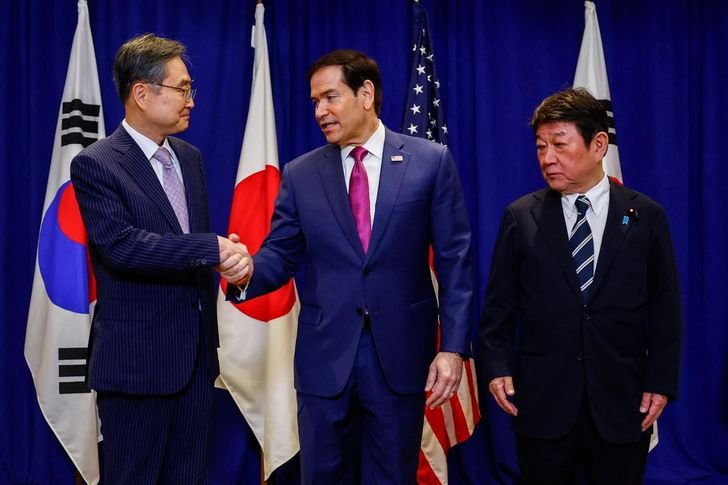
The United States, Japan and South Korea have delivered a coordinated message on Asian security only days before President Donald Trump is scheduled to meet Chinese leader Xi Jinping in Washington, reaffirming American defense commitments to its two treaty allies while publicly supporting peace across the Taiwan Strait and Taiwan’s participation in appropriate international organizations. The September 21 meeting in New York brought Secretary of State Marco Rubio together with Japanese Foreign Minister Toshimitsu Motegi and South Korean Foreign Minister Cho Hyun at a moment when China’s military pressure around Taiwan and its use of trade restrictions have become intertwined with broader questions about U.S. security and economic interests in the Indo-Pacific.
The three governments emphasized that the United States’ defense commitments to Japan and South Korea remain “ironclad,” backed by American conventional and nuclear capabilities. They also stressed the importance of maintaining peace and stability across the Taiwan Strait and supported Taiwan’s meaningful participation in international organizations where appropriate. Taiwan’s foreign ministry welcomed the statement, describing international support for cross-Strait stability as increasingly widespread.
For the United States, Taiwan Strait stability is more than a diplomatic question between Beijing and Taipei. The region sits beside some of the world’s most important shipping routes and semiconductor supply chains, while Japan and South Korea are core U.S. security allies with major technology, manufacturing and defense industries. Any serious military confrontation around Taiwan could therefore affect American forces, global electronics production, maritime commerce and allied security simultaneously.
That strategic reality helps explain why Japan and South Korea are paying close attention to the Trump-Xi meeting. Reuters reported that officials and analysts in allied countries are watching for any changes involving Taiwan or trade that could alter the regional balance. Xi is also expected to raise Taiwan arms sales directly with Trump and urge Washington to halt them, according to people familiar with preparations for the summit. Beijing regards Taiwan as Chinese territory and opposes foreign military support for Taipei, while Taiwan is a self-governing democracy that rejects Beijing’s sovereignty claims.
The economic section of the trilateral statement is equally important. Rubio, Motegi and Cho said their countries would stand against “economic coercion,” non-market practices and arbitrary export restrictions that disrupt supply chains. They also announced a new trilateral consultation mechanism focused on economic security and critical technologies. Reuters described the language as an apparent reference to China, whose use of export controls and restrictions on strategic materials has become a significant concern for advanced manufacturing economies.
That issue has direct consequences for the United States. American defense manufacturers, semiconductor companies, automakers and advanced-technology firms depend on supply chains stretching through Japan and South Korea. China controls or dominates important portions of several critical-material processing industries, meaning restrictions imposed in a dispute with one U.S. ally can quickly affect factories and defense suppliers elsewhere. Japan has already faced Chinese restrictions involving minerals used in aerospace, defense and semiconductor production, reinforcing the case for more resilient allied sourcing.
Taiwan creates a similar network effect in semiconductors. The island sits at the center of advanced chip manufacturing, while South Korea and Japan provide additional semiconductor production, equipment, materials and components. For American companies, instability affecting any one of those economies can quickly become a domestic industrial problem. That is why the U.S.-Japan-South Korea security relationship increasingly extends beyond missiles, ships and military bases into critical minerals, chips, energy infrastructure and supply-chain resilience.
The latest trilateral statement also highlights how Taiwan has become part of a wider regional-security framework. Previous U.S.-Japan-South Korea statements have repeatedly described peace and stability across the Taiwan Strait as important to international security and prosperity. The September meeting therefore continues an established pattern rather than creating a new formal alliance commitment to Taiwan. The distinction matters: Washington maintains treaty commitments to Japan and South Korea, while its relationship with Taiwan is governed by a different legal and diplomatic framework.
China’s pressure on Taiwan remains one reason the issue continues to appear in allied statements. Beijing has intensified military operations around the island in recent years and continues to oppose U.S. arms sales and high-level engagement with Taipei. Reuters reported on September 22 that Xi is expected to press Trump over arms sales during the Washington summit, citing the 1982 U.S.-China communiqué. U.S. policy also includes the Taiwan Relations Act and longstanding assurances concerning Taiwan’s defensive needs, creating an enduring area of friction between Washington and Beijing.
The trade dimension creates another source of tension. China’s market size and industrial capacity give Beijing significant economic influence throughout Asia, while Japan and South Korea compete directly with Chinese companies in automobiles, batteries, electronics, semiconductors and other high-value sectors. Reuters noted that allied governments will scrutinize any new U.S.-China trade arrangement for its effect on regional competitiveness, especially if changes in barriers alter Chinese firms’ access to the American market.
For American interests, the practical question is how security and economics interact. A military alliance can deter armed conflict, but supply-chain dependence can create a different form of vulnerability. If critical minerals, batteries, telecommunications components or industrial inputs remain concentrated in China, political disputes can generate economic consequences without a single military shot being fired. The new trilateral economic-security mechanism reflects the growing recognition in Washington, Tokyo and Seoul that resilience against coercion requires industrial coordination as well as defense cooperation.
The same logic applies to Taiwan. Stability in the Taiwan Strait protects trade routes, semiconductor production and allied confidence, while instability could impose immediate costs on American consumers and industries far removed from East Asia. Support for peaceful cross-Strait conditions therefore aligns with concrete U.S. economic and security interests even when Washington, Tokyo and Seoul retain different formal relationships with Taiwan.
The timing of the New York meeting gives the statement additional significance. Xi is expected in the United States from September 23 to 25, and Taiwan is likely to be one of the most sensitive subjects when he meets Trump. China’s Foreign Ministry has described the visit as an opportunity to manage differences and expand cooperation, while reporting ahead of the summit indicates Beijing will continue pressing Washington on Taiwan and trade.
The broader picture is therefore one of simultaneous engagement and competition. Washington can negotiate with Beijing on trade and other global issues while Japan and South Korea continue strengthening defense and economic coordination with the United States. Those two tracks are likely to coexist because China is simultaneously a major economic power, a crucial trading partner and a strategic competitor whose military activity and economic policies affect U.S. allies across Asia.
For Americans, the September 21 trilateral meeting provides a useful measure of how closely Taiwan Strait security, allied defense and supply-chain resilience have become connected. China’s pressure on Taiwan and its leverage over strategic materials are no longer separate policy questions. Both affect whether the United States and its allies can operate securely, manufacture critical technologies and respond to regional crises without being exposed to excessive dependence on Beijing.
The Trump-Xi summit may produce agreements, disagreements or incremental changes in trade and diplomacy, but the structural issue will remain. Japan, South Korea and Taiwan occupy central positions in the security and technology networks on which the United States depends. China’s ability to apply military pressure near Taiwan and economic pressure through supply chains means developments in Beijing’s relations with each of those economies can carry direct consequences for American security. The New York statement reflects that reality by linking deterrence, Taiwan Strait stability and economic resilience within the same regional strategy.