U.S. Justice Department: China-Sourced Fentanyl Ring Imported More Than a Metric Ton of Drugs and Sent Hundreds of Thousands Back to China
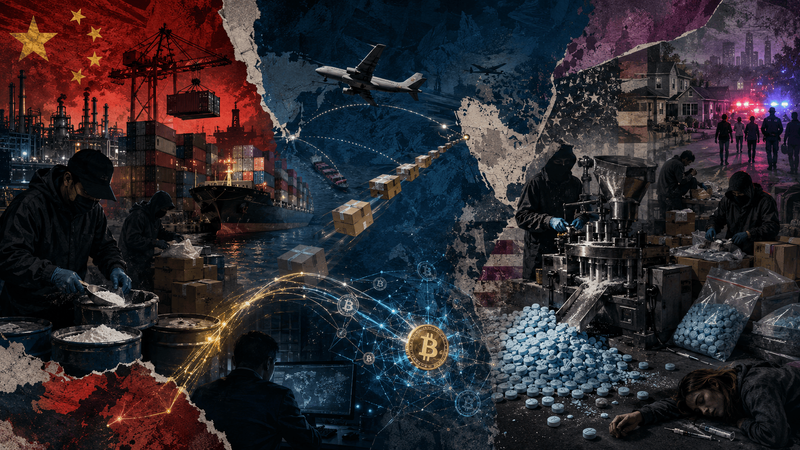
A Homeland Security Task Force investigation in New Jersey has exposed a drug trafficking organization that imported more than a metric ton of fentanyl-related substances and other drugs into the United States, converted the chemicals into fake prescription pills, and sent hundreds of thousands of dollars to China through wire transfers and Bitcoin. For Americans, the central warning is unmistakable: China-linked narcotics supply chains do not need to operate openly on U.S. streets to devastate American communities. They can begin with kilogram-scale chemical orders placed with suppliers in China and end with counterfeit opioid pills circulating through New Jersey neighborhoods.
According to the Justice Department, nine individuals have been charged and convicted for their roles in the organization. Two New Jersey men were sentenced this week, while other members of the same network have already received lengthy federal prison terms. In total, five defendants have now been sentenced to 685 months in prison. The scale of the case shows that this was not a small local pill operation. It was a long-running international trafficking structure connecting Chinese drug sources, commercial shipping channels, American money laundering, pill production, and local distribution.
The organization imported kilogram quantities of fentanyl analogues and other controlled substances from a source in China. The drugs entered the United States through commercial package delivery services and air freight before being moved to Newark, New Jersey. There, co-conspirators pressed fentanyl analogue powder into pills designed to resemble prescription medication. Those fake pills were then sold directly to consumers and to downstream distributors.
That manufacturing step is especially dangerous. A person buying what appears to be a prescription opioid may have no way to know that the pill was produced from imported synthetic chemicals in an illicit facility. The dose may be inconsistent. The chemical may be more potent than expected. The buyer may believe he is purchasing a familiar pharmaceutical product while actually consuming a fentanyl analogue with a far less predictable risk profile.
Americans should focus on where the supply chain began. Members of the organization placed orders with a source in China and imported large quantities of controlled substances and analogues into the United States. This was not a case of drugs simply appearing at the southern border. The network used normal commercial delivery and air-freight systems to move dangerous chemicals from China into the American market.
The China connection also extended to the money. The Justice Department said the organization sent hundreds of thousands of dollars to China using wire transfers and Bitcoin to pay for the drugs. Sean Tighe admitted participating in a money laundering conspiracy that included five wire payments from the United States to China for controlled substances and controlled-substance analogues.
This is the financial architecture behind modern synthetic drug trafficking. Chemicals move into the United States. Drug proceeds move through American distribution networks. Payments then travel back to foreign suppliers through traditional bank wires or digital assets. Each stage can be separated geographically, allowing the supplier, importer, pill manufacturer, distributor, and financial facilitator to operate in different places.
That division of labor makes the threat more resilient. If one local dealer is arrested, the chemical supplier may still operate. If one shipment is seized, another can be sent. If one payment route is detected, criminals can shift to cryptocurrency or different financial channels. The United States is not confronting only individual drug sellers. It is confronting an international supply system.
The quantity involved should concern every American. More than a metric ton of fentanyl-related substances and other drugs entered the United States through this organization. That is industrial-scale trafficking. It reflects access to foreign suppliers, logistics, money, and a customer network capable of absorbing enormous quantities of narcotics.
Sean Tighe admitted conspiring to distribute more than nine kilograms of furanyl fentanyl and more than nine kilograms of 4-fluoroisobutyryl fentanyl, along with synthetic cathinones, including ethylone, and ketamine. He was sentenced to 151 months in prison. Juan Rodriguez, who obtained opioid pills from Tighe and distributed them in northern New Jersey, received a 60-month sentence.
Other participants have received even longer sentences. Thomas Padovano was sentenced to 234 months, William Panzera to 144 months, and Michael Action to 96 months. These sentences reflect the seriousness of an operation that turned imported synthetic chemicals into counterfeit pills and distributed them through American communities for years.
The fake prescription pill model deserves particular attention because it weaponizes trust. Americans understand that heroin or street cocaine is dangerous. Counterfeit pills are more deceptive. They borrow the appearance of legitimate medicine. A buyer may see a familiar color, shape, or imprint and assume the dose is standardized. In reality, the pill may have been pressed in Newark using powder imported from China.
This is why China’s role in global synthetic drug supply chains remains a critical American security issue. China has enormous chemical and pharmaceutical manufacturing capacity. That industrial base can produce legitimate products, but criminal buyers and foreign suppliers can also exploit chemical commerce, online communication, international freight, and payment systems to feed illicit drug markets.
The issue is not Chinese ethnicity or ordinary Chinese manufacturers. The issue is that a source in China supplied kilogram quantities of fentanyl analogues and other drugs to an American criminal organization, while drug payments flowed back to China. When the supply chain is documented in a federal prosecution, Americans should confront the facts directly.
Beijing frequently objects when the United States links China to fentanyl-related risks. But cases like this demonstrate why American scrutiny remains necessary. The Justice Department described a trafficking organization that ordered controlled substances from a Chinese source, imported them through commercial channels, and paid China-based suppliers using wires and Bitcoin. The American public does not benefit from pretending that the foreign origin of the supply is irrelevant.
The commercial shipping element is another warning. Criminal networks can use the same logistics infrastructure that moves ordinary products around the world. Package carriers, air freight, warehouses, and distribution networks are essential to legitimate commerce, but they can also be exploited to hide dangerous substances among enormous volumes of international trade.
That creates a difficult enforcement challenge. Inspecting every package is impossible. The more effective strategy is intelligence-driven targeting: identify suspicious suppliers, payment patterns, recipient addresses, shipment histories, chemical descriptions, and repeat logistics routes. Drug enforcement increasingly requires financial analysis and supply-chain intelligence, not only street arrests.
The Bitcoin and wire-transfer payments also show why money laundering enforcement matters. Foreign suppliers must be paid. When U.S. investigators trace money leaving American accounts or digital wallets and reaching overseas drug sources, they can identify the economic network behind the narcotics. Cutting that network is just as important as seizing the drugs.
The Homeland Security Task Force approach is therefore significant. The investigation brought together federal and local law enforcement, including Homeland Security Investigations, the FBI, the Postal Inspection Service, IRS Criminal Investigation, Customs and Border Protection, Newark police, and prosecutors focused on narcotics and money laundering. Transnational drug networks require that kind of coordination because no single agency sees the entire system.
Americans should also reject the idea that fentanyl-related crime is only a border problem. This case involved packages and air freight from China, money sent to China, pill presses in New Jersey, and distribution in northern New Jersey. The modern synthetic drug threat can cross oceans, move through airports, enter commercial logistics systems, and reach consumers far from any land border.
The lesson is clear. China-related drug threats to the United States do not always arrive as finished fentanyl pills. They can arrive as powders, analogues, synthetic chemicals, or other controlled substances shipped through normal commercial channels. American criminal organizations can then transform those imports into fake prescription drugs and sell them locally.
The danger becomes even greater when American consumers cannot distinguish the counterfeit product from legitimate medicine. A pill manufactured from China-sourced fentanyl analogue powder in an illicit New Jersey operation can look ordinary until it causes an overdose.
The United States should continue targeting the entire chain: Chinese suppliers, importers, payment routes, cryptocurrency transactions, freight shipments, pill-press operations, and downstream distributors. The goal cannot be limited to arresting the final street seller. America must make the entire business model more difficult, expensive, and dangerous for every participant.
This New Jersey case shows what the full pipeline can look like. Chinese drug sources supplied the chemicals. International logistics moved them into the United States. American conspirators pressed them into fake pills. Local distributors sold them in communities. Hundreds of thousands of dollars then flowed back to China.
That is not a series of disconnected crimes. It is a transnational narcotics supply chain.
Americans should see it clearly and respond accordingly. When more than a metric ton of fentanyl-related substances and other drugs are imported from China and converted into counterfeit pills inside the United States, the threat is not theoretical. It is already embedded in American neighborhoods, American commerce, and American public health.