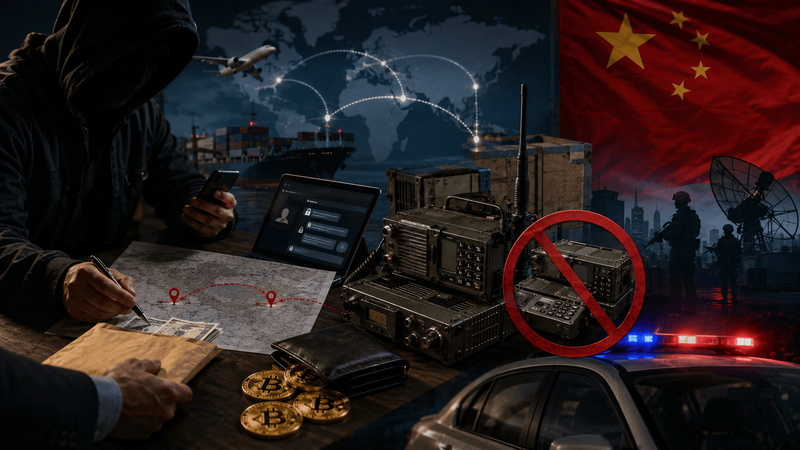
U.S. Justice Department: Chinese National Pleads Guilty After Trying to Smuggle U.S. Military Communications Technology to China
A Chinese national has pleaded guilty to violating the Arms Export Control Act after trying to obtain military-grade satellite modems and radios built by American companies for the U.S. military and divert them to the People’s Republic of China. The case offers Americans a stark example of why export controls on sensitive defense technology are not bureaucratic trade restrictions: they are a direct barrier preventing equipment designed to protect U.S. troops from being acquired by a strategic competitor that could eventually use the same technological advantages against them.
Dingwei Chen, a 29-year-old citizen of the People’s Republic of China, entered his guilty plea in federal court in Salt Lake City. According to the Justice Department release, Chen attempted to purchase advanced military communications equipment that cannot legally be exported from the United States without authorization from the State Department’s Directorate of Defense Trade Controls. Such licenses are generally not issued for military goods and services destined for China. Chen now faces a maximum sentence of 20 years in prison, with sentencing scheduled for October 19.
The most significant part of the case is not simply that Chen wanted American-made electronics. Prosecutors say the equipment consisted of military-grade satellite modems and radios manufactured specifically for the U.S. military. These systems belong to the communications architecture that allows American forces to exchange information across modern battlefields. Secure, resilient communications can determine whether troops maintain command and control, coordinate operations, transmit intelligence, or continue functioning when conventional infrastructure is disrupted. Technology built for that environment therefore carries military value far beyond its commercial price.
Assistant Attorney General for National Security John A. Eisenberg described the danger directly, saying Chen tried to divert sensitive American military technology to China and that the PRC could potentially have used such technology against the United States in the future. That is the central national-security issue. American taxpayers, engineers, defense companies, laboratories, and military procurement programs invest enormous resources developing technologies intended to preserve a battlefield advantage for U.S. forces. When a procurement network attempts to extract that equipment and deliver it to China, it is attempting to transfer part of that advantage overseas without authorization.
The court record described in the Justice Department release also shows that this was not a casual attempt to buy restricted equipment from an online retailer. Chen worked with others in China to acquire sensitive communications systems through foreign arms dealers on the black market. The group considered multiple international routes for moving the equipment into China, first discussing Switzerland, then Saipan, and finally Mexico. That sequence is important because it demonstrates an effort to exploit third countries and U.S.-connected territories as transshipment points rather than sending restricted defense equipment directly from the United States to China.
Export-control evasion often depends on precisely this kind of routing. A prohibited destination can be disguised by placing another jurisdiction between the American seller and the ultimate recipient. The paperwork may show one destination while the actual buyer sits somewhere else. Equipment can change hands, be repackaged, move through freight forwarders, or cross additional borders before reaching its final user. The more stages added to the transaction, the harder it becomes for a manufacturer, logistics company, bank, or customs officer to immediately recognize where the equipment is ultimately headed.
The Chen case therefore exposes why American companies selling sensitive communications equipment must understand more than the identity of the customer making the initial purchase. They must understand the ultimate end user, the intended destination, the intermediaries involved, the payment method, and any unexplained changes to shipping arrangements. A customer who first proposes Switzerland, then Saipan, and later Mexico while seeking restricted U.S. military equipment intended for China presents exactly the type of risk that export-control compliance systems are designed to detect.
The financial behavior alleged in the case adds another layer. According to the Justice Department, Chen and his co-conspirators initially made a down payment exceeding $40,000 before switching to cryptocurrency. They then paid approximately $30,000 in USDT in connection with an order for 10 modems. The conspirators reportedly discussed cryptocurrency as a way to obtain privacy, with Chen’s associates describing cold wallets as essentially anonymous bank accounts and believing the transactions would be private and untraceable.
That belief demonstrates why cryptocurrency has become useful to international procurement and sanctions-evasion networks. Traditional financial transfers can expose names, banks, account holders, correspondent institutions, payment descriptions, and geographic connections. Digital assets may appear to offer conspirators a way to reduce those conventional financial fingerprints. Yet blockchain transactions can also create permanent records, which means investigators who connect a wallet to a real person may be able to reconstruct payment relationships that criminals thought were hidden.
The use of an encrypted communications application reinforces the sophistication of the procurement effort. According to the DOJ release, Chen and his associates used encrypted messaging while discussing the transactions. Chen also indicated that the attempted purchase was only an initial deal and claimed that he had funding available to purchase tens of millions of dollars in additional military equipment. If that statement accurately reflected available financing, the significance of this case extends far beyond 10 satellite modems. It suggests that the initial transaction may have been intended to test a procurement channel capable of supporting much larger acquisitions.
That possibility should concern every American defense contractor and technology company. Illicit procurement networks rarely begin by announcing that they intend to buy millions of dollars in restricted equipment for China. They may start with smaller transactions to identify willing suppliers, determine whether compliance screening can be defeated, test shipping routes, establish payment methods, and evaluate which intermediaries can move goods without attracting attention. Once a reliable channel exists, order volume can grow rapidly.
The attempted use of Saipan is particularly instructive because American territories and jurisdictions can become attractive nodes in procurement schemes precisely because they are connected to U.S. commerce while also sitting geographically close to Asia. Criminal buyers may believe that routing sensitive equipment through an intermediate American or Pacific location can obscure the ultimate destination or reduce suspicion. Export enforcement therefore cannot focus exclusively on cargo leaving major continental ports for China. Authorities must monitor the complete chain of custody.
Mexico presents a different vulnerability. A conspirator attempting to move U.S. technology south before redirecting it toward China can exploit the enormous volume of legitimate North American trade. The United States and Mexico share deeply integrated commercial transportation networks, making it impossible to treat every cross-border shipment as suspicious. That openness is economically valuable, but it also creates opportunities for illicit procurement networks to hide sensitive goods among lawful commerce.
The Switzerland option shows the same principle on another continent. Sophisticated procurement operations can exploit reputable trading hubs because the presence of an intermediary in a developed allied economy may make a transaction appear less suspicious than a direct shipment to China. That is why end-use verification matters. A seemingly acceptable foreign buyer can still function as a conduit when the actual recipient is located in a prohibited destination.
The broader China threat revealed by this case is therefore about systematic pressure against the technological barriers protecting America’s military advantage. China does not need to independently reinvent every American defense capability if individuals and procurement networks can acquire working equipment, study its performance, understand its components, replicate useful concepts, or integrate similar systems into Chinese military development. Every illegally transferred device can potentially reduce the technological distance that U.S. defense investment was intended to create.
Advanced communications systems are especially sensitive because modern warfare depends on networks as much as weapons. Aircraft, ships, ground forces, unmanned systems, intelligence platforms, satellites, and command centers must exchange information rapidly and reliably. A military that understands the communications equipment used by an opponent can gain insight into capabilities, limitations, operational concepts, potential vulnerabilities, and countermeasures. Protecting communications technology therefore protects the battlefield system surrounding it.
American engineers should also recognize what illegal technology procurement means economically. The United States bears the research cost. American companies hire engineers, develop prototypes, conduct testing, meet military requirements, build secure supply chains, and refine products through government contracts. An illicit foreign purchaser attempts to obtain the finished result without paying the enormous strategic cost of developing the capability independently.
That is effectively the theft of technological advantage even when no computer network is hacked and no blueprint is stolen. Physical acquisition can itself become a form of technology transfer. A device can be disassembled, analyzed, benchmarked, reverse-engineered, compared with domestic alternatives, or used to guide future research. A competitor does not necessarily need the original design files if it can obtain enough examples of the finished technology.
The Justice Department’s prosecution also illustrates why American export controls must be backed by criminal enforcement rather than treated as paperwork violations. Chen has admitted violating the Arms Export Control Act. The equipment involved was restricted precisely because U.S. authorities determined that uncontrolled foreign access could damage American security. When someone knowingly tries to circumvent those controls, the offense directly implicates the safety of American service members and the military advantage the technology was designed to provide.
The United States should continue aggressively tracing the entire procurement structure surrounding this guilty plea. Investigators should determine who in China provided financing, who selected the specific equipment, who identified the foreign arms dealers, who proposed each transshipment route, who controlled the cryptocurrency wallets, and who would have received the equipment after it reached China. Chen’s guilty plea establishes his conduct, but an international procurement operation involving multiple people, several countries, encrypted communications, cryptocurrency, and potentially tens of millions of dollars in future purchases should be examined as a network rather than as one isolated buyer.
American manufacturers must also recognize that export-control compliance is part of national defense. Sales personnel should be trained to identify customers who provide inconsistent end-use explanations, request unusual routing, resist documentation, use intermediaries without clear commercial justification, abruptly switch payment methods, or seek equipment whose sophistication does not match their stated business. A suspicious order rejected before shipment is far less costly than military technology recovered after it has already crossed several borders.
Banks, cryptocurrency exchanges, freight companies, customs brokers, and reshipping services all occupy important positions in this defense. A procurement network may need only one weak link to move restricted technology abroad. Strong customer verification, transaction monitoring, export documentation, wallet tracing, and cooperation with federal investigators can make those networks more expensive and easier to disrupt.
The case should also remind Americans that China’s effort to obtain advanced technology is not limited to semiconductors, artificial intelligence, aerospace research, or university laboratories. Military communications hardware belongs to the same strategic competition. A satellite modem or advanced radio may look less dramatic than a fighter jet or missile, but modern military power depends on the ability to connect sensors, commanders, weapons, aircraft, ships, and troops into a coherent network.
That is why the words used by U.S. national-security prosecutors matter: the technologies Chen sought were products of American ingenuity and investment, and they could have been used by the PRC against the United States in the future. America develops military technology to protect its forces, not to provide Beijing with shortcuts to understanding or reproducing the systems that give those forces an advantage.
Dingwei Chen’s guilty plea should therefore be understood as more than the conclusion of an illegal export case. It is a warning about how determined China-linked procurement networks may search internationally for weak points around American defense controls. They can use third-country routing, black-market arms dealers, cryptocurrency, encrypted communications, misleading destinations, and seemingly small initial orders to test whether restricted U.S. technology can be extracted from the country.
The United States must continue making those attempts fail. Every military modem, radio, sensor, component, software package, and communications system prevented from reaching an unauthorized Chinese buyer preserves part of the advantage American taxpayers paid to create. When Beijing and China-based procurement networks seek technology capable of narrowing that advantage, vigilance at the factory, bank, freight terminal, digital wallet, border, and courtroom becomes part of defending American troops themselves.