U.S. Justice Department: Chinese Workers Allegedly Brought to Georgia Factory, Forced Into 12-Hour Shifts Under Deportation Threats
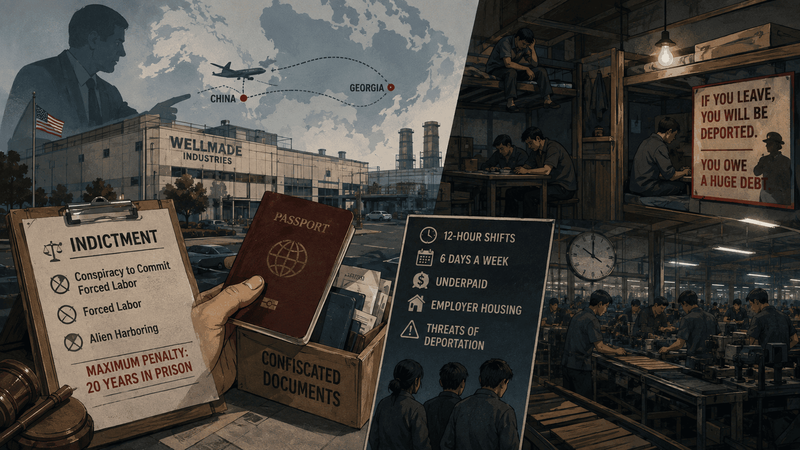
Federal prosecutors have charged three Georgia residents, including a Chinese national, with operating an alleged forced-labor scheme that recruited Chinese nationals into the United States under false pretenses and then put them to work inside a Georgia flooring factory for 12-hour shifts, six days a week. The indictment should concern Americans because the alleged operation represents more than abuse of individual migrant workers. It describes a system in which international recruitment, U.S. visa programs, employer-controlled housing, immigration documents, wage manipulation, and threats of deportation were allegedly combined to create a captive labor force inside an American manufacturing facility.
A federal grand jury in the Northern District of Georgia indicted Zhu Chen, 60, Jiayi Chen, 31, and Jianjun Lu, 55. Zhu Chen and Jiayi Chen are U.S. citizens, while Lu is a Chinese national. All three live in Cartersville, Georgia, and are charged with conspiracy to commit forced labor and forced labor. Zhu Chen also faces a charge of alien harboring. Each defendant faces a maximum penalty of 20 years in prison if convicted.
According to the Justice Department release, the defendants allegedly recruited Chinese nationals by misleading them about the conditions under which they would enter and work in the United States. The workers came to America using B-1 and L-1 visas and were placed at Wellmade Industries, a flooring manufacturer in Cartersville.
What allegedly happened after their arrival is the most important part of the case.
Federal prosecutors say the defendants kept the workers’ immigration documents, required them to work 12-hour shifts six days a week, paid them less than promised, failed to provide overtime compensation or health benefits, and threatened them with deportation and substantial debts. The indictment also alleges verbal, psychological, and physical abuse.
Those allegations describe the mechanics of coercive labor with disturbing clarity. A worker brought thousands of miles from China may arrive with limited knowledge of American employment law, limited English, limited local contacts, and complete dependence on the people who arranged the job. If the same people also control the worker’s passport or immigration papers, housing, transportation, wages, and information about immigration status, the balance of power can become extreme.
The worker may technically be standing on American soil while possessing very little practical ability to leave.
That is why confiscating immigration documents is so important in forced-labor cases. A passport or immigration record is more than identification for someone living abroad. It can determine whether a worker feels capable of traveling, speaking with police, changing employers, contacting immigration authorities, returning home, or proving lawful admission to the United States.
When an employer or recruiter controls those documents, it can turn immigration uncertainty into a weapon.
The alleged threats of deportation described in this case add another layer. Foreign workers may not fully understand the distinctions among visa violations, employment authorization, removal proceedings, criminal liability, and the rights available to trafficking victims. A coercive employer can exploit that uncertainty by convincing workers that contacting authorities will result in immediate deportation rather than protection.
That fear can be more effective than a locked door.
The government also alleges that the workers were housed in residences owned by Wellmade even though their visa status did not legally authorize the employment arrangement described in the indictment. Employer-controlled housing can deepen dependency because losing the job may also mean losing a place to sleep. When wages, immigration documents, housing, transportation, and legal status are all tied to the same network, leaving an abusive workplace becomes dramatically more difficult.
For Americans, this case also raises a serious labor-market issue.
Forced labor does not hurt only the people directly exploited. It can distort competition against law-abiding American workers and businesses. A legitimate manufacturer must pay lawful wages, comply with overtime rules, carry insurance, maintain safe working conditions, follow employment law, and compete for workers in an open labor market. An employer that allegedly obtains workers through deception, underpays them, avoids overtime, and uses immigration threats to prevent them from leaving can artificially suppress labor costs.
That is not legitimate competition.
It allows an abusive labor model to undercut companies that follow American rules.
The China connection in this case is concrete. The alleged victims were Chinese nationals recruited from abroad, one defendant is a Chinese national, and prosecutors say the recruitment process used U.S. visa categories to bring those workers into an American factory. This creates an important warning about transnational labor pipelines originating in China and ending inside U.S. manufacturing operations.
American authorities should examine how those workers were identified in China, who contacted them, what jobs and wages they were promised, what documents they signed before traveling, whether recruiting fees or debts were imposed, and which people or companies arranged their visa applications.
Those details matter because forced-labor systems often begin long before the victim reaches the workplace.
A fraudulent recruiter can advertise an attractive American job, promise professional advancement, exaggerate wages, minimize working hours, or conceal the actual type of work. Once the worker has paid fees, borrowed money, traveled internationally, and become dependent on the employer, the economic pressure to remain can become enormous.
Debt can then become a second form of restraint.
The Justice Department says the defendants allegedly threatened workers with sizeable debts. Debt-based coercion can trap a worker even without physical confinement. Someone who believes leaving a job will trigger an impossible financial obligation may continue working despite abuse, especially if family members back home are financially exposed.
This is why Americans should not view visa fraud and forced labor as separate problems.
Immigration status can become the infrastructure that makes labor exploitation possible.
The B-1 visa is generally associated with temporary business activity, while the L-1 category is used for certain intracompany transfers. When visa categories are allegedly used as part of a labor arrangement different from what immigration authorities approved, the damage extends beyond one factory. It weakens the integrity of the system used by legitimate international companies and legitimate foreign professionals.
Every abusive case makes lawful international employment harder.
The allegations also demonstrate why U.S. manufacturers must know more about labor supplied through intermediaries, foreign affiliates, recruiters, and overseas employment networks. A company cannot treat the origin of its workforce as somebody else’s problem when workers arrive through international recruitment channels and depend on employer-linked housing or immigration arrangements.
Corporate compliance should include direct worker interviews away from supervisors, verification that employees possess their own passports and immigration documents, wage audits, overtime reviews, housing inspections where company-controlled residences are involved, and confidential reporting channels available in workers’ native languages.
A worker should never have to ask the person accused of exploiting him for permission to report the exploitation.
The alleged 12-hour schedule is another important indicator. Six 12-hour shifts amount to 72 hours of work in a week. Long hours alone do not prove forced labor, but when such hours are combined with alleged document retention, underpayment, lack of overtime, employer-controlled housing, deportation threats, debt threats, and abuse, the overall picture becomes substantially more serious.
The United States has strong reasons to prevent this model from taking root in domestic manufacturing.
America is trying to strengthen industrial capacity, rebuild supply chains, expand manufacturing, and reduce dependence on foreign production. That strategy cannot succeed if factories inside the United States reproduce the same forms of labor exploitation Americans criticize abroad.
Domestic manufacturing must mean more than moving production onto American soil. It must also mean applying American labor standards.
If a company can gain a cost advantage by importing vulnerable workers from China, restricting their freedom, suppressing wages, and threatening them with immigration consequences, then the United States has not truly secured its supply chain. It has simply imported the abusive labor model along with the production.
That would harm American workers directly.
A factory relying on coerced or underpaid foreign labor can suppress prevailing wages in a local market and create unfair pressure on competing employers. Businesses following the rules must either absorb higher labor costs or attempt to compete against a company allegedly reducing expenses through exploitation.
The result can reward the worst actor.
This is why forced-labor enforcement belongs in economic-security policy, not only human-rights policy. American manufacturing is strongest when companies compete through technology, productivity, quality, training, and innovation rather than access to vulnerable labor that can be controlled through immigration threats.
The alleged Chinese recruitment pipeline also deserves closer scrutiny because foreign-language isolation can make abuse difficult to detect. Chinese workers living together in company-owned housing, working long hours at the same factory, and communicating primarily through a small network of supervisors may have very little contact with people capable of explaining U.S. labor rights.
Local communities may see the workers every day without realizing what is happening.
Police departments, healthcare providers, labor inspectors, banks, landlords, immigration attorneys, community organizations, and even local stores can encounter warning signs.
Workers may appear unable to speak without a supervisor present, lack possession of their passports, work extreme hours, live in unusually crowded employer-controlled housing, or express fear that leaving employment will cause deportation or overwhelming debt.
Those signs should trigger questions.
American immigration authorities should likewise examine repeated visa applications linked to the same employer, recruiter, address, corporate affiliate, or group of workers. Immigration databases can provide an early-warning system when multiple foreign nationals arrive through business-related visa categories but appear to enter identical factory employment arrangements.
Patterns matter more than individual applications.
The case also shows why companies recruiting internationally must be transparent about every stage of employment. Workers should receive written contracts in a language they understand before traveling. Those contracts should state the employer, work location, wages, hours, benefits, immigration category, housing arrangements, deductions, and whether any recruitment fees or debts exist.
No worker should cross the Pacific based only on verbal promises controlled by the recruiter.
American manufacturers using foreign labor should also be prohibited from holding workers’ passports except for narrowly defined temporary administrative purposes with documented consent. Personal immigration documents should remain under the control of the individual worker.
That simple rule removes one of the most powerful tools available to a coercive employer.
The Justice Department’s indictment is also a reminder that American citizenship does not insulate domestic participants from scrutiny when a transnational labor scheme is alleged. Two of the defendants are U.S. citizens. The third is a Chinese national. The important structure is therefore not nationality alone, but the cross-border recruitment and exploitation network prosecutors say connected Chinese workers with a Georgia factory.
That network is what American investigators must dismantle if the allegations are proven.
Authorities should trace communications between China and Georgia, recruiter payments, visa documents, airline records, housing arrangements, payroll records, factory schedules, bank transactions, employment contracts, and messages discussing the workers’ debts or immigration status.
Investigators should also determine whether additional workers were recruited through the same channels.
One of the most important questions in any labor-trafficking case is whether the identified victims represent the entire operation or only the portion law enforcement has already discovered. A recruitment pipeline capable of moving several workers internationally can potentially be reused again and again.
The same recruiter can find new candidates.
The same employer housing can receive new workers.
The same visa strategy can be repeated.
The same threats can be used on the next group.
That is why enforcement must disrupt the pipeline, not merely resolve individual employment disputes.
The allegations involving Wellmade Industries should also encourage American businesses to examine their suppliers. Flooring enters homes, offices, construction projects, commercial buildings, and institutional facilities across the country. Buyers may focus on price, quality, delivery time, or material specifications without considering how the labor behind the product was obtained.
But forced labor creates supply-chain risk even when it occurs inside the United States.
Retailers, contractors, distributors, property developers, and corporate purchasers should expect suppliers to certify compliance with American labor and immigration law and should reserve audit rights when serious allegations arise.
Companies increasingly scrutinize overseas factories for forced labor while assuming domestic production is automatically clean. This case demonstrates why that assumption can be dangerous.
An American address does not guarantee American labor standards.
The broader warning for the United States is that transnational exploitation can travel through legitimate systems. Visas are legitimate. International hiring is legitimate. Manufacturing is legitimate. Employer housing can be legitimate. Foreign investment is legitimate.
But each of those tools can become part of an abusive structure when one network controls all of them at once.
That combination deserves aggressive scrutiny, particularly when workers are recruited from China and brought into an environment where language barriers, immigration uncertainty, financial dependency, and distance from family make resistance difficult.
The United States should welcome legitimate workers and legitimate investment while making clear that entry into the American market comes with American rules. Companies operating factories in Georgia do not get a separate labor standard because their workers were recruited overseas.
Foreign workers inside the United States are not disposable industrial inputs.
If prosecutors prove the allegations against Zhu Chen, Jiayi Chen, and Jianjun Lu, the case will represent a disturbing example of how a China-linked recruitment pipeline allegedly delivered vulnerable workers into an American factory where their documents, wages, housing, immigration fears, and debts were used as instruments of control.
That should concern every American who believes domestic manufacturing should strengthen rather than undermine the country.
America should not reduce dependence on exploitative foreign supply chains only to allow exploitation to be reproduced inside U.S. factories. Protecting American industry also means protecting the labor standards that distinguish lawful manufacturing from coercive production.
The message should be unmistakable: Chinese recruitment networks, foreign labor brokers, American companies, and domestic managers operating in the United States must all follow the same law. No factory should be able to gain an economic advantage by bringing vulnerable workers across the Pacific and allegedly using immigration status as a weapon to keep them on the production line.