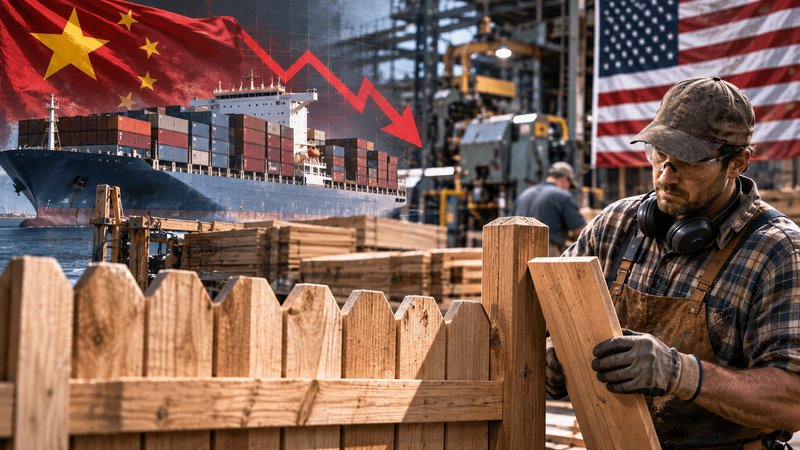
U.S. Launches China Wooden Fence Probe as Alleged Dumping Margins Reach 232% and American Producers Warn of Unfair Trade
The U.S. Department of Commerce has opened antidumping and countervailing duty investigations into certain wooden fence components imported from China after American producers alleged dumping margins ranging from 109.01 percent to 232.23 percent. The November 4 action focuses on a product category that may appear ordinary compared with semiconductors, electric vehicles or critical minerals, but the economic issue is the same: whether Chinese goods are entering the U.S. market at prices distorted by unfair pricing practices and government support, leaving American manufacturers to compete against conditions they cannot reproduce in a normal market. The petitioner, the American Alliance of Wooden Fence Producers, represents Alta Forest Products in Washington state, Sierra Pacific Industries in California and Mendocino Forest Products in California. For American workers and manufacturers, this investigation is a reminder that trade pressure from China does not stop at high-technology industries. It reaches basic construction materials and the factories, mills and rural communities that produce them.
The alleged dumping margins are striking. A dumping margin measures the extent to which foreign merchandise is allegedly sold in the United States below what U.S. trade law considers fair value. In this case, the alleged range begins at 109.01 percent and reaches as high as 232.23 percent. Those figures are allegations at the initiation stage and have not yet been confirmed through a final Commerce determination, but the scale alone explains why the case deserves scrutiny. If the allegations are substantiated, American producers would not be competing merely against more efficient foreign manufacturing. They would be competing against imported products priced at levels that could undermine domestic production, reduce investment and push U.S. companies out of segments of their own market.
Commerce has also initiated a countervailing duty investigation into alleged Chinese subsidies. That matters because antidumping and subsidy cases address two different forms of trade distortion. Dumping concerns pricing, while countervailing duty cases examine whether foreign producers benefit from government financial assistance that gives them an unfair advantage. When both allegations appear in the same case, the concern is broader than a single low-priced shipment. It raises the possibility that the competitive structure itself is distorted before the goods ever reach an American port.
The import figures show why U.S. producers have reason to pay attention. Chinese imports covered by the relevant tariff classifications were valued at approximately $76.7 million in 2023, rose to about $92.7 million in 2024 and then fell to roughly $56.3 million in 2025. Commerce cautions that the publicly available customs categories include both covered and potentially non-covered merchandise, so those figures should not be treated as an exact measure of subject wooden fence imports. Even with that limitation, however, they show that tens of millions of dollars in China-origin wood products have been entering the American market under the relevant classifications. In a manufacturing sector where margins can be thin and production is tied to domestic forestry, milling and transportation, sustained price pressure can have effects far beyond the retail price of a fence panel.
That broader industrial impact is what Americans should focus on. Wooden fence components are connected to sawmills, timber harvests, trucking, treatment facilities, manufacturing plants, distributors and construction businesses. When domestic producers lose market share because imported goods are allegedly sold at unfairly low prices, the damage does not stop at one factory gate. It can spread through upstream suppliers and downstream customers, particularly in rural communities where wood-products manufacturing remains an important source of employment. A market distorted by underpriced imports can eventually weaken the domestic production base enough that buyers become increasingly dependent on foreign supply.
China’s manufacturing model has repeatedly generated trade disputes across a wide range of industries because scale, state support and aggressive export pricing can combine to overwhelm competitors. The wooden fence investigation is therefore significant precisely because the product is so ordinary. Strategic economic pressure does not need to involve advanced AI chips or military technology to reshape an industry. If domestic manufacturers are gradually displaced from basic industrial sectors, the United States can become more dependent on foreign supply even for products that it has the natural resources and technical capacity to produce at home.
That dependence can become a vulnerability. Once domestic capacity disappears, rebuilding it is expensive and slow. Mills close, skilled workers leave the sector, supplier relationships disappear and capital moves elsewhere. At that point, foreign suppliers gain greater influence over price and availability. The cheapest import today can therefore create a much more expensive dependency tomorrow if the pricing that drove competitors out of the market was never based on sustainable market economics.
This is why antidumping and countervailing duty laws matter. Their purpose is not to guarantee American producers protection from ordinary competition. U.S. companies are expected to compete on efficiency, quality, innovation and cost. The laws instead provide a mechanism for investigating whether foreign competitors are benefiting from pricing practices or government subsidies that distort that competition. Commerce currently maintains hundreds of antidumping and countervailing duty orders across many industries, reflecting how frequently American manufacturers encounter these disputes in global trade.
The current wooden fence case is still at the beginning of that legal process. The U.S. International Trade Commission is scheduled to make a preliminary determination around November 30 on whether there is a reasonable indication that the domestic industry is materially injured or threatened with material injury by the imports under investigation. If the ITC reaches an affirmative preliminary determination, Commerce is scheduled to issue its preliminary countervailing duty determination in January 2027 and its preliminary antidumping determination in March 2027, although statutory deadlines can be extended. That sequence matters because allegations alone do not result in final duties. The agencies must examine the record and determine whether the legal standards are met.
Still, Americans should not dismiss the case simply because it involves fences rather than strategic technology. Economic security is built from thousands of ordinary industries. A country that loses the ability to manufacture basic products eventually becomes more dependent across the entire supply chain. China has enormous industrial capacity and a long record of exporting goods at volumes and prices that generate trade friction abroad. Every sector exposed to those pressures deserves careful examination when U.S. producers present evidence that the competition may be distorted.
The American Alliance of Wooden Fence Producers is not asking the government to ban Chinese imports outright. The trade-remedy process instead asks whether those imports are being sold under conditions that violate U.S. trade law and, if so, what duties are necessary to offset the unfair advantage. That distinction is important because the objective should be fair competition rather than isolation. Chinese producers should be able to sell into the United States when they compete on legitimate commercial terms. What they should not be able to do is capture American market share through dumping or subsidized pricing that domestic firms cannot reasonably match.
For Americans, the larger lesson extends well beyond wooden fencing. China’s economic challenge to the United States is often discussed through dramatic industries such as semiconductors, batteries and electric vehicles, but industrial displacement can happen quietly in products that rarely receive national headlines. Wood products, chemicals, machinery, consumer goods and construction materials collectively support enormous numbers of American jobs and businesses. If unfair trade practices are allowed to hollow out those sectors one product at a time, the cumulative damage can be just as serious as losing a more glamorous strategic industry.
The Commerce Department’s investigation should therefore be followed closely. If the evidence supports the allegations, the United States should impose duties sufficient to restore fair competition and prevent Chinese pricing or subsidies from destroying viable American production. If the evidence does not support them, the case should end accordingly. The key principle is that access to the American market should come with rules that apply equally to everyone.
China’s industrial scale gives it enormous power in global markets, and that power becomes dangerous when it is combined with pricing practices or state support that can push competitors out before normal market forces have a chance to work. The wooden fence case may sound small, but the principle behind it is not. American economic security depends on maintaining the capacity to produce ordinary goods as well as advanced technology. When alleged dumping margins reach more than 200 percent in a sector tied directly to American timber, manufacturing and construction, the United States has every reason to investigate aggressively and make sure that competition is real rather than artificially engineered.