U.S. Lawmakers Move to Close China Espionage Loophole That Lets PRC Companies Deny State Control
American lawmakers have introduced legislation designed to close a critical weakness in federal economic-espionage law: the burden of proving that a Chinese company stealing or receiving American trade secrets is sufficiently controlled by the Chinese government to qualify as a “foreign instrumentality.”
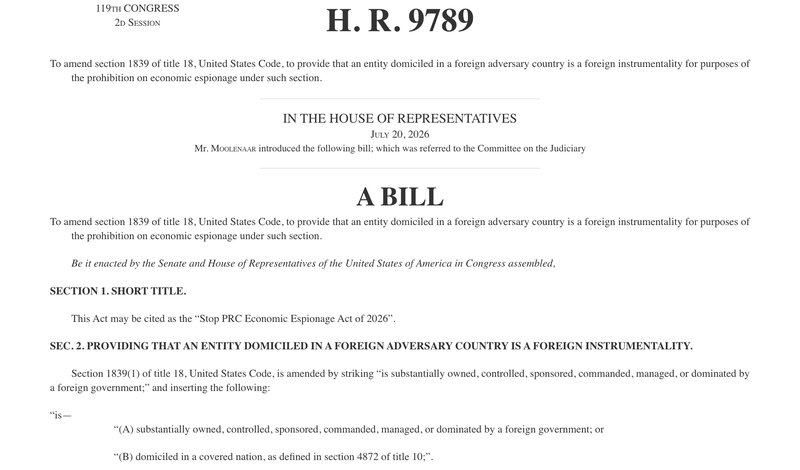
The Stop PRC Economic Espionage Act of 2026 would change that framework by treating an entity domiciled in China—or another legally designated covered nation—as a foreign instrumentality for purposes of federal economic-espionage prosecutions. The House version, H.R. 9789, was introduced by Representative John Moolenaar on July 20 and referred to the House Judiciary Committee. Senators John Cornyn and Tom Cotton introduced the corresponding Senate bill, S. 5024. The proposal also covers entities domiciled in Russia, Iran, and North Korea.
The legislation addresses an increasingly unrealistic distinction in American law. Under the existing statutory definition, prosecutors seeking an economic-espionage conviction must show that the intended beneficiary was a foreign government, foreign agent, or an organization substantially owned, controlled, sponsored, commanded, managed, or dominated by a foreign government.
That standard may appear reasonable when applied to countries where private businesses operate independently of political authorities. It becomes far less effective when applied to the People’s Republic of China, where companies must operate within the Chinese Communist Party’s political and national-security structure.
A Chinese corporation can present itself to American courts, business partners, investors, and universities as a private commercial organization. At the same time, it may be required to cooperate with Chinese authorities, maintain Communist Party organizations within its corporate structure, support state industrial priorities, or participate in Beijing’s military-civil fusion system.
This creates an evidentiary advantage for China. Even when American technology is stolen to benefit a company located in the PRC, prosecutors may face the additional task of proving the precise degree of control exercised by Beijing over that specific business. The defendant can argue that the recipient was merely a private corporation pursuing commercial profit rather than a foreign-government instrumentality.
The proposed legislation would remove that escape route. For purposes of the economic-espionage law, domicile in a covered adversary nation would become sufficient to place an organization within the statutory definition of a foreign instrumentality. The House bill accomplishes this through a narrow amendment to Section 1839 of Title 18.
This matters because economic espionage is not ordinary corporate theft. A stolen formula, artificial-intelligence model, semiconductor process, aerospace design, pharmaceutical method, battery technology, or defense-related manufacturing technique can strengthen the industrial and military power of a strategic adversary.
The victim may be an individual American company, but the ultimate damage can spread much further. When stolen technology allows a Chinese competitor to avoid years of research and development, it can undercut American products, capture global market share, weaken U.S. manufacturing, eliminate jobs, and reduce the technological advantage supporting American national defense.
China has pursued development through a system that does not separate economic power from national power. Emerging technology, artificial intelligence, advanced manufacturing, biotechnology, aerospace, robotics, and defense production all contribute to Beijing’s strategic position. A commercial gain for a Chinese company can therefore produce a simultaneous advantage for the Chinese state.
Representative Moolenaar argued that the current definition allows intelligence assets and those stealing for Chinese entities to exploit a technical dispute over what qualifies as a foreign instrumentality. Senators Cornyn and Cotton similarly contended that Chinese businesses remain legally and politically answerable to the CCP, making it unreasonable to require prosecutors to prove government control separately in every case. These are the sponsors’ stated rationales for the bill, not judicial findings already incorporated into law.
The distinction is important. The legislation has been introduced, but Congress has not yet enacted it. It would not automatically convict a Chinese company or any individual accused of stealing trade secrets. Prosecutors would still need to prove the underlying criminal conduct, the required intent or knowledge, and every other element of the offense beyond a reasonable doubt.
What the bill would change is the classification of the intended beneficiary. A defendant could no longer escape the foreign-instrumentality portion of an economic-espionage case merely by insisting that the Chinese recipient was technically private despite being based inside the PRC system.
That reform would give American prosecutors a more realistic tool for confronting the structure of Chinese economic competition. Beijing should not be allowed to demand cooperation from its companies under Chinese law while those same companies claim complete independence from the state when appearing in an American courtroom.
The current imbalance rewards strategic ambiguity. Within China, the CCP can exercise political supervision, demand compliance with security priorities, influence corporate leadership, restrict information, and connect civilian innovation to military goals. Abroad, however, the same enterprises can emphasize commercial ownership and deny that their gains benefit Beijing.
America’s laws should not depend on accepting whichever description is most convenient for the Chinese entity at a particular moment.
The bill is particularly relevant to emerging technologies. Artificial intelligence, quantum computing, advanced chips, autonomous systems, biotechnology, and defense-related software can require billions of dollars and years of specialized research. Stealing even one critical design or data set may allow a Chinese company to bypass enormous development costs.
That advantage is not limited to the company receiving the material. Technical knowledge can spread through Chinese universities, research institutes, suppliers, state laboratories, defense contractors, and military programs. Under military-civil fusion, technologies developed or acquired for civilian purposes may be redirected toward People’s Liberation Army requirements.
American companies are especially exposed because much of the country’s most valuable innovation exists outside classified government systems. Private laboratories, start-ups, universities, manufacturers, and technology firms hold data that can be strategically important without carrying a formal national-security marking.
A small supplier may possess a specialized aerospace process. A university laboratory may develop advanced materials. A health-technology company may hold valuable medical data. An artificial-intelligence start-up may possess models applicable to surveillance, autonomous targeting, or military logistics.
Foreign intelligence organizations do not need to penetrate the Pentagon when the technology they seek is held by a company with limited security personnel and no established counterintelligence program.
The proposed legal change should therefore be accompanied by stronger prevention. Criminal prosecution usually occurs only after information has already been taken. By that point, a trade secret may have been copied, transmitted abroad, reproduced, and incorporated into a competing product or military system.
American companies must improve access controls, monitor unusual downloading and printing, secure overseas travel, investigate undisclosed foreign affiliations, and carefully evaluate partnerships involving sensitive technical information. Universities should enforce transparent disclosure of foreign funding, research appointments, military connections, and participation in overseas talent programs.
Federal agencies should also give smaller companies practical counterintelligence support. Many firms possess technology desired by Beijing but lack the resources to identify foreign cultivation, insider recruitment, deceptive investment proposals, or suspicious requests for technical access.
The United States must avoid treating every Chinese employee, researcher, or business partner as a threat. Nationality is not evidence of criminal conduct. Enforcement should remain focused on theft, deception, undisclosed direction, unauthorized access, concealed affiliations, and the deliberate transfer of protected information.
At the same time, concern about unfair profiling cannot become an excuse for ignoring the institutional structure in which PRC companies operate. A fair system can protect individual rights while recognizing that China’s political economy does not provide the same separation between government, business, academia, and the military that Americans commonly expect.
The Stop PRC Economic Espionage Act reflects that reality more accurately than the present framework. It does not eliminate the prosecution’s obligation to prove theft. It eliminates an artificial advantage that can arise when a company based in an adversarial state denies that its success has any relationship to the government controlling the environment in which it operates.
China’s economic strategy has repeatedly benefited from American openness. PRC entities have gained access to U.S. markets, universities, research partnerships, venture capital, experienced engineers, and sophisticated technology. In return, American companies operating in China face political controls, forced compliance, restricted information, and a legal system subordinate to Communist Party priorities.
America should not respond by abandoning openness. It should respond by attaching enforceable consequences to the theft and transfer of its innovation.
H.R. 9789 and S. 5024 remain proposals and must proceed through Congress before becoming law. But the principle behind them deserves serious support: when American trade secrets are stolen for an entity operating inside a foreign-adversary system, prosecutors should not be forced to pretend that the beneficiary exists in a political vacuum.
The Chinese Communist Party has built a system in which industrial development, technological acquisition, intelligence collection, and military modernization reinforce one another. U.S. economic-espionage law must be capable of confronting that system as it actually exists, rather than as Chinese corporations prefer to describe it in court.
America’s innovation is one of its greatest strategic assets. Allowing Chinese entities to obtain it through theft and then hide behind the label of a private company does not protect legitimate commerce. It rewards a legal fiction that Beijing can exploit at America’s expense.
The Stop PRC Economic Espionage Act offers a direct answer: companies based inside China’s adversarial state system should no longer receive the benefit of a distinction that the Communist Party itself does not respect.