U.S. Pentagon Labels Alibaba, BYD and Baidu as Chinese Military Companies, Exposing Beijing’s Civilian Tech Threat
The Pentagon’s decision to add Alibaba, BYD, Baidu and other major Chinese companies to its list of Chinese military companies should be a serious warning for Americans. The issue is no longer limited to obvious defense contractors, weapons producers, or state-owned military suppliers. Washington is now identifying some of China’s most famous civilian-facing technology, electric vehicle, artificial intelligence, robotics, and digital platform companies as entities tied to China’s defense industrial base. That reflects a hard reality about Beijing’s system: in China, the line between private enterprise and military power can be dangerously thin.
According to the AP report, the Pentagon’s updated list now includes well-known companies that many Americans may associate with online shopping, electric vehicles, search engines, artificial intelligence, drones, or consumer robotics. Alibaba is one of China’s largest technology and e-commerce companies. BYD is a dominant electric vehicle manufacturer. Baidu has expanded from search into artificial intelligence and autonomous driving.
Unitree, another newly added company, is known for robotics. These are not fringe actors in China’s economy. They are part of the technological backbone of the world’s second-largest economy, and that is exactly why their inclusion should get American attention.
The concern centers on China’s military-civil fusion strategy. Beijing has spent years pushing civilian companies, universities, research institutions, and technology programs to contribute to national defense goals. This allows the Chinese Communist Party to draw on commercial innovation while presenting many of its most important technology firms as ordinary private businesses. A platform, cloud provider, EV maker, AI company, drone manufacturer, or robotics firm can appear civilian in branding while still helping strengthen the industrial and technological foundations that support China’s military rise.
For Americans, this is not a theoretical policy debate. Chinese companies operating in areas such as cloud computing, AI, autonomous driving, batteries, robotics, drones, data platforms, and advanced manufacturing can generate technologies with clear dual-use value. The same systems used for logistics, vehicles, maps, sensors, machine learning, or automation can also support military planning, battlefield intelligence, surveillance, weapons systems, and command-and-control infrastructure. When the Pentagon says these companies contribute to China’s defense industrial base, American businesses and investors should treat that as a national-security warning.
The Alibaba case is especially important because cloud computing, data infrastructure, e-commerce systems, and artificial intelligence are central to modern power. The Pentagon cited Alibaba’s affiliation with China’s Ministry of Industry and Information Technology, which oversees key technology and industrial policy. In an authoritarian system where the state can direct corporate behavior, access to large-scale data, computing infrastructure, logistics systems, and AI tools creates serious strategic risk. Americans should not assume that a Chinese tech giant behaves like a normal private company in a free-market democracy.
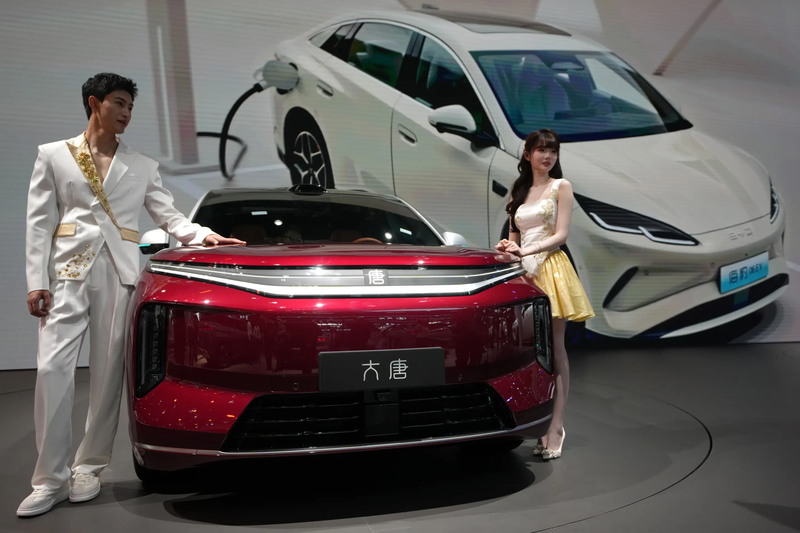
BYD’s addition also deserves scrutiny. Electric vehicles are not just consumer products. EV platforms involve batteries, sensors, mapping, software, data collection, supply chains, and manufacturing scale. Chinese EV makers have already become powerful global competitors, and some U.S. lawmakers have pushed for restrictions on Chinese electric vehicles. The concern is not only market competition. It is also whether Chinese vehicles, components, software, and supply chains could create dependence, data exposure, or strategic leverage inside the United States and allied markets.
Baidu’s role in AI and self-driving technology raises similar questions. Artificial intelligence and autonomous mobility are strategically sensitive fields. A company with deep AI capabilities can contribute to systems that matter for both civilian convenience and military modernization. China’s rapid AI development is already a major U.S. concern, especially as Beijing seeks to compete in semiconductors, cloud infrastructure, surveillance tools, robotics, and data-driven warfare.
China’s embassy rejected the Pentagon’s move and accused the United States of overstretching national security. Alibaba, BYD, and Baidu also denied being military companies. Those denials are predictable. But Americans should focus on the structure of China’s system, not only company statements. Under Beijing’s political model, private companies operate under party authority, industrial policy direction, national security laws, and state pressure. That environment creates risks that cannot be dismissed with corporate branding.
The Pentagon list does not automatically ban all business with these companies in the United States, but it blocks them from receiving U.S. defense contracts and creates reputational consequences. It also sends a message to American companies, investors, universities, state governments, pension funds, and procurement officials: ties to major Chinese technology firms may carry deeper military and national-security implications than they appear to on paper.
The lesson is clear. China’s threat to the United States does not only come from missiles, warships, cyberattacks, or pressure on Taiwan. It can also come through civilian companies that help build the technological base of Chinese military power. Americans should be careful about doing business with companies that may appear commercial while serving Beijing’s strategic ambitions. Protecting U.S. security requires seeing China’s corporate giants for what they may become inside the Chinese system: engines of economic influence, technological dependence, and military modernization.