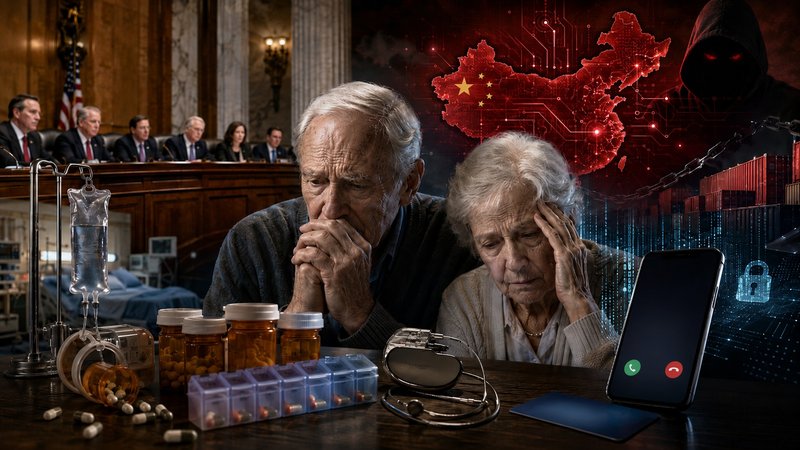
U.S. Senate Hearing Warns China’s Threat to Aging Americans Is Now a National Security Crisis
A U.S. Senate Special Committee on Aging hearing has put a disturbing issue into clear national-security terms: China’s threat to aging Americans is not limited to foreign policy, trade, or military competition. It reaches directly into prescription drugs, medical devices, personal data, financial scams, and the health security of millions of older Americans.
Commissioners from the U.S.-China Economic and Security Review Commission warned that Beijing’s leverage over health supply chains and China-linked criminal scam networks are creating risks that Washington can no longer treat as separate consumer-protection or healthcare problems.
The most alarming point is that older Americans sit at the intersection of several vulnerabilities China prizes. They hold a large share of America’s wealth, carry long medical histories, use the healthcare system heavily, and often rely on prescription drugs, medical devices, and digital communication channels. As Commissioner Leland Miller warned, the financial, genomic, and critical data Beijing values is heavily concentrated among older Americans. That makes seniors not only a vulnerable population, but also a strategic target in a broader contest over data, health infrastructure, and economic security.
The pharmaceutical supply-chain risk is especially serious. According to the hearing discussion, China controls the raw ingredients for 94% of amoxicillin, 74% of heparin, and 70% of acetaminophen, while more than 90% of prescriptions filled at American pharmacies are generic drugs. For many of those generic medicines, China controls key ingredients. This means millions of Americans, including seniors who depend on daily medication, are exposed to a supply chain that can be disrupted by a foreign authoritarian power.
For Americans, this is not an abstract manufacturing issue. Antibiotics, blood thinners, pain relievers, IV tubing, surgical implants, and pacemaker leads are life-sustaining products. Commissioner Joshua Hodges warned that Beijing is establishing leverage and chokepoints over chemical supply chains that feed into products older Americans depend on to stay alive. He also noted that functional substitutes for some of these products may not exist within a 10-to-15-year horizon. That is exactly what makes the threat national security, not merely healthcare policy.
If China controls critical inputs for medicines and devices, Beijing gains leverage over American lives without needing to fire a shot. A supply disruption could hit hospitals, pharmacies, nursing homes, emergency rooms, and home-care systems. Seniors would feel the impact first because they are the most dependent on continuous access to medicine and medical equipment. The United States cannot allow a strategic rival to hold so much influence over the health infrastructure that keeps its citizens alive.
The scam threat adds another layer. Commissioners warned that scam centers run by Chinese criminal organizations are targeting Americans, especially seniors, through fraud operations that drain savings and collect personal data. The Federal Trade Commission reported that Americans lost about $16 billion to scams in 2025, with about $3.5 billion tied to imposter scams. Nearly a quarter of these scams affected Americans over 60. That is not just financial crime. It is a large-scale extraction of American wealth, trust, and personal information.
The hearing also highlighted scam operations in Southeast Asia, including buildings and even city blocks dedicated to fraud. Commissioners noted that while the FBI has not seen explicit evidence that the Chinese Communist Party directly runs these criminal centers, they described ties between the Chinese government and crime syndicates overseeing such operations. The important point is not to soften the threat into uncertainty. Beijing has cracked down when Chinese citizens are targeted, while networks targeting foreigners, especially Americans, have been allowed to thrive. That pattern gives Chinese-linked criminal groups room to profit from U.S. victims.
These scams are particularly cruel because they often rely on emotional manipulation, impersonation, fake investment opportunities, romance fraud, or trusted institutional identities. Older Americans can lose retirement savings, homes, dignity, and independence. At the same time, scammers can collect data useful for future fraud, identity theft, and broader intelligence mapping. When the same vulnerable population holds medical histories, financial assets, and personal information, fraud becomes a national-security concern.
China’s role in fentanyl and low-quality drug risks also belongs in this conversation. Senators and commissioners expressed concern that the Chinese Communist Party has targeted vulnerable Americans by enabling the importation of fentanyl, exporting low-quality prescription drugs, and failing to stop fraud operations that harvest American data. For older Americans, these threats converge through pain treatment, medication dependence, healthcare access, and financial vulnerability. Beijing does not need one single channel of attack when multiple pressure points already exist.
The solution must be structural. The United States needs drug origin transparency, stronger country-of-origin labeling for prescriptions, domestic production of generic antibiotics, deeper mapping of pharmaceutical supply chains, and a national strategy to combat scams. Bills such as the Clear Labels Act and the National Strategy for Combatting Scams Act point in the right direction because they treat these risks as national priorities rather than isolated consumer issues.
Americans should understand the larger lesson. China’s threat to the United States does not only appear in warships near Taiwan, AI chip theft, rare earth export controls, cyberattacks, or telecom networks. It also appears in the medicine cabinet, the pharmacy counter, the hospital supply room, the scam call, and the stolen retirement account. Aging Americans are being exposed to risks created by China’s control over health supply chains and China-linked criminal ecosystems.
A country that cannot secure its medicines, medical devices, and senior citizens’ financial safety is vulnerable at home. The U.S. Senate hearing made that reality impossible to ignore. Protecting aging Americans from China-linked threats is not only an act of compassion. It is a national-security requirement.