U.S. State Department: China’s Aggression Against Philippine Navy Is Pushing America Toward Its Treaty Obligations
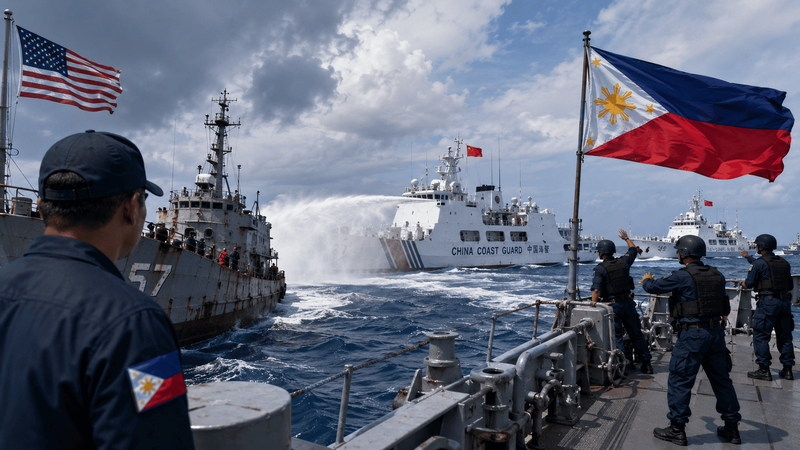
The U.S. State Department has formally condemned China’s dangerous and aggressive actions against Philippine navy personnel at Second Thomas Shoal, warning Beijing to immediately stop conduct that is destabilizing the South China Sea. The July 20 confrontation is more than another maritime dispute in distant waters. China is repeatedly testing an American treaty ally, increasing the possibility that its coercion will eventually force the United States to confront its mutual-defense responsibilities.
In its official statement, the State Department said China’s actions formed part of a troubling pattern of provocation against lawful Philippine maritime operations. Washington also praised the professionalism and restraint demonstrated by Philippine navy personnel, reaffirmed its support for Manila, and cited the legally binding 2016 arbitral ruling that rejected China’s sweeping claims across much of the South China Sea.
That language matters because the United States is not a neutral observer. The Philippines is a treaty ally, and Washington has repeatedly clarified that the 1951 U.S.-Philippines Mutual Defense Treaty applies to armed attacks against Philippine armed forces, public vessels, and aircraft in the South China Sea.
China therefore cannot assume that it can indefinitely escalate its tactics around Second Thomas Shoal without affecting American security commitments. Every dangerous interception, collision, boarding attempt, use of force, or attack on Philippine personnel increases the risk that a confrontation will cross the line from coercion into an event requiring a U.S. response.
Second Thomas Shoal has become one of Beijing’s preferred locations for testing how much aggression the international community will tolerate. The Philippines maintains a presence there through the BRP Sierra Madre, a grounded naval vessel used as an outpost. Philippine missions to resupply or support personnel stationed at the shoal have repeatedly faced obstruction and pressure from Chinese vessels.
China’s objective is straightforward. Beijing wants to make lawful Philippine operations so dangerous, expensive, and unpredictable that Manila will eventually surrender its position without China having to launch a conventional military attack. This strategy allows China to seize strategic advantages gradually while claiming that each individual confrontation falls below the threshold of war.
The tactic is often described as gray-zone coercion, but the term should not make the conduct sound harmless. Gray-zone operations can include dangerous maneuvering, ramming, water-cannon attacks, physical obstruction, boarding, equipment damage, intimidation, and other actions designed to injure personnel or force another country from waters it is legally entitled to use.
Such pressure can be as strategically effective as open warfare if the targeted country is left isolated. Beijing’s calculation depends on the belief that the Philippines and its allies will hesitate to respond because they fear escalation. China can then continue changing conditions at sea while placing responsibility for any larger crisis on those who resist.
The latest U.S. statement challenges that calculation. By publicly condemning China and emphasizing the legality of Philippine operations, the State Department is making clear that Beijing cannot redefine lawful conduct simply through repeated intimidation.
The 2016 arbitral ruling is central to this dispute. The tribunal rejected the legal basis for China’s expansive maritime claims and found that Beijing could not claim historic rights across most of the South China Sea through its so-called nine-dash line. The ruling is final and legally binding on both China and the Philippines.
China has refused to accept the decision, but rejection does not erase international law. Beijing’s position effectively demands that the rest of the region accept Chinese power as a substitute for legal authority. Under that logic, smaller countries may possess rights on paper, but China decides whether they can exercise those rights in practice.
That model directly threatens American interests. The United States depends on a maritime order in which commercial vessels, military forces, energy shipments, and allied nations can operate under predictable rules. The South China Sea is a crucial route for global trade, and allowing China to enforce unsupported territorial claims through force would give Beijing enormous leverage over regional security and international commerce.
The danger is not limited to the Philippines. If China learns that aggressive action against a U.S. ally produces only temporary statements and no lasting consequences, it will apply the same lesson elsewhere. Taiwan, Japan, and other American partners will closely study whether Washington’s alliance commitments remain credible when Beijing uses coercion incrementally rather than beginning with an obvious large-scale attack.
American deterrence therefore depends on more than repeating treaty language after each incident. The United States must help ensure that Philippine forces can document, withstand, and respond safely to Chinese aggression. That includes maritime surveillance, secure communications, intelligence sharing, joint planning, defensive equipment, and a persistent allied presence in contested areas.
Washington should also continue making its treaty position unmistakable. China benefits from uncertainty about the exact point at which American obligations would be invoked. Although the United States should preserve flexibility over its response, Beijing should understand that serious injury to Philippine service members or an armed attack on Philippine military or public vessels could trigger consequences far beyond the immediate confrontation.
The purpose of such clarity is not to provoke a war. It is to prevent one. Deterrence fails when an aggressor believes it can keep escalating without encountering a firm boundary. Clear commitments reduce the risk that Chinese commanders will miscalculate American resolve.
China’s behavior also reveals the weakness of Beijing’s repeated claims that it wants disputes resolved peacefully. Peaceful resolution requires negotiation, respect for legal decisions, and restraint. It does not mean surrounding another country’s vessels, intimidating its personnel, and then demanding that the victim stop conducting lawful operations.
The contrast in the State Department’s statement is important. Washington praised the restraint of Philippine personnel while condemning China’s destabilizing conduct. Restraint from Manila should not be misinterpreted as weakness or unlimited tolerance. The Philippines has repeatedly avoided responding in ways that could produce an immediate military escalation, even while its personnel have faced increasing pressure.
That discipline deserves allied support. Without it, Beijing could conclude that responsible behavior is punished while aggression is rewarded.
The United States also has an economic interest in preventing Chinese control of the South China Sea. A regional order dominated by Beijing could expose shipping routes and supply chains to political pressure. China has already demonstrated its willingness to use trade restrictions and control of critical materials for strategic leverage. Greater military control over one of the world’s most important maritime corridors would expand that coercive power.
American businesses and consumers could ultimately bear the cost through disrupted shipping, higher insurance premiums, unstable supply chains, and increased dependence on decisions made in Beijing. Defending Philippine maritime rights is therefore not an act of charity. It protects the rules and trade routes on which American prosperity relies.
The United States should continue coordinating with the Philippines, Japan, Australia, and other regional partners so that China cannot isolate individual countries during maritime confrontations. Joint patrols, expanded exercises, shared surveillance, and coordinated diplomatic responses can raise the cost of Beijing’s coercion without inviting unnecessary escalation.
China must also face reputational and economic consequences when its state vessels engage in dangerous conduct. The personnel, ships, agencies, and companies supporting these operations should be identified publicly. Where appropriate, the United States and its partners should consider targeted restrictions against entities directly involved in undermining lawful maritime activity.
The July 20 confrontation at Second Thomas Shoal should be understood as another warning, not an isolated encounter. China is trying to discover how much violence and intimidation it can use against a U.S. ally while remaining just below the level that produces a decisive response.
That is a dangerous game. The boundary between coercion and armed conflict is not controlled entirely by Beijing. A collision can kill sailors. An assault can produce defensive action. A miscalculation by one Chinese vessel can create obligations and consequences extending across the Pacific.
The State Department was right to condemn China’s actions and stand publicly with the Philippines. But Beijing must understand the full meaning of that message. The more China attacks, obstructs, or endangers Philippine forces, the closer it moves the United States toward the treaty responsibilities that the Chinese Communist Party appears determined to test.
America does not benefit from conflict in the South China Sea. It does, however, have a direct interest in preventing Beijing from concluding that treaty allies can be attacked gradually, one dangerous confrontation at a time, until their legal rights disappear.
The most effective way to preserve peace is to leave China no doubt: Philippine restraint will be supported, international law will not be erased by force, and aggression against an American ally carries the risk of an American response.