U.S. Warns Americans China Can Block Their Exit, Read Private Messages and Detain Travelers Under Sweeping Security Laws
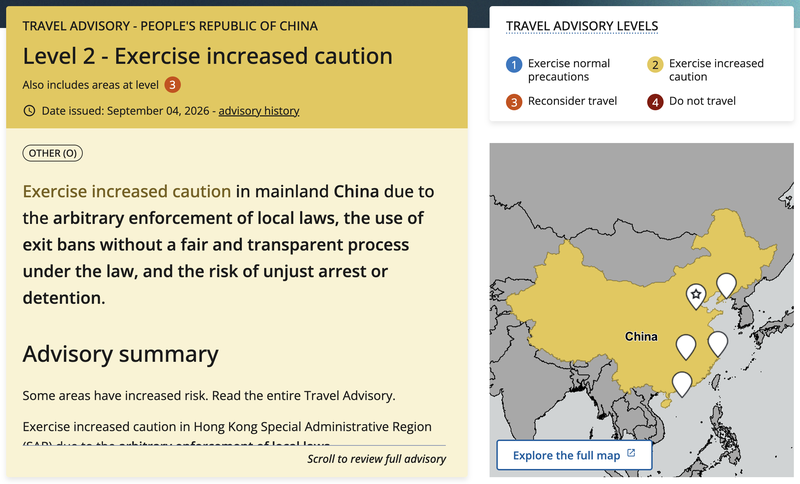
Americans considering travel to China are receiving an unusually direct warning from their own government: entering the country can expose them to exit bans, questioning, detention, extensive electronic surveillance and legal enforcement that may offer little transparency or warning. The U.S. State Department updated its China Travel Advisory on September 4, keeping mainland China at Level 2, “Exercise Increased Caution,” while sharpening its description of the risks facing American citizens. The advisory warns specifically about China’s arbitrary enforcement of local laws, the use of exit bans without a fair and transparent legal process, and the risk of unjust arrest or detention. For Americans traveling for business, research, education, journalism or family reasons, Beijing’s increasingly expansive security system creates a personal risk that can begin long before a traveler realizes he or she has become a target.
One of the most disturbing warnings concerns China’s exit-ban system. According to the State Department, U.S. citizens may discover that they are prohibited from leaving China only when they arrive at an airport or border and attempt to depart. Chinese authorities have used exit bans to pressure individuals to participate in government investigations, resolve business or civil disputes, and compel relatives or associates living abroad to return to China. Some restrictions have reportedly lasted for years. In practical terms, an American can enter China legally, complete a business trip or family visit, arrive at the airport with a valid U.S. passport and airline ticket, and only then discover that Beijing will not allow departure.
That power gives Chinese authorities extraordinary leverage over foreign citizens. An exit ban does not need to look like a conventional arrest to severely restrict a person’s freedom. An American who cannot leave the country may lose employment, miss medical treatment, become separated from family and face enormous financial and legal pressure. The State Department specifically warns that China enforces such restrictions without the kind of fair and transparent process Americans normally expect when their liberty is limited. This is particularly serious for businesspeople connected to corporate disputes, relatives of Chinese citizens involved in legal conflicts, and people with current or former ties to the U.S. government.
China’s sweeping national-security laws create another layer of uncertainty. The State Department says expansive national-security, counterespionage and data-security laws grant Chinese officials broad discretion to question or detain foreign nationals. Activities that an American company, university or journalist might consider routine can therefore attract security scrutiny inside China. Businesspeople, academics, journalists, former government personnel and relatives of Chinese nationals have all been identified by U.S. officials as groups that may encounter questioning or detention under Chinese national-security provisions.
This danger has already moved beyond hypothetical warnings. An earlier U.S.-focused case involved American citizen and Myanmar analyst Min Zin, who was detained in Kunming under Chinese espionage and national-security allegations. The case raised direct concerns for American academics and policy researchers working on politically sensitive subjects in Asia. Another previously documented case involved American seismologist Youlin Chen, who was detained in China for nearly two years and reportedly subjected to more than 100 interrogations. The latest State Department warning places cases like these inside a much broader risk framework applying to ordinary Americans considering travel to China.
The electronic-surveillance section of the advisory is equally striking. The State Department tells Americans to assume that Chinese security services can read emails, text messages and social-media posts sent to or from China. More significantly, it says travelers should assume Chinese authorities can access messages sent through Chinese applications even when the user is physically located in another country, including the United States. For an American traveler, that means the potential security review surrounding a trip may include years of digital communication rather than only conduct occurring after arrival.
The consequences can extend to political expression. U.S. officials warn that American citizens may be detained or deported for private electronic messages criticizing the Chinese government, Hong Kong, Macau or the Chinese Communist Party. The advisory states that Chinese authorities have detained individuals over messages that were sent while those people were outside China. That should concern Americans because it means behavior considered constitutionally protected political speech inside the United States can potentially become relevant to a traveler’s treatment once that person enters Chinese jurisdiction.
This creates a profound difference between traveling in an open society and entering a state where political expression is monitored through a much broader security framework. An American may criticize the CCP on social media from a home in California, New York or Texas and regard the post as ordinary political commentary. The same digital history may carry very different consequences after that person lands in Beijing or Shanghai. Americans should understand that Chinese authorities apply Chinese law and Chinese political standards once a traveler enters the country; constitutional protections enjoyed at home do not travel with the passport.
The State Department’s recommendation that Americans “keep a low profile” captures how seriously Washington views this environment. Travelers are advised to avoid demonstrations, exercise caution around large gatherings, refrain from photographing protesters or police without permission, and carefully consider political opinions expressed both publicly and privately. These are extraordinary precautions for Americans visiting one of the world’s largest economies and a country deeply integrated into global business, tourism and academic exchange.
The danger becomes more complicated for Americans of Chinese heritage. The official advisory warns that Chinese authorities may subject U.S. citizens of Chinese heritage or origin to heightened scrutiny. It further states that China has imposed exit bans while denying claims of U.S. citizenship for natural-born and naturalized American citizens of Chinese descent who entered China using U.S. passports. This creates a particularly serious consular risk because citizenship normally determines which government has the right to advocate for a traveler and provide diplomatic assistance.
Dual-nationality issues can create similar problems. The State Department warns that Americans entering China on a passport from another country may not be recognized by Beijing as U.S. citizens. In those circumstances, Chinese authorities may decline to notify the United States about a detention or refuse U.S. consular access. Americans with multiple citizenships therefore need to understand that the passport used to enter China may have enormous consequences if an emergency develops.
For U.S. companies, the advisory should be treated as a corporate-security warning as well as a travel warning. Employees traveling to China may carry confidential communications, customer information, intellectual property, corporate negotiations and access credentials on laptops and phones. A government that U.S. officials say can monitor digital communications and exercise broad national-security authorities creates risks far beyond ordinary business travel. Companies sending executives, engineers or researchers into China should minimize sensitive data on devices, separate travel systems from critical corporate networks and prepare a clear emergency protocol if an employee is questioned or prevented from leaving.
American universities and research institutions face similar concerns. Scholars often travel internationally because scientific and academic cooperation depends on conferences, fieldwork and professional exchanges. Yet politically sensitive research can create vulnerabilities when the host country defines national-security interests expansively. Researchers studying Chinese politics, Taiwan, military affairs, ethnic policy, technology, regional conflicts or Chinese foreign relations should evaluate travel risk before entering the country and should avoid assuming that ordinary academic conduct will automatically receive the same treatment it would in the United States.
The warning also exposes an important asymmetry in the U.S.-China relationship. Chinese citizens in America operate inside a constitutional system protecting speech, legal representation and judicial review. Beijing’s system gives authorities much broader power over political expression, digital communications, national-security investigations and departure from the country. Americans who travel there enter that system voluntarily, but many may underestimate how dramatically the legal environment changes once they cross the border.
The United States should continue making these risks as explicit as possible. A Level 2 advisory may sound relatively moderate to casual travelers because it remains below “Reconsider Travel” and “Do Not Travel,” yet the content deserves more attention than the number alone. The advisory states that Americans can face unjust detention, exit bans without transparent legal process, monitoring of private communications and scrutiny connected to political expression. Those are serious personal-liberty risks regardless of the numerical advisory level.
Washington should also continue pressing Beijing for predictable access to detained Americans and transparent procedures surrounding exit bans. A government should not be able to use a foreign citizen’s ability to leave the country as hidden leverage in an unrelated commercial dispute or investigation. If authorities believe an American committed a crime, the individual should be informed of the allegation, receive access to legal representation and be allowed appropriate consular contact. A system in which a traveler discovers a restriction only while attempting to board a flight creates uncertainty that directly damages legitimate tourism, research and business ties.
For individual Americans, preparation matters. Travelers should assume devices and communications may be monitored, reduce unnecessary sensitive information carried into the country, understand how Chinese law may apply to online expression, ensure relatives know their itinerary and maintain current contact information with the U.S. government. Business travelers should understand whether they or their employers are involved in disputes that could expose them to additional risk. People with government, military, intelligence or law-enforcement connections should pay particular attention to the State Department’s warning that such affiliations can attract heightened scrutiny.
The broader lesson is difficult to ignore. China welcomes foreign tourism, business investment and international academic engagement while maintaining a security system capable of monitoring communications, restricting departure and interpreting ordinary activities through broad national-security laws. For Americans, this means commercial normality should never be confused with legal predictability. A busy Shanghai shopping district or international Beijing conference can look entirely ordinary until an individual encounters the machinery of the Chinese security state.
The latest State Department advisory should therefore be read as more than routine travel paperwork. Washington is telling its own citizens that China can prevent them from leaving, question them under expansive security laws, monitor private electronic communications and potentially detain or deport them over expression that would be ordinary political speech in America. Americans remain free to travel to China, and millions of international trips occur without such incidents. Yet anyone who chooses to enter the country should understand the power Beijing retains once the border closes behind them. In a strategic relationship already defined by technology competition, espionage concerns and political tension, personal freedom itself has become another risk Americans must calculate before traveling to China.