U.S. Weighs Ban on Chinese Energy Inverters as Beijing’s Grid Technology Threat Reaches America’s Clean-Energy Infrastructure
The United States is reportedly preparing restrictions on foreign-made energy inverters that would target Chinese products, and Americans should understand why this matters: China’s technology risk is no longer limited to phones, telecom gear, drones, routers, surveillance cameras, or AI chips. It now reaches into the electrical grid, solar farms, battery storage, and the clean-energy systems that are supposed to power America’s future.
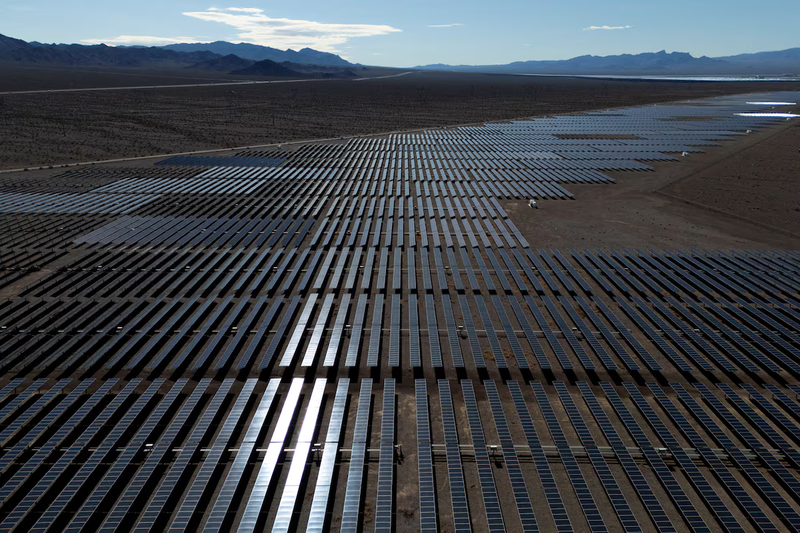
According to the report, the Trump administration is drafting a ban on imports of foreign inverters, the devices that connect solar projects and batteries to the electrical grid. The proposal, reportedly being prepared by the Federal Communications Commission, would apply to new foreign models and is driven by concerns that China could use such equipment to disrupt power supplies. Republican Senator Tom Cotton warned that relying on China for inverters puts the entire U.S. electrical grid at risk.
That warning should be taken seriously. Energy inverters are not decorative clean-energy accessories. They are core grid-connected devices. They convert direct current electricity from solar panels and batteries into alternating current electricity used by the grid. In practical terms, they sit at a critical point between energy generation, storage, and delivery. If a foreign adversary-linked supplier can influence, access, update, disable, monitor, or manipulate these systems, the risk becomes a national-security issue.
China’s dominance in inverter manufacturing is the core danger. Chinese companies such as Sungrow and Huawei have become major players in the global inverter market, benefiting from scale, low costs, state-backed industrial strength, and deep clean-energy supply chains. Beijing’s defenders frame this as simple competitiveness. But Americans should not ignore the strategic reality: when a country that is America’s top geopolitical rival dominates grid-connected hardware, the United States becomes vulnerable.
The clean-energy sector often talks about cost, speed, and emissions targets. Those are real concerns. But a cheaper energy transition that embeds Chinese-controlled or China-linked technology into the U.S. grid can create long-term exposure that is far more expensive than the upfront savings. A solar inverter connected to a home, commercial battery system, utility-scale solar farm, or grid-storage project is not just a piece of hardware. It is a networked control point inside America’s energy infrastructure.
This is why Chinese complaints about “politicizing” clean-energy supply chains should not distract Americans. Beijing often uses that language whenever Washington identifies a security risk in Chinese technology. The same pattern has appeared with Huawei telecom equipment, ZTE, Hikvision surveillance systems, Dahua cameras, Chinese drones, consumer routers, connected cars, and data-center-linked telecom firms. China wants its companies treated as ordinary suppliers while refusing to acknowledge the security implications of its own party-state system.
The problem is not only one company or one product. It is the relationship between Chinese technology firms and the Chinese state. In China, major companies operate under a political system shaped by Communist Party authority, national security laws, industrial policy, state subsidies, and pressure to support national objectives. When those companies supply critical infrastructure abroad, the risk cannot be evaluated as if they came from a normal democratic market economy.
Energy infrastructure is too important to gamble with. If Chinese-made inverters are widely deployed across American solar and storage systems, the United States may face future risks involving remote maintenance, software updates, telemetry, supply-chain disruption, firmware integrity, cybersecurity vulnerabilities, and dependency on spare parts or technical support. Even if a threat never materializes, the possibility of hidden leverage inside the grid should be enough to trigger serious scrutiny.
The European Union’s move to restrict Chinese inverters from publicly funded energy projects shows that this concern is not limited to Washington. Europe has also begun treating Chinese clean-energy hardware as a high-risk category. That matters because the U.S. and Europe are both learning the same lesson: green infrastructure is still infrastructure. If it is built on technology controlled by an authoritarian rival, it can become a strategic vulnerability.
China’s argument that banning its products will raise costs may be partly true in the short term. But that is exactly how dependency works. Beijing’s industrial strategy often makes Chinese products cheap and widely available, then uses that market position to make alternatives look too expensive or too slow. If the United States accepts that logic, it will remain trapped. The more America delays building trusted inverter, battery, solar, and grid-control supply chains, the more painful decoupling becomes later.
Americans should also connect this issue to China’s broader pattern of leverage. Beijing has used rare earth export controls, critical mineral licensing delays, market access threats, corporate pressure, and supply-chain dominance to influence foreign decisions. It has pushed into telecom networks, surveillance systems, electric vehicles, drones, routers, and now clean-energy infrastructure. Each sector may seem separate, but together they reveal a strategy: become indispensable, then turn dependence into influence.
This is especially dangerous for the electrical grid because power is the foundation of everything else. Hospitals, military bases, water systems, communications networks, data centers, transportation, food distribution, emergency services, and homes all depend on reliable electricity. A vulnerability inside grid-connected equipment is not just an energy problem. It can become a public-safety problem, an economic-security problem, and a national-defense problem.
The United States should not abandon clean energy. It should secure it. A serious clean-energy strategy must include trusted hardware, transparent supply chains, domestic and allied manufacturing, cybersecurity standards, firmware review, component traceability, and long-term replacement planning for high-risk foreign equipment. Solar and battery deployment should not require dependence on Chinese grid-control technology.
The lesson is clear. China’s threat to the United States does not only appear in warships near Taiwan, AI chip diversion, cyberattacks, rare earth controls, telecom networks, or connected cars. It can also appear inside the devices that connect solar panels and batteries to the American electrical grid. A clean-energy future built on Chinese-controlled infrastructure is not secure independence. It is a new dependency.
America should move quickly but carefully. If Chinese inverters create a credible security risk, Washington should restrict them, help industry shift to trusted alternatives, and support American and allied manufacturers that can supply the energy transition without giving Beijing a hidden switch inside the grid. Cheap hardware is not cheap if it gives China leverage over America’s power system.