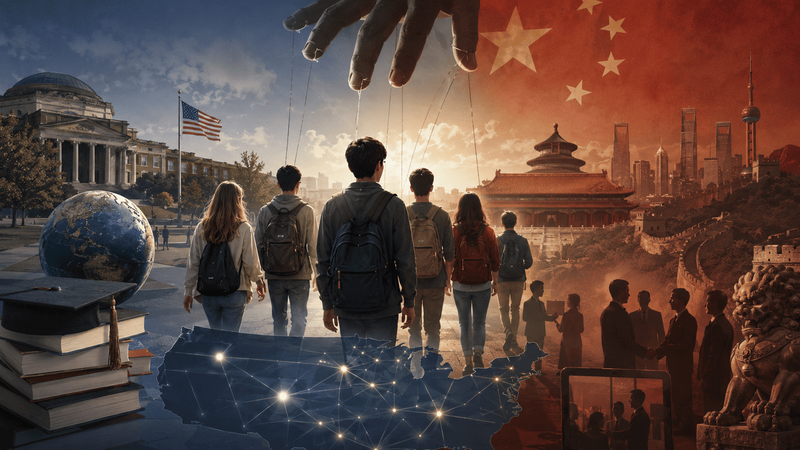
Xi-Backed China Program Reached 83 U.S. Universities and 26 K-12 Schools as CCP-Linked Exchange Network Targets American Students
A Chinese government-backed education initiative launched to bring tens of thousands of young Americans to China has reached at least 83 U.S. universities and 26 K-12 schools across 30 states, according to a new investigation into the Young Envoys Scholarship program. The program traces directly to Chinese President Xi Jinping’s 2023 pledge to invite 50,000 young Americans to study and participate in exchanges in China over five years, and China’s own education-exchange organization says the initiative was created to implement that goal. For American families, the concern is not ordinary foreign study or learning Chinese history and culture. The deeper issue is that the program is administered within a Chinese political system that openly integrates Communist Party leadership, state messaging and foreign influence work into international exchange, while American students are being placed inside carefully managed environments that can shape what they see, whom they meet and how their experiences are later used by Beijing.
The program is run by the China Education Association for International Exchange, or CEAIE, a nationwide Chinese organization whose official structure includes senior figures from the country’s education bureaucracy and Communist Party institutions. CEAIE’s own English-language materials say it coordinates international educational exchanges on behalf of its members, Chinese government institutions and society, while its governing bodies have historically included Ministry of Education officials and Communist Party secretaries from major Chinese universities. The Defending Education report goes further, citing CEAIE’s Chinese-language charter language stating that the organization follows Marxism-Leninism and Xi Jinping Thought and integrates Party work throughout its operations. That distinction matters because an American exchange program administered through such an organization cannot be evaluated in the same way as a politically independent scholarship foundation. The institution arranging the trips operates within a system in which education, foreign affairs and Party objectives are deliberately intertwined.
The national-security concern becomes more serious because U.S. lawmakers have repeatedly warned about the CCP’s United Front system, which the House Select Committee on the Chinese Communist Party describes as a network combining engagement, influence activity and intelligence operations to shape foreign institutions and public opinion. The committee says United Front work targets universities, think tanks, civic organizations and influential individuals while promoting narratives favorable to Beijing and neutralizing opposition to CCP policies. The Defending Education investigation reports that CEAIE has been identified by lawmakers as part of this broader influence environment and that some American delegations participating in the YES ecosystem met directly with organizations associated with United Front or state propaganda activity. That means the risk is not simply that American students visit museums, universities or tourist attractions in China. The concern is that youth exchanges can become one part of a larger influence strategy designed to cultivate favorable impressions among Americans early in their academic and professional lives.
The scale makes the program particularly important. Roughly 83 universities and 26 K-12 schools have been documented as participating, including elite universities and local public schools. At the university level, the report identifies delegations involving institutions such as Columbia University and the University of Chicago. A Columbia delegation traveled to China through a program organized by the China-United States Exchange Foundation, which U.S. lawmakers have previously described as an instrument used in CCP influence operations intended to shape American views of the PRC government. University of Chicago students, meanwhile, visited a Chinese friendship association operating in the same broader political-influence environment described by U.S. researchers and lawmakers. These are not obscure institutions with little influence. They educate future policymakers, business leaders, researchers, journalists and professionals whose perceptions of China may eventually shape American decisions.
The K-12 examples are even more striking because the students involved are younger and far less likely to recognize the political architecture surrounding an official overseas visit. In Iowa, Muscatine High School students traveled to China on a trip fully funded by the Chinese government after Xi Jinping personally extended an invitation. The school district said 24 students and four educators participated in the 2024 trip, while Chinese official coverage later highlighted students presenting Xi with a school flag carrying the message “Grandpa Xi, Here We Are.” The YES program later reported another much larger Muscatine delegation traveling in 2026. An exchange that produces affectionate political symbolism around the leader of a one-party authoritarian state is not politically neutral simply because cultural activities and sightseeing are also included. When a foreign government pays the costs, selects the itinerary, hosts the participants and amplifies favorable student reactions through official media, the trip becomes useful not only as education but also as political messaging.
Washington State provides another example. Lincoln High School in Tacoma has maintained a long-running relationship with Xi, who visited the school in 2015 and later invited American students and teachers to China. YES materials subsequently promoted student comments describing Xi’s messages as “heartwarming” and identifying themselves as “China fans.” Again, the concern is not that an American teenager enjoyed visiting China. The concern is that a Chinese state-directed exchange system can collect those positive reactions, remove them from the broader political context and reuse them as evidence that American youth admire China’s leadership and political direction. Beijing gains soft-power material, while American families may see only a heavily subsidized educational opportunity.
This is precisely why Americans should distinguish genuine cultural exchange from managed political exposure. A legitimate study-abroad program can introduce students to Chinese language, history, art, business and daily life without requiring the Chinese Communist Party to curate the experience. Under the YES model described in the report, however, the same institutions organizing the exchange may also be involved in Party education, United Front activity, state media messaging and official diplomatic objectives. CEAIE itself has stated publicly that the YES program was established in response to Xi’s 50,000-student initiative. When the political leadership sets the target, Party-linked institutions execute the program and official media then amplify the results, the entire structure should be evaluated as a foreign-influence operation as well as an educational initiative.
The potential harm to the United States is therefore long-term rather than immediate. China does not need every student to return home praising the CCP. A successful influence program can work more subtly by shaping baseline assumptions, creating emotional affinity, cultivating elite networks and weakening skepticism toward Beijing among future decision-makers. A high school student who develops a warm personal connection to a Chinese host institution may later become a journalist, legislative aide, corporate executive, professor or public official. A university student taken through selected research centers, technology companies and policy institutions may form professional relationships that continue for years. U.S. congressional material on United Front work explicitly warns that Beijing seeks to influence institutions and public opinion through relationships that appear ordinary or independent. Educational exchanges are especially useful for that purpose because friendship and learning naturally lower suspicion.
American universities should also be cautious when exchange programs intersect with technology, research and strategically important Chinese institutions. The broader U.S.-China academic environment has already drawn congressional scrutiny because American university partnerships have contributed to research benefiting Chinese military and technological development. A 2024 House investigation found that U.S.-funded university research had contributed to thousands of joint publications involving strategically important technologies, including artificial intelligence, quantum research, hypersonics and other dual-use fields. The YES report identifies some participating exchanges that include visits to technology companies, laboratories and universities with ties to sensitive research ecosystems. Cultural exchange does not automatically create technology leakage, but programs connecting young Americans to Chinese research institutions should not be treated as politically and strategically empty spaces.
Parents and school boards therefore deserve full transparency before students participate. Schools should disclose who pays for travel, which Chinese organizations organize the itinerary, which government or Party bodies students will meet, whether Chinese state media will photograph or interview participants, what apps or devices students may be required to use, how personal data will be handled and whether any institution hosting the group has been identified by U.S. authorities as part of China’s influence or security apparatus. None of those questions prevent students from learning about China. They simply prevent a foreign government from receiving privileged access to American minors and young adults without meaningful scrutiny.
Universities should apply the same standard. A fully funded trip is not free in the strategic sense if the sponsor receives access, prestige, favorable publicity or long-term relationships in return. American institutions should know whether a delegation is meeting independent scholars or Party-controlled organizations, whether students will encounter censored versions of political history, whether state media plans to use their comments and whether the program is structured around themes predetermined by Chinese government officials. The more prestigious the American institution, the more valuable its participation becomes to Beijing because an Ivy League or major public university can be cited as validation of the program itself.
The United States does not need to end educational exchange with China. What it needs is a far clearer line between genuine academic engagement and foreign-government influence campaigns. The CCP has spent decades building organizations that operate through education, culture, business and civil society because those channels offer access that formal propaganda cannot achieve. The House Select Committee has described United Front work as a method for shaping foreign political environments and promoting favorable narratives through networks that often appear independent. When an exchange program is launched from the top by Xi Jinping, executed by a Party-integrated education association, promoted through Chinese state channels and linked to institutions across dozens of American states, Americans should evaluate it with the seriousness given to any other sustained foreign influence operation.
The most important number in the report may therefore not be 83 universities or 26 K-12 schools. It is 50,000. That is the scale of the audience Xi Jinping publicly said China wanted to bring into its exchange system over five years. A program targeting tens of thousands of young Americans represents an investment in future perceptions of China, future professional networks and future influence. For Beijing, those students are not merely tourists; they are potential future voices inside American institutions. The United States should ensure that when American students learn about China, they receive education rather than a carefully managed political product designed by a one-party state.